
Go to JCI Insight
  • About
  • Editors
  • Consulting Editors
  • For authors
  • Publication ethics
  • Publication alerts by email
  • Advertising
  • Job board
  • Contact
  • Clinical Research and Public Health
  • Current issue
  • Past issues
  • By specialty
    • COVID-19
    • Cardiology
    • Gastroenterology
    • Immunology
    • Metabolism
    • Nephrology
    • Neuroscience
    • Oncology
    • Pulmonology
    • Vascular biology
    • All ...
  • Videos
    • ASCI Milestone Awards
    • Video Abstracts
    • Conversations with Giants in Medicine
  • Reviews
    • View all reviews ...
    • The cGAS-STING pathway: DNA sensing in health and disease (Jun 2026)
    • Neurodegeneration (Mar 2026)
    • Clinical innovation and scientific progress in GLP-1 medicine (Nov 2025)
    • Pancreatic Cancer (Jul 2025)
    • Complement Biology and Therapeutics (May 2025)
    • Evolving insights into MASLD and MASH pathogenesis and treatment (Apr 2025)
    • Microbiome in Health and Disease (Feb 2025)
    • View all review series ...
  • Viewpoint
  • Collections
    • In-Press Preview
    • Clinical Research and Public Health
    • Research Letters
    • Letters to the Editor
    • Editorials
    • Commentaries
    • Editor's notes
    • Reviews
    • Viewpoints
    • 100th anniversary
    • Top read articles

  • Current issue
  • Past issues
  • Specialties
  • Reviews
  • Review series
  • ASCI Milestone Awards
  • Video Abstracts
  • Conversations with Giants in Medicine
  • In-Press Preview
  • Clinical Research and Public Health
  • Research Letters
  • Letters to the Editor
  • Editorials
  • Commentaries
  • Editor's notes
  • Reviews
  • Viewpoints
  • 100th anniversary
  • Top read articles
  • About
  • Editors
  • Consulting Editors
  • For authors
  • Publication ethics
  • Publication alerts by email
  • Advertising
  • Job board
  • Contact
Aberrant STAT signaling and T cell dysregulation define a targetable pediatric sepsis endotype
Robert B. Lindell, Samir U. Sayed, Jose S. Campos Duran, Sydney A. Sheetz, Apoorva Babu, Montana S. Knight, Andrea A. Mauracher, Ceire A. Hay, Peyton E. Conrey, Julie C. Fitzgerald, Nadir Yehya, Stephen T. Famularo III, Teresa Arroyo, Richard Tustin III, Hossein Fazelinia, Edward M. Behrens, David T. Teachey, Lisa R. Forbes Satter, Alexandra F. Freeman, Jenna R.E. Bergerson, Steven M. Holland, Jennifer W. Leiding, Scott L. Weiss, Mark W. Hall, Deanne M. Taylor, Rui Feng, E. John Wherry, Nuala J. Meyer, Sarah E. Henrickson
View: Text | PDF
Clinical Research and Public Health Clinical Research Immunology Inflammation

Aberrant STAT signaling and T cell dysregulation define a targetable pediatric sepsis endotype

  • Text
  • PDF
Abstract

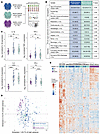
BACKGROUND Sepsis is a leading cause of morbidity and mortality in critically ill children, yet heterogeneous immune responses complicate the development of targeted therapies and the host immune factors driving sepsis pathobiology remain unclear.METHODS We integrated deep immune phenotyping, plasma proteomics, single-cell transcriptomics, and phosphoflow cytometry in a prospective cohort of 88 critically ill children to elucidate the mechanisms underlying immune heterogeneity.RESULTS Unsupervised clustering of plasma cytokines identified 3 immunologic subgroups, including a high-severity group (“Group C”) characterized by hypercytokinemia driven by IL-6 and IFN-γ. Group C exhibited distinct alterations in immune cell frequency and activation, with a strong association between hyperinflammatory cytokine signaling and lymphocyte dysfunction. Single-cell RNA-seq revealed transcriptional signatures of T cell activation and metabolic stress, with suppression of a lymphoid protective gene program across CD8+ T cell subsets. Despite increased expression of activation markers, T cell receptor repertoire analysis revealed no dominant clonotypes, consistent with bystander activation. Phosphoflow cytometry demonstrated baseline STAT1/STAT3 hyperactivation in Group C CD8+ T cells, which failed to respond to αCD3/αCD28/αCD49d stimulation.CONCLUSIONS These findings define an IL-6/IFN-γ–driven endotype of T cell dysfunction in pediatric sepsis and highlight the JAK/STAT axis as a rational target for immunomodulatory therapy.FUNDING K12HD047349, K23GM159013, K08AI135091, R01HD095976, Thrasher Research Fund, Burroughs Wellcome Fund, Immune Deficiency Foundation, Primary Immune Deficiency Treatment Consortium, Barbara Brodsky Foundation, CHOP Research Institute.

Authors

Robert B. Lindell, Samir U. Sayed, Jose S. Campos Duran, Sydney A. Sheetz, Apoorva Babu, Montana S. Knight, Andrea A. Mauracher, Ceire A. Hay, Peyton E. Conrey, Julie C. Fitzgerald, Nadir Yehya, Stephen T. Famularo III, Teresa Arroyo, Richard Tustin III, Hossein Fazelinia, Edward M. Behrens, David T. Teachey, Lisa R. Forbes Satter, Alexandra F. Freeman, Jenna R.E. Bergerson, Steven M. Holland, Jennifer W. Leiding, Scott L. Weiss, Mark W. Hall, Deanne M. Taylor, Rui Feng, E. John Wherry, Nuala J. Meyer, Sarah E. Henrickson

×

Supplemental tables 1, 4, 7 and 13 - Download (89.16 KB)

No preview available for this file type: xlsx
Use the download link to access the file.
Advertisement

Copyright © 2026 American Society for Clinical Investigation
ISSN: 0021-9738 (print), 1558-8238 (online)

Sign up for email alerts