
Advertisement
Research ArticleHematologyImmunology
Open Access |  10.1172/JCI202073
Gene therapy via CRISPR/Cas9-mediated Cxcr4 disease allele inactivation reverses leukopenia in WHIM mice
Ji-Liang Gao, Zhanzhuo Li, Rafael Calderon-Perez, Antonia Pavek, Lina Kim, David H. McDermott, and Philip M. Murphy
Molecular Signaling Section, Laboratory of Molecular Immunology, National Institute of Allergy and Infectious Diseases (NIAID), NIH, Bethesda, Maryland, USA.
Address correspondence to: Philip M. Murphy, Bldg 10, Room 11N113, NIH, Bethesda, Maryland 20892, USA. Phone: 301.496.8616; Email: pmm@nih.gov.
Find articles by Gao, J. in: PubMed | Google Scholar
Molecular Signaling Section, Laboratory of Molecular Immunology, National Institute of Allergy and Infectious Diseases (NIAID), NIH, Bethesda, Maryland, USA.
Address correspondence to: Philip M. Murphy, Bldg 10, Room 11N113, NIH, Bethesda, Maryland 20892, USA. Phone: 301.496.8616; Email: pmm@nih.gov.
Find articles by Li, Z. in: PubMed | Google Scholar
Molecular Signaling Section, Laboratory of Molecular Immunology, National Institute of Allergy and Infectious Diseases (NIAID), NIH, Bethesda, Maryland, USA.
Address correspondence to: Philip M. Murphy, Bldg 10, Room 11N113, NIH, Bethesda, Maryland 20892, USA. Phone: 301.496.8616; Email: pmm@nih.gov.
Find articles by Calderon-Perez, R. in: PubMed | Google Scholar
Molecular Signaling Section, Laboratory of Molecular Immunology, National Institute of Allergy and Infectious Diseases (NIAID), NIH, Bethesda, Maryland, USA.
Address correspondence to: Philip M. Murphy, Bldg 10, Room 11N113, NIH, Bethesda, Maryland 20892, USA. Phone: 301.496.8616; Email: pmm@nih.gov.
Find articles by Pavek, A. in: PubMed | Google Scholar
Molecular Signaling Section, Laboratory of Molecular Immunology, National Institute of Allergy and Infectious Diseases (NIAID), NIH, Bethesda, Maryland, USA.
Address correspondence to: Philip M. Murphy, Bldg 10, Room 11N113, NIH, Bethesda, Maryland 20892, USA. Phone: 301.496.8616; Email: pmm@nih.gov.
Find articles by Kim, L. in: PubMed | Google Scholar
Molecular Signaling Section, Laboratory of Molecular Immunology, National Institute of Allergy and Infectious Diseases (NIAID), NIH, Bethesda, Maryland, USA.
Address correspondence to: Philip M. Murphy, Bldg 10, Room 11N113, NIH, Bethesda, Maryland 20892, USA. Phone: 301.496.8616; Email: pmm@nih.gov.
Find articles by
McDermott, D.
in:
PubMed
|
Google Scholar
|

Molecular Signaling Section, Laboratory of Molecular Immunology, National Institute of Allergy and Infectious Diseases (NIAID), NIH, Bethesda, Maryland, USA.
Address correspondence to: Philip M. Murphy, Bldg 10, Room 11N113, NIH, Bethesda, Maryland 20892, USA. Phone: 301.496.8616; Email: pmm@nih.gov.
Find articles by Murphy, P. in: PubMed | Google Scholar
Published January 8, 2026 - More info
J Clin Invest. 2026;136(5):e202073. https://doi.org/10.1172/JCI202073.
© 2026 Gao et al. This work is licensed under the Creative Commons Attribution 4.0 International License. To view a copy of this license, visit http://creativecommons.org/licenses/by/4.0/.
Received: November 7, 2025; Accepted: January 5, 2026

-
Results
Enhanced but limited engraftment of Cxcr4-edited HSCs in unconditioned WHIM mice. We previously demonstrated that leukopenia in WHIM mice can be corrected by transplanting Cxcr4+/o BM cells without recipient conditioning, but correction required transplantation of 50 million total BM cells to achieve 70% myeloid chimerism in the blood (21). More recently, we developed a CRISPR/Cas9-based protocol to inactivate the disease allele in donor HSCs and demonstrated a selective advantage of Cxcr4+/o cells over Cxcr4+/w cells for hematopoietic reconstitution (19). We sought to determine whether this gene-editing approach could generate a sufficient number of Cxcr4+/o cells to correct leukopenia in WHIM mice without conditioning.
To test this, we transplanted 106 Cxcr4-sgRNA/Cas9 ribonucleoprotein-electroporated (RNP-electroporated) cKit+ BM cells (HSPCs, hematopoietic stem and progenitor cells) from Cxcr4+/w mice (abbreviated Cxcr4-RNP-transfected HSPCs) into each Cxcr4+/w congenic recipient mouse and monitored donor cell engraftment in peripheral blood, along with total blood counts, over 400 days. For comparison, we set up 3 control groups: mock control (Cxcr4+/w mice transplanted with the same number of Cxcr4+/w HSPCs that were electroporated with Cas9 protein alone without sgRNA), untransplanted littermates of Cxcr4+/w mice, and untransplanted littermates of WT mice. To track transplanted donor cell fate in vivo, donor mice and recipient mice had distinct CD45 congenic markers, CD45.2 and CD45.1/CD45.2, respectively (Figure 1A).
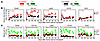 Figure 1
Enhanced but limited engraftment of Cxcr4-edited HSCs in unconditioned WHIM mice. (A) Experimental design. Unconditioned Cxcr4+/w (+/w) mice were transplanted with 106 Cxcr4-sgRNA/Cas9 RNP-transfected [+/w (edited)] or mock-transfected [+/w (mock)] Cxcr4+/w HSPCs (cKit+) (n = 5 per group). Donor and recipient mice were marked genetically by the indicated CD45 polymorphisms. (B and C) Time course of donor-derived leukocyte reconstitution in recipient blood after transplantation as a percentage of total cells (B) and as absolute total cell counts (C) for each of the subsets indicated at the top of each column of panels. The symbol keys are to the far right. Untransplanted WT and untransplanted Cxcr4+/w (WHIM) control littermates were tested at the same time points. Two-way ANOVA was used for statistical comparison between 2 groups.
In the mock control group, donor-derived cells accounted for only ~2% of each leukocyte subset in the peripheral blood of unconditioned Cxcr4+/w recipients. In contrast, recipients of Cxcr4-RNP-transfected donor cells showed significantly higher frequencies of donor-derived myeloid cells (CD11b+) and neutrophils (Ly6G+), reaching up to ~10% and ~8%, respectively (Figure 1B). However, this level of chimerism failed to significantly increase peripheral white blood cell counts compared with mock controls and untransplanted Cxcr4+/w littermates (Figure 1C).
Nongenotoxic CD117-antibody-saporin-conjugate is a safe and effective conditioning reagent for durable hematopoietic reconstitution of donor Cxcr4+/o HSCs to reverse leukopenia in WHIM mice. We next evaluated whether our CRISPR/Cas9 editing protocol could generate sufficient numbers of Cxcr4+/o HSCs to correct leukopenia under clinically feasible conditions.
As an estimate, the expected genotype frequencies resulting from a gene-editing event can be calculated from the edited allele frequencies using the Hardy-Weinberg equation (p² + 2pq + q² = 1). This calculation assumes a population in Hardy-Weinberg equilibrium, where p represents the frequency of the edited allele and q the frequency of the unedited allele (i.e., q = 1 – p). Accordingly, the frequency of cells with both alleles edited (o/o) is p², the frequency of cells with both alleles unedited (+/+) is (1 – p)², and the frequency of heterozygous cells is 2p(1 – p) (Supplemental Figure 1; supplemental material available online with this article; https://doi.org/10.1172/JCI202073DS1) (23).
In the case of Cxcr4+/w cells, editing may occur on either the WT or WHIM allele (Supplemental Figure 1). Assuming that the editing probability is the same for both alleles, the frequency of Cxcr4o/o cells remains p², and the frequency of unedited cells (Cxcr4+/w) is (1 – p)². The heterozygous population is composed of 2 genotypes: Cxcr4o/w (WT allele edited) and Cxcr4+/o (WHIM allele edited). Since both are assumed to occur with equal probability, each accounts for half of the heterozygous frequency, i.e., 2p(1 – p)/2. Thus, the maximum achievable frequency of the Cxcr4+/o genotype that we can generate is 25% under our CRISPR/Cas9 editing protocol (Supplemental Figure 1).
Based on this estimate, to generate 50 million Cxcr4+/o donor BM cells — sufficient to correct leukopenia in an unconditioned Cxcr4+/w recipient as reported previously (21) — approximately 200 million Cxcr4+/w donor BM cells would be required at the outset of editing, a quantity that is clinically impractical.
This analysis highlights the need for additional strategies to improve the in vivo performance of gene-edited cells. To enhance engraftment, we evaluated gene therapy in combination with a nongenotoxic CD117-targeted conditioning reagent, CD117-antibody-saporin-conjugate (CD117-ASC). Saporin is a plant-derived ribosome-inactivating protein that halts protein synthesis, leading to cell death. A single dose of CD117-ASC has been shown to deplete more than 99% of host HSCs, enabling rapid and efficient donor hematopoietic cell engraftment in both autologous transplantation and allotransplantation protocols in WT mice (24, 25). Importantly, the absence of genotoxicity makes this approach particularly well suited for a relatively benign genetic disease like WHIM syndrome.
We first conducted competitive transplantation experiments using 5 × 10⁶ BM cells each from Cxcr4+/o and Cxcr4+/w mice as donor cells, with CD117-ASC–conditioned Cxcr4+/w mice as recipients (Figure 2). The transplanted mice showed no overt clinical abnormalities, such as increased mortality, body weight loss, spontaneous infections, or tumors. For all leukocyte subsets analyzed, Cxcr4+/o chimerism in peripheral blood was significantly higher than Cxcr4+/w chimerism. Notably, Cxcr4+/o myeloid cells reconstituted most efficiently, consisting of up to 95% of total myeloid cells in recipient mice (Figure 2C). The Cxcr4+/o advantage was maintained up to 281 days posttransplantation when the experiment was terminated. When mice were sacrificed, we observed a significant increase in the frequency of Cxcr4+/o donor-derived HSPCs (Figure 2F) but not mature leukocytes in the BM compared with the input frequency (Figure 2E). Most importantly, Cxcr4+/o BM transplantation corrected leukopenia in recipient Cxcr4+/w mice that had received BM CD117-ASC conditioning (Figure 2D). Thus, CD117-ASC appeared to be a safe and effective conditioning reagent for selective engraftment of Cxcr4+/o HSCs, consistent with its performance in autologous and allogeneic WT mouse HSC transplantation.
 Figure 2
Nongenotoxic CD117-ASC is a safe and effective conditioning reagent for durable hematopoietic reconstitution of donor Cxcr4+/o HSCs to reverse leukopenia in WHIM mice. (A) Experimental design of competitive transplantation. Recipient Cxcr4+/w (+/w) mice were injected i.v. with CD117-ASC 8 days before transplantation and then transplanted i.v. with a 1:1 mixture of 5 × 10⁶ BM cells each from Cxcr4+/o (+/o) and Cxcr4+/w (+/w) donor mice. Donor and recipient mice were marked genetically by the indicated CD45 polymorphisms. Bio, biotin; SA, streptavidin; SAP, saporin. (B) Flow cytometry plot of input mixed donor cells. (C and D) Time course of donor-derived leukocyte reconstitution in recipient blood after transplantation as a percentage of total cells (C) and as absolute total cell counts (D) for each subset indicated at the top of each column of panels. The symbol keys are to the far right of each row of panels. BMT, BM transplanted; +/+, WT littermates. (E) Mature donor-derived BM cells 280 days after transplantation. The corresponding blood frequencies are replotted from panel C for each subset to facilitate comparison. R, recipient. (F) Donor-derived CD45+ cells and HSPCs in BM 280 days after transplantation. LSK, Lin–Sca1+cKit+; LT-HSC, long-term hematopoietic stem cell (CD34–Flt3−Lin−Sca1+cKit+); ST-HSC, short-term hematopoietic stem cell (CD34+Flt3−Lin−Sca1+cKit+); MPP, multipotential progenitor (CD34+Flt3+Lin−Sca1+cKit+). Data are from a single experiment (n = 5 mice per data point), representative of 2 independent experiments. In E and F, 2-tailed Student’s t test was used for statistical comparison between 2 groups. *P < 0.05; **P < 0.01; ***P < 0.005; ****P < 0.0001.
CRISPR/Cas9-mediated WHIM allele inactivation corrects myeloid cytopenia in WHIM mice conditioned with CD117-ASC. We next tested engraftment of Cxcr4-RNP-transfected Cxcr4+/w HSPCs in CD117-ASC-conditioned WHIM mice. To do this, we first conducted competitive transplantation using a 1:1 mix of 5 × 10⁵ each of Cxcr4-RNP-transfected and mock-transfected Cxcr4+/w HSPCs as competitive donor cells (Figure 3A).
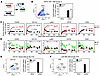 Figure 3
Nongenotoxic CD117-ASC is a safe and effective conditioning reagent for selective engraftment of Cxcr4+/o HSCs after allele-nonselective Cxcr4 inactivation by CRISPR/Cas9. (A) Experimental design of competitive transplantation. Recipient Cxcr4+/w (+/w) mice were injected i.v. with CD117-ASC 8 days before transplantation and then transplanted i.v. with a mixture of 5 × 10⁵ each of Cxcr4-sgRNA/Cas9 RNP-transfected [+/w (edited)] and mock-transfected [+/w (mock)] HSPCs (cKit+) from Cxcr4+/w donor mice (n = 5 per recipient group). Donor and recipient mice were marked genetically by the indicated CD45 polymorphisms. Bio, biotin; SA, streptavidin; SAP, saporin. (B) Flow cytometry plot of input mixed donor cells (left) and frequencies of Cas9-edited (Cxcr4 inactivated) alleles identified by PCR sequencing of the donor cells (right). (C and D) Time course of donor-derived leukocyte reconstitution in recipient blood after transplantation, shown as percentages of total cells (C) and as absolute total cell counts (D) for each subset indicated at the top of each column of panels. The symbol keys are shown at the far right. Untransplanted WT controls and transplanted littermates (BMT) were tested at the same time points. (E and F) Cxcr4 editing analysis of flow cytometry–sorted CD11b+ cells from blood (E) and LSK cells from BM (F) at 518 days posttransplantation. Left panels: representative flow cytometry plots of sorted populations from a recipient mouse. Right panels: frequencies of Cas9-edited (Cxcr4-inactivated) alleles identified by PCR sequencing of the sorted cells. In D, 2-way ANOVA was used for statistical comparison between 2 groups.
The editing efficiency of the donor cells was assessed using a T7E1 assay (data not shown) and DNA sequencing of cloned Cxcr4 PCR amplicons that covered both the protospacer adjacent motif site targeted by CRISPR/Cas9 and the WHIM mutation site, allowing unambiguous assignment of indels to either the WT or WHIM allele. Among 9 PCR clones derived from the DNA of Cxcr4-RNP-transfected input HSPCs, 3 of 5 WT alleles and 2 of 4 WHIM alleles were edited. The overall allele-editing efficiency was approximately 50%, as we have observed previously using the same protocol. As expected, none of the 10 PCR clones from the DNA of mock-transfected input HSPCs showed evidence of CRISPR/Cas9-mediated editing (Figure 3B).
Following transplantation, we monitored hematopoietic reconstitution over time by FACS analysis of peripheral blood. Transplanted mice exhibited no overt clinical abnormalities. Results revealed strong donor cell engraftment and a strong selective advantage of Cxcr4-RNP-transfected donor cells over mock-transfected cells in reconstituting blood leukocytes. Frequencies of Cxcr4-RNP-transfected donor-derived leukocytes were significantly higher across all tested subsets compared with their initial input frequencies. Notably, myeloid cells derived from Cxcr4-RNP-transfected donors constituted up to 87% of total myeloid cells in peripheral blood (Figure 3, C and E). This advantage was durable and stable until the end of the experiment (day 518 posttransplantation).
When the mice were sacrificed, the frequency of Cxcr4-RNP-transfected donor-derived LSK (lineage–Sca1+cKit+) cells was also significantly increased in the BM relative to the input cell frequency, albeit to a lesser extent than the frequency of donor-derived cells in peripheral blood (Figure 3F).
Since the sgRNA we used targets a nonmutated region of Cxcr4 and is therefore not selective for the WHIM allele over the WT allele, we next quantitated in vivo enrichment of WHIM allele-inactivated donor-derived Cxcr4+/o cells after transplantation. The cells could be derived from either Cxcr4-RNP-transfected or mock-transfected donors (Figure 3E). DNA from CD11b+ cells sorted from the blood at day 518 posttransplantation was analyzed using the T7E1 assay and sequencing of cloned Cxcr4 PCR amplicons. Among 9 PCR clones from Cxcr4-RNP-transfected donor cells (from 1 mouse), 3 of 4 WHIM alleles, but none of 5 WT alleles, were edited by CRISPR/Cas9. As expected, none of 9 clones derived from the mock-transfected donor cells showed indels (Figure 3E). These results were confirmed by T7E1 assays from 5 individual mice (data not shown). Since no WT allele was edited, and further assuming that no cells had the Cxcr4o/o genotype (Cxcr4o/o HSCs are unable to engraft in BM after transplantation; ref. 5), the results indicated that approximately 75% of CD11b+ cells derived from Cxcr4-RNP-transfected donors carried inactivated WHIM alleles. Given that these donor-derived CD11b+ cells made up 87% of the recipient CD11b+ cells (Figure 3E), the final proportion of WHIM allele-inactivated CD11b+ cells was approximately 65% (75% of 87%).
We next assessed the frequency of WHIM and WT allele-inactivated cells in BM by analyzing FACS-purified LSK cells derived from Cxcr4-RNP-transfected and mock-transfected donor HSCs (Figure 3F). Cxcr4 PCR amplicons from sorted cells were sequenced to identify indel frequencies in the WT or WHIM allele. Among 10 PCR clones from Cxcr4-RNP-transfected cells, 3 of 5 WHIM alleles, but none of the 5 WT alleles, were edited. As expected, none of 9 clones from mock-transfected cells contained indels. Since Cxcr4-RNP-transfected donor-derived LSK cells accounted for 73% of the total LSK cells in BM (Figure 3F), the final proportion of WHIM allele-inactivated LSK cells was approximately 44% (60% of 73%).
Importantly, the numbers of total CD11b+ myeloid cells and neutrophils in the peripheral blood of the transplanted Cxcr4+/w mice were sustained at a level similar to the range observed for control untransplanted WT littermates of the same age (Figure 3D).
We next tested single donor engraftment in CD117-ASC–conditioned WHIM mice (Figure 4). A total of 1.25 × 10⁶ Cxcr4-RNP-transfected or mock-transfected HSPCs from Cxcr4+/w mice were transplanted into each Cxcr4+/w recipient and monitored for donor cell engraftment in peripheral blood, along with total blood counts, for 418 days, when the experiment was terminated. Transplantation of either Cxcr4-RNP-transfected or mock-transfected cells into conditioned Cxcr4+/w mice quickly established donor cell engraftment in peripheral blood with ~90% for myeloid cells and ~75% for both B and T lymphocytes that was sustained at these levels for the entire time course of the experiment (Figure 4B). Importantly, the numbers of total myeloid cells and neutrophils in the peripheral blood of conditioned Cxcr4+/w mice receiving Cxcr4-RNP-transfected HSPCs were in the range of their untransplanted WT littermates of the same age, indicating full correction (Figure 4C). In contrast, blood leukocyte counts in conditioned Cxcr4+/w mice receiving mock-transfected HSCs were in the range of untransplanted Cxcr4+/w littermates of the same age.
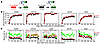 Figure 4
CRISPR/Cas9-mediated HSC WHIM allele inactivation corrects myeloid cytopenia in WHIM mice conditioned with CD117-ASC. (A) Experimental design. Recipient Cxcr4+/w (+/w) mice were injected i.v. with CD117-ASC 8 days before transplantation and then transplanted with 1.25 × 10⁶ Cxcr4-sgRNA/Cas9 RNP-transfected [+/w (edited)] or mock-transfected [+/w (mock)] Cxcr4+/w HSPCs (cKit+) (n = 6 per group). Donor and recipient mice were marked genetically by the indicated CD45 polymorphisms. Bio, biotin; SA, streptavidin; SAP, saporin. (B and C) Time course of donor-derived leukocyte reconstitution in recipient blood after transplantation as a percentage of total cells (B) and as absolute total cell counts (C) for each of the subsets indicated at the top of each column of panels. The symbol keys are to the far right. Unconditioned and untransplanted WT controls and transplanted littermates were tested at the same time points. Data are from a single experiment representative of 2 independent experiments. In C, 2-way ANOVA was used for statistical comparison between 2 groups.


Copyright © 2026 American Society for Clinical Investigation
ISSN: 0021-9738 (print), 1558-8238 (online)