
Advertisement
Commentary
Open Access |  10.1172/JCI197910
GSK3β guides chromosomal repair pathway selection to support BRCA1-independent PARP inhibitor sensitivity
Justin W. Leung1 and David Gius1,2
1Department of Radiation Oncology, Mays Cancer Center at University of Texas Health San Antonio MD Anderson, Joe R. and Teresa Lozano Long School of Medicine, San Antonio, Texas, USA.
2Barshop Institute for Longevity and Aging Studies, University of Texas Health San Antonio, San Antonio, Texas, USA.
Address correspondence to: David Gius, 7979 Wurzbach Road, San Antonio, Texas, 78229, USA. Email: gius@UTHSCSA.edu.
Find articles by Leung, J. in: PubMed | Google Scholar
1Department of Radiation Oncology, Mays Cancer Center at University of Texas Health San Antonio MD Anderson, Joe R. and Teresa Lozano Long School of Medicine, San Antonio, Texas, USA.
2Barshop Institute for Longevity and Aging Studies, University of Texas Health San Antonio, San Antonio, Texas, USA.
Address correspondence to: David Gius, 7979 Wurzbach Road, San Antonio, Texas, 78229, USA. Email: gius@UTHSCSA.edu.
Find articles by Gius, D. in: PubMed | Google Scholar
Published November 17, 2025 - More info
J Clin Invest. 2025;135(22):e197910. https://doi.org/10.1172/JCI197910.
© 2025 Leung et al. This work is licensed under the Creative Commons Attribution 4.0 International License. To view a copy of this license, visit http://creativecommons.org/licenses/by/4.0/.

Related article:
Abstract
Resistance to genotoxic therapies remains a major contributor to tumor recurrence and treatment failure, yet the mechanisms by which cancer cells escape these therapies through DNA damage response (DDR) activation are not fully understood. Here, we identify a DDR regulatory pathway in which glycogen synthase kinase 3 β (GSK3B), a multifunctional serine/threonine kinase, governs DNA double-strand break (DSB) repair pathway choice by phosphorylating 53BP1 at threonine 334 (T334) — a site distinct from canonical ATM targets. This phosphorylation event disrupts 53BP1’s interaction with nonhomologous end joining (NHEJ) effectors PTIP and RIF1, promoting their dissociation from DSBs and inhibiting 53BP1-driven NHEJ. Simultaneously, T334 phosphorylation facilitates the recruitment of CtIP and RPA32 for DNA end resection and promotes homologous recombination (HR) by enabling BRCA1 and RAD51 loading. Notably, the phospho-deficient T334A mutant of 53BP1, unlike 53BP1 loss, accumulates aberrantly at DSBs along with PTIP/RIF1, impairs end resection, and suppresses HR activity. Importantly, both genetic and pharmacologic disruption of the GSK3B–53BP1 axis sensitizes tumors to PARP inhibitors (PARPi) independently of BRCA1 status. Together, these findings reveal a GSK3B-dependent mechanism that regulates DSB repair pathway choice and provide a rationale for targeting this axis to enhance PARPi efficacy in solid tumors regardless of BRCA1 status.
Authors
Heba S. Allam, Scarlett Acklin-Wehnert, Ratan Sadhukhan, Mousumi Patra, Fen Xia
BRCA1/2 mutations confer a large increase in risk of developing breast and ovarian cancer, as well as increase the risk of pancreatic, prostate, and other cancers. Tumors harboring loss-of-function mutations in BRCA1 or BRCA2 are deficient in homologous repair (HR), one of two main pathways to repair DNA double-strand breaks (DSBs), making these tumors dependent on PARP1-mediated repair of single-strand breaks and stalled replication forks. Inhibition of PARP1 in these cells leads to unrepaired DNA lesions, replication fork collapse, and the accumulation of lethal DSBs. This mechanistic insight has been successfully translated into targeted therapy with PARP inhibitors (PARPi), which are now approved for BRCA1/2-mutant breast, ovarian, pancreatic, and prostate cancers (1, 2).
However, the binary classification of tumors as “BRCA-deficient” or “BRCA-proficient” is increasingly recognized as an oversimplification. A subset of BRCA-proficient tumors responds to PARPi, whereas some BRCA-deficient tumors display intrinsic or acquired resistance. This discrepancy points to a more complex landscape of HR regulation, in which additional factors can modulate pathway choice and PARPi sensitivity independently of BRCA1/2 status.
-
Kinases as regulators of DSB repair pathway choice
While DDR signaling is widely recognized to depend on PI3K-like kinases (ATM, ATR, and DNA-PKcs) and checkpoint kinases (CHK1 and CHK2), there is a growing appreciation that other cellular kinases influence repair pathway usage (9). In the current issue of JCI, Allam and colleagues (10) presented compelling evidence that glycogen synthase kinase-3β (GSK3β) acts as a key determinant of DNA DSB repair pathway choice via phosphorylating 53BP1 at threonine 334 (T334) following DNA damage (Figure 1A). Interestingly, unlike the canonical ATM-mediated phosphorylation, which enhances 53BP1’s ability to protect DNA ends and drives NHEJ, phosphorylation at T334 attenuated this function. The authors demonstrated that GSK3β-mediated 53BP1 T334 phosphorylation weakened the association between 53BP1 and its NHEJ cofactors RIF1 and PTIP. This disruption allowed resection machinery to engage the DNA ends, facilitating the recruitment of HR proteins such as CtIP, RPA32, BRCA1, and RAD51 (10).
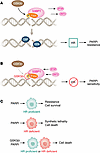 Figure 1
GSK3β-guided selection of DNA double stranded break pathways affects PARP inhibitor sensitivity. (A) Allam et al.’s study described the noncanonical mechanistic regulation of GSK3β-mediated 53BP1 phosphorylation at DSBs. 53BP1 phosphorylation prevented its interaction with PTIP and RIF1 and recruited CtIP and RPA to the DSB, promoting homologous recombination (HR) and therefore resistance to PARP inhibition (PARPi). (B) A GSK3β inhibitor (GSK3βi) sensitized HR-proficient cells to PARPi by blocking the noncanonical regulation shown in panel A. (C) Summary of therapeutic outcomes in HR-proficient and -deficient cells in response to PARPi or PARPi/GSK3βi.
Allam et al. showed that the kinetics of this phosphorylation were consistent with HR engagement: phospho-T334 foci accumulated later after DNA damage, in line with the slower timing of HR repair rather than the rapid response typical of NHEJ. Loss of T334 phosphorylation, either through a T334A substitution or pharmacologic inhibition of GSK3β, resulted in prolonged retention of 53BP1 at DSB sites, an increase in NHEJ activity, and a reduction in HR efficiency, even in cells with functional BRCA1 (Figure 1, A and B). This work therefore defines T334 phosphorylation as a negative regulatory event for 53BP1’s end-protection role, functioning as a molecular switch to tip the balance toward HR.


Copyright © 2026 American Society for Clinical Investigation
ISSN: 0021-9738 (print), 1558-8238 (online)