
Advertisement
Commentary
Open Access |  10.1172/JCI197144
Repurposing the antihistamine cyproheptadine for osteoarthritis: nothing to sneeze at
Richard F. Loeser1,2 and Philip R. Coryell1
1Thurston Arthritis Research Center and
2Division of Rheumatology, Allergy and Immunology, School of Medicine, University of North Carolina, Chapel Hill, North Carolina, USA.
Address correspondence to: Richard F. Loeser, 3300 Thurston Building, CB#7280, Chapel Hill, North Carolina 27599, USA. Email: richard_loeser@med.unc.edu.
Find articles by
Loeser, R.
in:
PubMed
|
Google Scholar
|

1Thurston Arthritis Research Center and
2Division of Rheumatology, Allergy and Immunology, School of Medicine, University of North Carolina, Chapel Hill, North Carolina, USA.
Address correspondence to: Richard F. Loeser, 3300 Thurston Building, CB#7280, Chapel Hill, North Carolina 27599, USA. Email: richard_loeser@med.unc.edu.
Find articles by Coryell, P. in: PubMed | Google Scholar
Published November 3, 2025 - More info
J Clin Invest. 2025;135(21):e197144. https://doi.org/10.1172/JCI197144.
© 2025 Loeser, et al. This work is licensed under the Creative Commons Attribution 4.0 International License. To view a copy of this license, visit http://creativecommons.org/licenses/by/4.0/.

Related article:
Abstract
Osteoarthritis (OA) is the most common joint disease. Controlling the complex pathogenesis is challenging, thus, disease-modifying OA drugs are not available. Forkhead box O (FOXO) transcription factors contribute to cartilage homeostasis through autophagy and oxidative stress resistance. Here, we sought to discover FOXO activators and found that cyproheptadine, a histamine H1 receptor (HRH1) inverse agonist, promoted FOXO3 nuclear translocation and increased FOXO target genes while suppressing inflammation. In a murine OA model, cyproheptadine reduced structural joint tissue damage and pain behaviors. Mechanistically, the inhibition of HRH1 constitutive activity mediated the effects of cyproheptadine on calcium balance between endoplasmic reticulum (ER) and cytoplasm, and FOXO activation was part of this mechanism. The antiinflammatory effect of cyproheptadine involved the inhibition of protein kinase C/NF-κB pathway. HRH1 inhibition also suppressed osteogenesis in mesenchymal stem cells and nerve growth factor expression, which are mechanisms of osteophyte formation and pain behaviors. Moreover, cyproheptadine suppressed ER stress–induced lipogenesis by upregulating insulin-induced gene 1. Our findings suggest that HRH1 constitutive activity controls important OA-promoting mechanisms and indicate that HRH1 inverse agonists are promising drug repurposing candidates for structure and pain improvement in OA.
Authors
Ichiro Kurakazu, Merissa Olmer, Hannah Swahn, Kevin Myers, Chelsea Kenvisay, Yukio Akasaki, Yasuharu Nakashima, Martin K. Lotz
-
Histamine and histamine receptors in OA
Studies have shown that histamine is present in the synovial fluid that bathes the joint, and its origin has been attributed to histamine-producing mast cells observed in the synovium (10, 11). Indeed, mice lacking mast cells were protected from the development of OA in the DMM model (12). However, mast cells produce a number of mediators in addition to histamine, such as the serine protease tryptase, which could also contribute to OA. There is in vitro evidence that histamine can stimulate chondrocytes to produce matrix-degrading enzymes, including the metalloproteinases MMP-3 and MMP-13 (13). Moreover, histamine activation of chondrocyte H1 and H2 receptors was shown to potentially promote joint tissue degradation through signaling that resulted in activation of RANKL and NR4A, components of an essential pathway that regulates bone resorption and is closely linked with OA (14).
The present study by Kurakazu et al. (5) identified a mechanism by which constitutive activity of HRH1 in chondrocytes, independent of the presence of histamine, resulted in activation of signaling that inhibited FOXO activity and upregulated expression of OA mediators (Figure 1A). They noted that HRH1 was the primary histamine receptor expressed by chondrocytes and that its levels were increased in human OA cartilage. Inhibition of chondrocyte HRH1 signaling by cyproheptadine altered activity of several different pathways, in part, due to alterations in calcium flux between the endoplasmic reticulum and the cytosol. The alteration in calcium signaling resulted in a reduction in phosphorylation of the signaling protein AKT, which normally promotes FOXO retention and degradation in the cytosol. Through this mechanism, cyproheptadine promoted FOXO3 nuclear translocation to increase expression of its target genes (Figure 1B), resulting in improved autophagy and an increase in the intracellular antioxidant status.
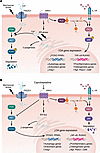 Figure 1
HRH1-mediated signaling in OA and the effects of cyproheptadine inhibition. (A) In OA, constitutive HRH1 signaling contributes to ER stress and increased release of calcium (Ca2+) to the cytosol, which serves to stimulate AKT activation. AKT activation leads to phosphorylation of FOXO, causing it to be retained in the cytosol where it is degraded. The resulting decreased levels of FOXO in the nucleus decrease expression of FOXO-regulated genes. HRH1 signaling also activates PLC, which leads to PKC activation and increased p65 phosphorylation, which promotes p65 translocation to the nucleus, increasing transcription of proinflammatory NF-κB–mediated genes. HRH1 also promotes IL-1 signaling as well as an increase in RUNX2-mediated transcription of osteogenesis genes that could promote bone formation seen in OA. Other genes upregulated by HRH1 include those coding for the pain mediator NGF, the calcium channel protein Piezo1, and the calcium binding protein calmodulin. Additional effects of HRH1 include downregulation of PPARγ activity and Insig1 expression, the latter of which results in increased lipogenesis. (B) Cyproheptadine, acting as an inverse agonist, inhibits HRH1 signaling, resulting in increased ER flux. Enhanced ER flux balances calcium levels in the cytosol and increases activity of FOXO3. It also inhibits proinflammatory signaling to reduce expression of OA mediators, an effect also mediated by the increase in FOXO3 and PPARγ.
Many but not all of the effects of cyproheptadine were due to increased FOXO3 activity. Inhibition of NF-κB–mediated proinflammatory gene expression was independent of FOXO3 activation. Cyproheptadine also inhibited IL-1–driven proinflammatory signaling in chondrocytes and synovial fibroblasts, which is thought to play an important role in OA pathogenesis. This finding suggests a unique cross talk occurring between HRH1 and IL-1 signaling. Cyproheptadine also blocked IL-1–induced expression of nerve growth factor (NGF), an important pain mediator in OA, and increased expression of PPARγ target genes, which would also be predicted to benefit joint tissue homeostasis (15). Other FOXO3-independent effects included increased insulin induced gene 1 (Insig1) expression, which suppressed lipogenesis and cholesterol metabolism; inhibition of ossification gene expression in chondrocytes and mesenchymal stem cells, mediated by a decrease in RUNX2 activity; and reduced expression of PIEZO1, a mechanosensitive ion channel protein that mediates calcium influx and is also thought to contribute to pain and inflammation in OA (16).
As noted above, cyproheptadine and similar antihistamines have been in clinical use for many years. Epidemiologic studies examining chronic antihistamine use and OA risk have shown mixed outcomes. Antihistamine use was associated with reduced prevalence of knee OA in a cross-sectional study using data from the Osteoarthritis Initiative (OAI) (17), and a separate longitudinal OAI study noted a “weak signal” for reduced OA progression (18). In contrast, another OAI study failed to find evidence that antihistamines were protective of knee OA radiographic progression (19), nor was a benefit seen for prevalent OA, joint pain, or future incident OA in a large Swedish cohort (20). However, these studies included all antihistamines — antagonists as well as inverse agonists of histamine receptors. Inhibition of HRH1 constitutive activity by an inverse agonist such as cyproheptadine may be more effective in OA than receptor antagonists that block ligand binding without affecting receptor activity. It is not clear if antihistamines with mechanisms that differ from cyproheptadine or desloratadine would have the same effects as those reported by Kurakazu et al. (5).


Copyright © 2026 American Society for Clinical Investigation
ISSN: 0021-9738 (print), 1558-8238 (online)