
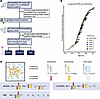
Abstract
BACKGROUND Axonal degeneration is believed to be an early hallmark of Alzheimer’s disease (AD). This study investigated the temporal trajectory of axonal loss and its association with cognitive and functional decline using a dMRI-derived axonal density index (ADI).METHODS Longitudinal dMRI, CSF, and PET data from the ADNI study were analyzed, including 117 subjects that were cognitively normal (CN) and 88 that were cognitively impaired (CI), consisting of 74 individuals with mild cognitive impairment (MCI) and 14 with AD. Linear mixed-effects models examined group differences and associations between baseline and longitudinal changes in ADI, CSF, or PET biomarkers and clinical outcomes. Results derived from larger CSF (n = 527) and PET (tau-PET: n = 870; amyloid-PET: n = 1,581) datasets are also presented.RESULTS Compared with the CN group, the CI group exhibited significantly lower baseline ADI values and steeper longitudinal decline (P < 10–6). Lower baseline ADI predicted faster cognitive and functional decline in the CI group (MMSE: P = 0.03; CDR-SB: P < 10–4), and longitudinal decreases in ADI were associated with worsening clinical outcomes (MMSE: P = 0.001; CDR-SB: P < 10–12). Compared with CSF and PET biomarkers, ADI demonstrated superior sensitivity in tracking disease progression and matched these biomarkers in predicting future cognitive and functional decline. Furthermore, decreases in ADI were significantly associated with declines in clinical outcomes; this association was observed only with amyloid-PET, but not CSF, biomarkers.CONCLUSION Axonal degeneration is an early and clinically meaningful feature of AD. ADI is a promising noninvasive biomarker for early detection, prognosis, and disease monitoring.TRIAL REGISTRATION ClinicalTrials.gov NCT00106899.FUNDING This work was supported by the National Institute on Aging Intramural Research Program.
Authors
Zhaoyuan Gong, John P. Laporte, Alexander Y. Guo, Murat Bilgel, Jonghyun Bae, Noam Y. Fox, Angelique de Rouen, Nathan Zhang, Aaliya Taranath, Rafael de Cabo, Josephine M. Egan, Luigi Ferrucci, Mustapha Bouhrara, Alzheimer’s Disease Neuroimaging Initiative
This file is in Adobe Acrobat (PDF) format. If you have not installed and configured the Adobe Acrobat Reader on your system.
Having trouble reading a PDF?
PDFs are designed to be printed out and read, but if you prefer to read them online, you may find it easier if you increase the view size to 125%.
Having trouble saving a PDF?
Many versions of the free Acrobat Reader do not allow Save. You must instead save the PDF from the JCI Online page you downloaded it from. PC users: Right-click on the Download link and choose the option that says something like "Save Link As...". Mac users should hold the mouse button down on the link to get these same options.
Having trouble printing a PDF?
- Try printing one page at a time or to a newer printer.
- Try saving the file to disk before printing rather than opening it "on the fly." This requires that you configure your browser to "Save" rather than "Launch Application" for the file type "application/pdf", and can usually be done in the "Helper Applications" options.
- Make sure you are using the latest version of Adobe's Acrobat Reader.
Supplemental data - Download (2.79 MB)


Copyright © 2026 American Society for Clinical Investigation
ISSN: 0021-9738 (print), 1558-8238 (online)