
Abstract
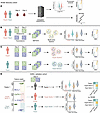
BACKGROUND Critically ill patients with acute respiratory distress syndrome (ARDS) and sepsis exhibit distinct inflammatory phenotypes with divergent clinical outcomes, but the underlying molecular mechanisms remain poorly understood. These phenotypes, derived from clinical data and protein biomarkers, were associated with metabolic differences in a pilot study.METHODS We performed integrative multiomics analysis of blood samples from 160 patients with ARDS in the ROSE trial, randomly selecting 80 patients from each latent class analysis–defined inflammatory phenotype (hyperinflammatory and hypoinflammatory) with phenotype probability greater than 0.9. Untargeted plasma metabolomics and whole-blood transcriptomics at day 0 and day 2 were analyzed using multimodal factor analysis (MEFISTO). The primary outcome was 90-day mortality, with validation in an independent critically ill sepsis cohort (EARLI).RESULTS Multiomics integration revealed 4 molecular signatures associated with mortality: (a) enhanced innate immune activation coupled with increased glycolysis (associated with hyperinflammatory phenotype), (b) hepatic dysfunction and immune dysfunction paired with impaired fatty acid β-oxidation (associated with hyperinflammatory phenotype), (c) interferon program suppression coupled with altered mitochondrial respiration (associated with hyperinflammatory phenotype), and (d) redox impairment and cell proliferation pathways (not associated with inflammatory phenotype). These signatures persisted through day 2 of trial enrollment. Within-phenotype analysis revealed distinct mortality-associated pathways in each group. All molecular signatures were validated in the independent EARLI cohort.CONCLUSION Inflammatory phenotypes of ARDS reflect distinct underlying biological processes with both phenotype-specific and phenotype-independent pathways influencing patient outcomes, all characterized by mitochondrial dysfunction. These findings suggest potential therapeutic targets for precise treatment strategies in critical illness.FUNDING NIH National Heart, Lung, and Blood Institute and National Institute of General Medical Sciences.
Authors
Narges Alipanah-Lechner, Lucile Neyton, Pratik Sinha, Carolyn Leroux, Kim Bardillon, Sidney A. Carrillo, Suzanna Chak, Olivia Chao, Taarini Hariharan, Carolyn Hendrickson, Kirsten Kangelaris, Charles R. Langelier, Deanna Lee, Chelsea Lin, Kathleen Liu, Liam Magee, Angelika Ringor, Aartik Sarma, Emma Schmiege, Natasha Spottiswoode, Kathryn Sullivan, Melanie F. Weingart, Andrew Willmore, Hanjing Zhuo, Angela J. Rogers, Kathleen A. Stringer, Michael A. Matthay, Carolyn S. Calfee
This file is in Adobe Acrobat (PDF) format. If you have not installed and configured the Adobe Acrobat Reader on your system.
Having trouble reading a PDF?
PDFs are designed to be printed out and read, but if you prefer to read them online, you may find it easier if you increase the view size to 125%.
Having trouble saving a PDF?
Many versions of the free Acrobat Reader do not allow Save. You must instead save the PDF from the JCI Online page you downloaded it from. PC users: Right-click on the Download link and choose the option that says something like "Save Link As...". Mac users should hold the mouse button down on the link to get these same options.
Having trouble printing a PDF?
- Try printing one page at a time or to a newer printer.
- Try saving the file to disk before printing rather than opening it "on the fly." This requires that you configure your browser to "Save" rather than "Launch Application" for the file type "application/pdf", and can usually be done in the "Helper Applications" options.
- Make sure you are using the latest version of Adobe's Acrobat Reader.
Supplemental data - Download (3.83 MB)


Copyright © 2026 American Society for Clinical Investigation
ISSN: 0021-9738 (print), 1558-8238 (online)