
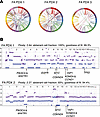
Abstract
Fanconi anemia (FA) confers a high risk (~700-fold increase) of solid tumor formation, most often head and neck squamous cell carcinoma (HNSCC). FA germline DNA repair defects preclude administration of most chemotherapies, and prior hematopoietic stem cell transplantation limits the use of immunotherapy. Thus, surgery and judicious delivery of radiation offer the only treatment options, with most patients dying from their cancers. A paucity of preclinical models has limited the development of new treatments. Here, we report what to our knowledge are the first patient-derived xenografts (PDXs) of FA-associated HNSCC (FA-HNSCC) and highlight the efficacy of FDA-approved EGFR-targeted therapies in tumors with high EGFR and phosphorylated EGFR levels and the activity of the FDA-approved B-cell lymphoma 2 (Bcl-2) inhibitor venetoclax in a FA-HNSCC PDX overexpressing Bcl-2. These findings support the development of precision medicine approaches for FA-HNSCC.
Authors
Jennifer R. Grandis, Hua Li, Benjamin A. Harrison, Andrew L.H. Webster, Joanna Pucilowska, Austin Nguyen, Jinho Lee, Gordon B. Mills, Jovanka Gencel-Augusto, Yan Zeng, Steven R. Long, Mi-Ok Kim, Rex H. Lee, David I. Kutler, Theresa Scognamiglio, Margaret Brandwein-Weber, Mark Urken, Inna Khodos, Elisa de Stanchina, Yu-Chien Lin, Frank X. Donovan, Settara C. Chandrasekharappa, Moonjung Jung, Mathijs A. Sanders, Agata Smogorzewska, Daniel E. Johnson
Supplemental table 2 - Download (57.26 KB)
No preview available for this file type: xlsx
Use the download link to access the file.


Copyright © 2026 American Society for Clinical Investigation
ISSN: 0021-9738 (print), 1558-8238 (online)