
Go to JCI Insight
  • About
  • Editors
  • Consulting Editors
  • For authors
  • Publication ethics
  • Publication alerts by email
  • Advertising
  • Job board
  • Contact
  • Clinical Research and Public Health
  • Current issue
  • Past issues
  • By specialty
    • COVID-19
    • Cardiology
    • Gastroenterology
    • Immunology
    • Metabolism
    • Nephrology
    • Neuroscience
    • Oncology
    • Pulmonology
    • Vascular biology
    • All ...
  • Videos
    • Conversations with Giants in Medicine
    • Video Abstracts
  • Reviews
    • View all reviews ...
    • Clinical innovation and scientific progress in GLP-1 medicine (Nov 2025)
    • Pancreatic Cancer (Jul 2025)
    • Complement Biology and Therapeutics (May 2025)
    • Evolving insights into MASLD and MASH pathogenesis and treatment (Apr 2025)
    • Microbiome in Health and Disease (Feb 2025)
    • Substance Use Disorders (Oct 2024)
    • Clonal Hematopoiesis (Oct 2024)
    • View all review series ...
  • Viewpoint
  • Collections
    • In-Press Preview
    • Clinical Research and Public Health
    • Research Letters
    • Letters to the Editor
    • Editorials
    • Commentaries
    • Editor's notes
    • Reviews
    • Viewpoints
    • 100th anniversary
    • Top read articles

  • Current issue
  • Past issues
  • Specialties
  • Reviews
  • Review series
  • Conversations with Giants in Medicine
  • Video Abstracts
  • In-Press Preview
  • Clinical Research and Public Health
  • Research Letters
  • Letters to the Editor
  • Editorials
  • Commentaries
  • Editor's notes
  • Reviews
  • Viewpoints
  • 100th anniversary
  • Top read articles
  • About
  • Editors
  • Consulting Editors
  • For authors
  • Publication ethics
  • Publication alerts by email
  • Advertising
  • Job board
  • Contact
Signaling architecture of the glucagon-like peptide-1 receptor
Gregory Austin, Alejandra Tomas
View: Text | PDF
Review Series

Signaling architecture of the glucagon-like peptide-1 receptor

  • Text
  • PDF
Abstract

The glucagon-like peptide-1 receptor (GLP-1R) is a class B1 G protein–coupled receptor and major therapeutic target in type 2 diabetes and obesity. Beyond its canonical role in Gαs/cAMP signaling, GLP-1R is increasingly recognized as an organizer of spatiotemporally defined signaling nanodomains, or “signalosomes.” This Review highlights our current knowledge on the mechanisms of assembly and regulation of GLP-1R signalosomes, including the involvement of biomolecular condensates formed by liquid-liquid phase separation, and the role of membrane contact sites between the endoplasmic reticulum (ER) and other organelles as key locations for GLP-1R signaling assemblies. Furthermore, we discuss existing data on the molecular composition and functional impact of two predicted GLP-1R nanodomains, one at ER–plasma membrane contact sites, where GLP-1R might interact with ion channels and transporters to influence local excitability and coordinated insulin secretion, and another at ER–mitochondria membrane contact sites, with the capacity to control lipid and calcium signaling and modulate ER and/or mitochondrial activity. We additionally discuss the role of GLP-1R posttranslational modifications as critical modulators of GLP-1R signal specification and nanodomain organization. Conceptualizing GLP-1R as a dynamic architect of spatiotemporally encoded signalosomes opens new avenues for a deeper understanding of incretin biology with the potential for identification of novel GLP-1R effectors and the development of refined therapeutic strategies for metabolic disease.

Authors

Gregory Austin, Alejandra Tomas

×

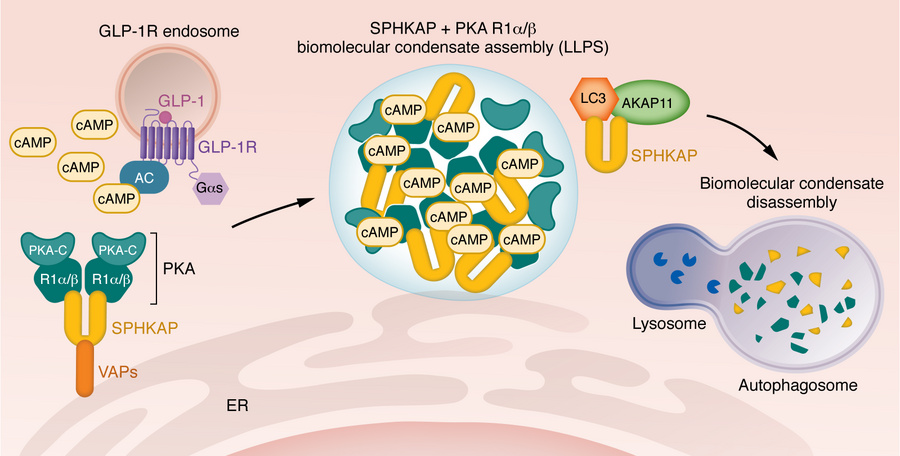
Figure 1

Proposed mechanism of GLP-1R–mediated assembly and disassembly of SPHKAP–PKA RIα/β biomolecular condensates.
Options: View larger image (or click on image) Download as PowerPoint
Proposed mechanism of GLP-1R–mediated assembly and disassembly of SPHKAP...
Active GLP-1Rs are trafficked to endosomes where they engage VAPs to form ER-endosome MCSs, generating local pools of cAMP. VAPs engage SPHKAP to form PKA RIα/β biomolecular condensates upon local PKA activation by GLP-1R–generated cAMP. SPHKAP subsequently recruits AKAP11, triggering LC3-dependent autophagosomal degradation of PKA RIα/β biomolecular condensates. AC, adenylate cyclase; PKA-C, catalytic subunit of PKA; PKA RIα/β, PKA regulatory subunit Iα/β; SPHKAP, sphingosine kinase 1 interactor, AKAP domain–containing; ER, endoplasmic reticulum; AKAP11, A-kinase anchoring protein 11; LC3, microtubule-associated protein 1A/1B-light chain 3; LLPS, liquid-liquid phase separation.

Copyright © 2026 American Society for Clinical Investigation
ISSN: 0021-9738 (print), 1558-8238 (online)

Sign up for email alerts