
Advertisement
Research ArticleHematologyVascular biology
Open Access |  10.1172/JCI193976
Estrogen and obesity synergistically suppress protein S via HIF1α, enhancing thrombosis potential
Mohammad A. Mohammad,1 Narender Kumar,1 Sonali Ghosh,1 Ashley Paysse,1 Claudia Leonardi,2 Vijaya Pilli,1 Ma Lorena Duhaylungsod,1 Eric Lazartigues,3 Diana C. Polania-Villanueva,4 Sadaf Nouman,1 Logan A. Barrios,1 Rima Chattopadhyay,1 Rafika Yasmin,1 Alaina Guilbeau,1 Manoj Kumar,1 Tina Nguyen,1 Jovanny Zabaleta,1 Li Li,4 Luis Del Valle,5 Mallory T. Barbier,5 Samarpan Majumder,4 Laurent O. Mosnier,6 and Rinku Majumder1
1Department of Interdisciplinary Oncology,
2Department of Orthopedics,
3Cardiovascular Center of Excellence,
4Department of Genetics, and
5Department of Pathology, Louisiana State University Health Sciences Center (LSUHSC), New Orleans, Louisiana, USA.
6Department of Translational Medicine, Scripps Research, La Jolla, California, USA.
Address correspondence to: Rinku Majumder, Clinical Sciences Research Building (CSRB) – 549, 533 Bolivar Street New Orleans, Louisiana, 70112, USA. Phone: 504.568.2810; Email: rmajum@lsuhsc.edu.
Authorship note: MAM, NK, and SG contributed equally to this work and have been designated as co–first authors.
Find articles by Mohammad, M. in: PubMed | Google Scholar
1Department of Interdisciplinary Oncology,
2Department of Orthopedics,
3Cardiovascular Center of Excellence,
4Department of Genetics, and
5Department of Pathology, Louisiana State University Health Sciences Center (LSUHSC), New Orleans, Louisiana, USA.
6Department of Translational Medicine, Scripps Research, La Jolla, California, USA.
Address correspondence to: Rinku Majumder, Clinical Sciences Research Building (CSRB) – 549, 533 Bolivar Street New Orleans, Louisiana, 70112, USA. Phone: 504.568.2810; Email: rmajum@lsuhsc.edu.
Authorship note: MAM, NK, and SG contributed equally to this work and have been designated as co–first authors.
Find articles by Kumar, N. in: PubMed | Google Scholar
1Department of Interdisciplinary Oncology,
2Department of Orthopedics,
3Cardiovascular Center of Excellence,
4Department of Genetics, and
5Department of Pathology, Louisiana State University Health Sciences Center (LSUHSC), New Orleans, Louisiana, USA.
6Department of Translational Medicine, Scripps Research, La Jolla, California, USA.
Address correspondence to: Rinku Majumder, Clinical Sciences Research Building (CSRB) – 549, 533 Bolivar Street New Orleans, Louisiana, 70112, USA. Phone: 504.568.2810; Email: rmajum@lsuhsc.edu.
Authorship note: MAM, NK, and SG contributed equally to this work and have been designated as co–first authors.
Find articles by Ghosh, S. in: PubMed | Google Scholar
1Department of Interdisciplinary Oncology,
2Department of Orthopedics,
3Cardiovascular Center of Excellence,
4Department of Genetics, and
5Department of Pathology, Louisiana State University Health Sciences Center (LSUHSC), New Orleans, Louisiana, USA.
6Department of Translational Medicine, Scripps Research, La Jolla, California, USA.
Address correspondence to: Rinku Majumder, Clinical Sciences Research Building (CSRB) – 549, 533 Bolivar Street New Orleans, Louisiana, 70112, USA. Phone: 504.568.2810; Email: rmajum@lsuhsc.edu.
Authorship note: MAM, NK, and SG contributed equally to this work and have been designated as co–first authors.
Find articles by Paysse, A. in: PubMed | Google Scholar
1Department of Interdisciplinary Oncology,
2Department of Orthopedics,
3Cardiovascular Center of Excellence,
4Department of Genetics, and
5Department of Pathology, Louisiana State University Health Sciences Center (LSUHSC), New Orleans, Louisiana, USA.
6Department of Translational Medicine, Scripps Research, La Jolla, California, USA.
Address correspondence to: Rinku Majumder, Clinical Sciences Research Building (CSRB) – 549, 533 Bolivar Street New Orleans, Louisiana, 70112, USA. Phone: 504.568.2810; Email: rmajum@lsuhsc.edu.
Authorship note: MAM, NK, and SG contributed equally to this work and have been designated as co–first authors.
Find articles by Leonardi, C. in: PubMed | Google Scholar
1Department of Interdisciplinary Oncology,
2Department of Orthopedics,
3Cardiovascular Center of Excellence,
4Department of Genetics, and
5Department of Pathology, Louisiana State University Health Sciences Center (LSUHSC), New Orleans, Louisiana, USA.
6Department of Translational Medicine, Scripps Research, La Jolla, California, USA.
Address correspondence to: Rinku Majumder, Clinical Sciences Research Building (CSRB) – 549, 533 Bolivar Street New Orleans, Louisiana, 70112, USA. Phone: 504.568.2810; Email: rmajum@lsuhsc.edu.
Authorship note: MAM, NK, and SG contributed equally to this work and have been designated as co–first authors.
Find articles by Pilli, V. in: PubMed | Google Scholar
1Department of Interdisciplinary Oncology,
2Department of Orthopedics,
3Cardiovascular Center of Excellence,
4Department of Genetics, and
5Department of Pathology, Louisiana State University Health Sciences Center (LSUHSC), New Orleans, Louisiana, USA.
6Department of Translational Medicine, Scripps Research, La Jolla, California, USA.
Address correspondence to: Rinku Majumder, Clinical Sciences Research Building (CSRB) – 549, 533 Bolivar Street New Orleans, Louisiana, 70112, USA. Phone: 504.568.2810; Email: rmajum@lsuhsc.edu.
Authorship note: MAM, NK, and SG contributed equally to this work and have been designated as co–first authors.
Find articles by Duhaylungsod, M. in: PubMed | Google Scholar
1Department of Interdisciplinary Oncology,
2Department of Orthopedics,
3Cardiovascular Center of Excellence,
4Department of Genetics, and
5Department of Pathology, Louisiana State University Health Sciences Center (LSUHSC), New Orleans, Louisiana, USA.
6Department of Translational Medicine, Scripps Research, La Jolla, California, USA.
Address correspondence to: Rinku Majumder, Clinical Sciences Research Building (CSRB) – 549, 533 Bolivar Street New Orleans, Louisiana, 70112, USA. Phone: 504.568.2810; Email: rmajum@lsuhsc.edu.
Authorship note: MAM, NK, and SG contributed equally to this work and have been designated as co–first authors.
Find articles by Lazartigues, E. in: PubMed | Google Scholar
1Department of Interdisciplinary Oncology,
2Department of Orthopedics,
3Cardiovascular Center of Excellence,
4Department of Genetics, and
5Department of Pathology, Louisiana State University Health Sciences Center (LSUHSC), New Orleans, Louisiana, USA.
6Department of Translational Medicine, Scripps Research, La Jolla, California, USA.
Address correspondence to: Rinku Majumder, Clinical Sciences Research Building (CSRB) – 549, 533 Bolivar Street New Orleans, Louisiana, 70112, USA. Phone: 504.568.2810; Email: rmajum@lsuhsc.edu.
Authorship note: MAM, NK, and SG contributed equally to this work and have been designated as co–first authors.
Find articles by Polania-Villanueva, D. in: PubMed | Google Scholar
1Department of Interdisciplinary Oncology,
2Department of Orthopedics,
3Cardiovascular Center of Excellence,
4Department of Genetics, and
5Department of Pathology, Louisiana State University Health Sciences Center (LSUHSC), New Orleans, Louisiana, USA.
6Department of Translational Medicine, Scripps Research, La Jolla, California, USA.
Address correspondence to: Rinku Majumder, Clinical Sciences Research Building (CSRB) – 549, 533 Bolivar Street New Orleans, Louisiana, 70112, USA. Phone: 504.568.2810; Email: rmajum@lsuhsc.edu.
Authorship note: MAM, NK, and SG contributed equally to this work and have been designated as co–first authors.
Find articles by Nouman, S. in: PubMed | Google Scholar
1Department of Interdisciplinary Oncology,
2Department of Orthopedics,
3Cardiovascular Center of Excellence,
4Department of Genetics, and
5Department of Pathology, Louisiana State University Health Sciences Center (LSUHSC), New Orleans, Louisiana, USA.
6Department of Translational Medicine, Scripps Research, La Jolla, California, USA.
Address correspondence to: Rinku Majumder, Clinical Sciences Research Building (CSRB) – 549, 533 Bolivar Street New Orleans, Louisiana, 70112, USA. Phone: 504.568.2810; Email: rmajum@lsuhsc.edu.
Authorship note: MAM, NK, and SG contributed equally to this work and have been designated as co–first authors.
Find articles by Barrios, L. in: PubMed | Google Scholar
1Department of Interdisciplinary Oncology,
2Department of Orthopedics,
3Cardiovascular Center of Excellence,
4Department of Genetics, and
5Department of Pathology, Louisiana State University Health Sciences Center (LSUHSC), New Orleans, Louisiana, USA.
6Department of Translational Medicine, Scripps Research, La Jolla, California, USA.
Address correspondence to: Rinku Majumder, Clinical Sciences Research Building (CSRB) – 549, 533 Bolivar Street New Orleans, Louisiana, 70112, USA. Phone: 504.568.2810; Email: rmajum@lsuhsc.edu.
Authorship note: MAM, NK, and SG contributed equally to this work and have been designated as co–first authors.
Find articles by Chattopadhyay, R. in: PubMed | Google Scholar
1Department of Interdisciplinary Oncology,
2Department of Orthopedics,
3Cardiovascular Center of Excellence,
4Department of Genetics, and
5Department of Pathology, Louisiana State University Health Sciences Center (LSUHSC), New Orleans, Louisiana, USA.
6Department of Translational Medicine, Scripps Research, La Jolla, California, USA.
Address correspondence to: Rinku Majumder, Clinical Sciences Research Building (CSRB) – 549, 533 Bolivar Street New Orleans, Louisiana, 70112, USA. Phone: 504.568.2810; Email: rmajum@lsuhsc.edu.
Authorship note: MAM, NK, and SG contributed equally to this work and have been designated as co–first authors.
Find articles by Yasmin, R. in: PubMed | Google Scholar
1Department of Interdisciplinary Oncology,
2Department of Orthopedics,
3Cardiovascular Center of Excellence,
4Department of Genetics, and
5Department of Pathology, Louisiana State University Health Sciences Center (LSUHSC), New Orleans, Louisiana, USA.
6Department of Translational Medicine, Scripps Research, La Jolla, California, USA.
Address correspondence to: Rinku Majumder, Clinical Sciences Research Building (CSRB) – 549, 533 Bolivar Street New Orleans, Louisiana, 70112, USA. Phone: 504.568.2810; Email: rmajum@lsuhsc.edu.
Authorship note: MAM, NK, and SG contributed equally to this work and have been designated as co–first authors.
Find articles by Guilbeau, A. in: PubMed | Google Scholar
1Department of Interdisciplinary Oncology,
2Department of Orthopedics,
3Cardiovascular Center of Excellence,
4Department of Genetics, and
5Department of Pathology, Louisiana State University Health Sciences Center (LSUHSC), New Orleans, Louisiana, USA.
6Department of Translational Medicine, Scripps Research, La Jolla, California, USA.
Address correspondence to: Rinku Majumder, Clinical Sciences Research Building (CSRB) – 549, 533 Bolivar Street New Orleans, Louisiana, 70112, USA. Phone: 504.568.2810; Email: rmajum@lsuhsc.edu.
Authorship note: MAM, NK, and SG contributed equally to this work and have been designated as co–first authors.
Find articles by Kumar, M. in: PubMed | Google Scholar
1Department of Interdisciplinary Oncology,
2Department of Orthopedics,
3Cardiovascular Center of Excellence,
4Department of Genetics, and
5Department of Pathology, Louisiana State University Health Sciences Center (LSUHSC), New Orleans, Louisiana, USA.
6Department of Translational Medicine, Scripps Research, La Jolla, California, USA.
Address correspondence to: Rinku Majumder, Clinical Sciences Research Building (CSRB) – 549, 533 Bolivar Street New Orleans, Louisiana, 70112, USA. Phone: 504.568.2810; Email: rmajum@lsuhsc.edu.
Authorship note: MAM, NK, and SG contributed equally to this work and have been designated as co–first authors.
Find articles by Nguyen, T. in: PubMed | Google Scholar
1Department of Interdisciplinary Oncology,
2Department of Orthopedics,
3Cardiovascular Center of Excellence,
4Department of Genetics, and
5Department of Pathology, Louisiana State University Health Sciences Center (LSUHSC), New Orleans, Louisiana, USA.
6Department of Translational Medicine, Scripps Research, La Jolla, California, USA.
Address correspondence to: Rinku Majumder, Clinical Sciences Research Building (CSRB) – 549, 533 Bolivar Street New Orleans, Louisiana, 70112, USA. Phone: 504.568.2810; Email: rmajum@lsuhsc.edu.
Authorship note: MAM, NK, and SG contributed equally to this work and have been designated as co–first authors.
Find articles by
Zabaleta, J.
in:
PubMed
|
Google Scholar
|

1Department of Interdisciplinary Oncology,
2Department of Orthopedics,
3Cardiovascular Center of Excellence,
4Department of Genetics, and
5Department of Pathology, Louisiana State University Health Sciences Center (LSUHSC), New Orleans, Louisiana, USA.
6Department of Translational Medicine, Scripps Research, La Jolla, California, USA.
Address correspondence to: Rinku Majumder, Clinical Sciences Research Building (CSRB) – 549, 533 Bolivar Street New Orleans, Louisiana, 70112, USA. Phone: 504.568.2810; Email: rmajum@lsuhsc.edu.
Authorship note: MAM, NK, and SG contributed equally to this work and have been designated as co–first authors.
Find articles by Li, L. in: PubMed | Google Scholar
1Department of Interdisciplinary Oncology,
2Department of Orthopedics,
3Cardiovascular Center of Excellence,
4Department of Genetics, and
5Department of Pathology, Louisiana State University Health Sciences Center (LSUHSC), New Orleans, Louisiana, USA.
6Department of Translational Medicine, Scripps Research, La Jolla, California, USA.
Address correspondence to: Rinku Majumder, Clinical Sciences Research Building (CSRB) – 549, 533 Bolivar Street New Orleans, Louisiana, 70112, USA. Phone: 504.568.2810; Email: rmajum@lsuhsc.edu.
Authorship note: MAM, NK, and SG contributed equally to this work and have been designated as co–first authors.
Find articles by Del Valle, L. in: PubMed | Google Scholar
1Department of Interdisciplinary Oncology,
2Department of Orthopedics,
3Cardiovascular Center of Excellence,
4Department of Genetics, and
5Department of Pathology, Louisiana State University Health Sciences Center (LSUHSC), New Orleans, Louisiana, USA.
6Department of Translational Medicine, Scripps Research, La Jolla, California, USA.
Address correspondence to: Rinku Majumder, Clinical Sciences Research Building (CSRB) – 549, 533 Bolivar Street New Orleans, Louisiana, 70112, USA. Phone: 504.568.2810; Email: rmajum@lsuhsc.edu.
Authorship note: MAM, NK, and SG contributed equally to this work and have been designated as co–first authors.
Find articles by Barbier, M. in: PubMed | Google Scholar
1Department of Interdisciplinary Oncology,
2Department of Orthopedics,
3Cardiovascular Center of Excellence,
4Department of Genetics, and
5Department of Pathology, Louisiana State University Health Sciences Center (LSUHSC), New Orleans, Louisiana, USA.
6Department of Translational Medicine, Scripps Research, La Jolla, California, USA.
Address correspondence to: Rinku Majumder, Clinical Sciences Research Building (CSRB) – 549, 533 Bolivar Street New Orleans, Louisiana, 70112, USA. Phone: 504.568.2810; Email: rmajum@lsuhsc.edu.
Authorship note: MAM, NK, and SG contributed equally to this work and have been designated as co–first authors.
Find articles by Majumder, S. in: PubMed | Google Scholar
1Department of Interdisciplinary Oncology,
2Department of Orthopedics,
3Cardiovascular Center of Excellence,
4Department of Genetics, and
5Department of Pathology, Louisiana State University Health Sciences Center (LSUHSC), New Orleans, Louisiana, USA.
6Department of Translational Medicine, Scripps Research, La Jolla, California, USA.
Address correspondence to: Rinku Majumder, Clinical Sciences Research Building (CSRB) – 549, 533 Bolivar Street New Orleans, Louisiana, 70112, USA. Phone: 504.568.2810; Email: rmajum@lsuhsc.edu.
Authorship note: MAM, NK, and SG contributed equally to this work and have been designated as co–first authors.
Find articles by
Mosnier, L.
in:
PubMed
|
Google Scholar
|
1Department of Interdisciplinary Oncology,
2Department of Orthopedics,
3Cardiovascular Center of Excellence,
4Department of Genetics, and
5Department of Pathology, Louisiana State University Health Sciences Center (LSUHSC), New Orleans, Louisiana, USA.
6Department of Translational Medicine, Scripps Research, La Jolla, California, USA.
Address correspondence to: Rinku Majumder, Clinical Sciences Research Building (CSRB) – 549, 533 Bolivar Street New Orleans, Louisiana, 70112, USA. Phone: 504.568.2810; Email: rmajum@lsuhsc.edu.
Authorship note: MAM, NK, and SG contributed equally to this work and have been designated as co–first authors.
Find articles by Majumder, R. in: PubMed | Google Scholar
Published November 17, 2025 - More info
J Clin Invest. 2025;135(22):e193976. https://doi.org/10.1172/JCI193976.
© 2025 Mohammad et al. This work is licensed under the Creative Commons Attribution 4.0 International License. To view a copy of this license, visit http://creativecommons.org/licenses/by/4.0/.
Received: March 28, 2025; Accepted: September 3, 2025

-
Results
Estrogen and obesity increase thrombin generation in human plasma. PS prevents thrombin formation by acting as a cofactor for activated protein C and tissue factor pathway inhibitor and by directly inhibiting factor IXa, which subsequently inhibits thrombin generation (38–40). Therefore, we hypothesized that thrombin generation is affected in plasma of individuals who take estrogen-based OCAs and/or obese (hypoxic) individuals. Consequently, we collected plasma samples from premenopausal women with diverse demographic characteristics (Table 1) and grouped these women into 4 categories: normal (N), normal plus estrogen (N+E), obese (O), and obese plus estrogen (O+E). Measurement of peak thrombin by thrombin generation assay (TGA) (Figure 1A) showed an increase in thrombin formation by 1.5-fold in O women and 1.7-fold in N+E women, respectively. The combined effects of estrogen and obesity (Figure 1A) showed a substantial 2.7-fold increase in thrombin generation in O+E women. Additionally, supplementation of anti-PS antibody in normal plasma increased peak thrombin levels by approximately 2-fold (Supplemental Figure 1A; supplemental material available online with this article; https://doi.org/10.1172/JCI193976DS1), thereby reinforcing the effect of PS in thrombin generation and clotting time. Although activated partial thromboplastin time (aPTT) is primarily used in clinical settings to monitor anticoagulation therapy, we used it alongside TGA to achieve a more comprehensive assessment of coagulation status in plasma samples. Our results showed that the clotting time (Figure 1B) remained largely unchanged in O women and N+E women. However, in O+E women, the clotting time was shortened by 1.6-fold (Figure 1B) when compared with the normal reference range of clotting times (36.3 ± 2.8 seconds to 40.8 ± 1.5 seconds), which suggest a hypercoagulable state in those women (Supplemental Figure 1B). Next, to investigate whether PS supplementation mitigates the prothrombotic effects of low PS levels in O+E women, we conducted a plasma thrombin generation assay with and without exogenous PS (300 nM). PS supplementation in O+E plasma reduced peak thrombin by approximately 70%, restoring it to levels comparable to those in normal plasma (Supplemental Figure 1C).
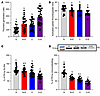 Figure 1
Estrogen and obesity downregulate PS in human plasma. The effects of estrogen and obesity on plasma from female participants (n = 157) grouped as N, N+E, O, or O+E were determined by TGA (A), aPTT (B), ELISA (C), and immunoblotting (D). a,b,c,dLeast squares means with adjusted for age as a covariate, with unique superscripts indicate significant differences between all female participants (P < 0.05). Pairwise comparisons of least squares means were adjusted using the Bonferroni method to correct for multiple comparisons. All data are presented as the mean ± SEM and are representative of 3 independent experiments. The color red represents N+E participant, blue represents O participants, and purple represents O+E participants.
Estrogen and obesity attenuate PS in human plasma. Measurement of free PS by ELISA (Figure 1C) showed a moderate reduction of 9% in PS levels in N+E women and 13% in O women, respectively. The combined effect of estrogen and obesity resulted in a 32.5% reduction in PS concentrations in plasma of O+E women (Figure 1C). We observed a similar trend in the reduction of PS expression (Figure 1D), reaching 32% in N+E women, 42% in O women, and a significant 60% in O+E women, respectively (Table 2). Moreover, we confirmed the inverse relationship between PS downregulation and thrombin generation (Supplemental Figure 1D) by measuring the correlation coefficient between the percentage of free PS and peak thrombin in O+E women, with a substantial negative Pearson correlation (r) value of –0.3782.
Estrogen and obesity increase thrombin generation in mouse plasma. Mice were also grouped into 4 categories (Figure 2A) — lean (L), lean plus estrogen pelleted (L+E), O, and O+E pelleted — to mimic the same conditions as the participants, and mouse plasma samples were analyzed by TGA to examine the effects of estrogen and hypoxia-associated obesity on thrombin generation over a period of 5 weeks. Measurement of peak thrombin (Figure 2B, top panel) showed an increase in thrombin generation that reached 3-fold in L+E mice, 4-fold in O mice, and a substantial 6-fold in O+E mice by the fifth week (Figure 2, B and H, top, middle, and bottom panels, and Table 3), respectively.
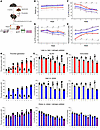 Figure 2
The effect of estrogen and obesity in a C57BL/6 mouse model. (A) Schematic illustration of the experimental design. The effects of estrogen and obesity on isolated plasma from female mice (n = 40) grouped as lean (L), lean plus estrogen pelleted (L+P), obese (O), and obese plus estrogen pelleted (O+P) were determined by TGA (B), ELISA (C), and immunoblotting (D). Overall significance of the entire mouse population emerged (P < 0.0001), indicating (E) variations in weight among the 4 mouse groups. Group comparisons were conducted for each week, revealing a significant overall group effect within each week (P < 0.0001) reflected on PS levels measured by ELISA (F), immunoblotting (G), and thrombin generation (H) over 5 weeks. Statistical analysis in F–H was performed using Bonferroni’s multiple-comparison adjustment, and distinctions among the 4 groups within each week are illustrated by distinct superscript lowercase letters a–d (P < 0.05). All data are presented as the mean ± SEM and are representative of 3 independent experiments.
Estrogen and obesity synergistically downregulate PS in mouse plasma. Since mice lack the β-chain of C4BP in their plasma, PS exists predominantly as a free active form, and hence there is no distinction between free and total PS in mice (41). Therefore, PS from isolated plasma samples was analyzed by both ELISA and immunoblotting over a period of 5 weeks to determine the effects of estrogen and hypoxia on PS levels. Measurement of free PS by ELISA (Figure 2, C and F) showed a gradual reduction in PS concentration, reaching 40% in O mice (Figure 2C, middle panel), 50% in L+E mice (Figure 2C, top panel), and a substantial 62% in O+E mice (Figure 2C, bottom panel) by the fifth week compared with the control (L) mice. The expression of PS (Figure 2D) was also reduced by 30% in L+E mice (Figure 2D, top panel), by 40% in O mice (Figure 2D, middle panel), and by 51% in O+E mice (Figure 2D, bottom panel) compared with the control mice. Next, the correlation between adipose tissue and estrogen production was determined by comparing estrogen levels in control mice plasma (week zero) with levels at week 5 (Figure 2E). Measurement of 17 β-estradiol in plasma from mice showed a substantial increase in estrogen levels, reaching approximately 6.5-fold in O+E mice and 3.7-fold in L+E mice compared with L or O mice, respectively (Supplemental Figure 2).
Estrogen and obesity downregulate PS expression in mouse liver. Since PS is synthesized primarily by the liver, and liver hypoxia is also associated with obesity, we used immunoblotting, ELISA, and IHC to examine the effects of estrogen and obesity on PS downregulation in liver tissues. Compared with the control (L), immunoblot quantification (Figure 3A) showed a 30%–40% reduction in PS expression in both L+E and O mice, whereas a significant 78% reduction in PS expression was observed in O+E mice (Figure 3B). Measurement of free PS by ELISA also showed a similar trend, reaching 30% in L+E mice, 35% in O mice, and 49% in O+E mice (Figure 3C). Furthermore, IHC analysis of PS expression (Figure 3D and Supplemental Figure 3A) also showed a substantial reduction in PS in both L+E mice (second panel) and O+E mice (fourth panel) compared with the L control mice (first panel). However, PS expression was slightly decreased in O mice (third panel) compared with the control and other 2 groups (Figure 3D). Furthermore, to determine the correlation between HIF1α expression with respect to the O and O+E groups, RNA was isolated from liver samples, and HIF1α was quantified by reverse transcription quantitative PCR (RT-qPCR). Compared with the control L mice, we observed a significant increase in Hif1a mRNA, reaching 50% in O+E mice and 25% in O mice, respectively (Supplemental Figure 4).
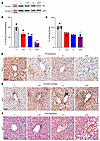 Figure 3
The combined effects of obesity and estrogen on the downregulation of PS in mouse liver. (A) Immunoblot showing the effects of estrogen and obesity on the expression of PS in different mice liver samples. eEF2, Eukaryotic elongation factor 2. Relative PS levels were determined by immunoblotting (B), ELISA (C), and IHC staining (D). Histological representation shows thrombin formation (E) and fibrin deposition (F) in mouse liver samples. Original magnification, ×400 (scale bars: 60 μm). n = 3 replicates of liver samples isolated from each mouse group. *P < 0.05 and **P < 0.01.
Estrogen with obesity upregulates thrombin formation and fibrin deposition in mouse livers. Next, we performed IHC to determine the effect of PS downregulation on thrombin formation. Analysis of mouse liver samples showed similar patterns in thrombin formation and intensity (Figure 3E and Supplemental Figure 3B), particularly at hepatocytes adjacent to the centrilobular vein in both L+E mice (Figure 3E, second panel) and O mice (Figure 3E, third panel) compared with control L mice. In O+E mice (Figure 3E, fourth panel), thrombin formation was substanially higher, particularly at the perivascular hepatocytes. Furthermore, analysis of fibrin with Martius Scarlet Blue staining (Figure 3F) showed no fibrin deposition in either the L or L+E mice. However, we observed newly deposited fibrin (yellowish color) in O and O+E mouse samples, in which fibrin occluded the lumen of numerous portals and centrilobular veins.
RNA-Seq and differential gene expression. We performed whole-transcriptome RNA-Seq to identify genes regulated by estrogen and obesity in mouse liver. The heatmap generated showed substantial transcriptome differences between L+E (Figure 4A) and O+E (Figure 4B) mice compared with the L and O controls. The enrichment score of pathway analysis showed a significant upregulation in the steroid hormone biosynthesis pathway in estrogen-pelleted L+E mice (Figure 4C), whereas in O+E mice, we observed an upregulation in the complement and coagulation cascades (Figure 4D).
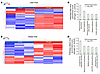 Figure 4
The effect of estrogen and obesity on the modulation of gene transcription. Heat map of differentially expressed genes identified in control (L) versus estrogen (L+E) mice (A) and O+E mice (B). Enrichment analysis of the top 5 pathways identified in estrogen versus lean (C) and obese (D) mice with a statistical significance of FDR ≤ 0.05. Heatmaps show differentially expressed genes and pathways that were identified by Partek Flow (DESEQ2). n = 3 replicates of liver samples isolated from each mouse group.
Estrogen downregulates PS in HepG2 cells. To determine the effect of estrogen on PS expression, HepG2 cells were treated with various β-estradiol concentrations (5–150 nM) for 4 hours, and the expression of PS was measured by immunoblotting and RT-qPCR. Incubation of cells with lower estrogen concentrations (5–30 nM) (Figure 5A) resulted in a significant 60%–70% reduction in PS expression (Figure 5B) and mRNA levels (Figure 5C), particularly at 25–30 nM. At higher estrogen concentrations (50–150 nM), a similar pattern of reduction (Supplemental Figure 5A) reaching 70% was also observed in PS expression (Supplemental Figure 5B) and mRNA levels (Supplemental Figure 5C). We noticed that the maximal inhibitory effect on PS expression was achieved between 25–30 nM, and this concentration is also typically found in low-dose estrogen-containing contraceptive pills used by premenopausal women (42). Therefore, we conducted further experiments using an estrogen concentration of 25 nM.
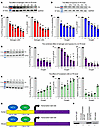 Figure 5
Estrogen and hypoxia downregulate PS expression and mRNA levels in HepG2 cells. (A and D) Estrogen-treated (5–30 nM) or hypoxia-induced (10%–1%) HepG2 cells were lysed and separated by SDS-PAGE, and the transferred proteins were probed with either PS or GAPDH to determine the effects on PS levels. Quantification of relative PS expression by immunoblotting (B and E) and mRNA levels by RT-qPCR (C and F). The combined effects of estrogen (25 nM) and oxygen concentrations (10%–1%) on the downregulation of PS were quantified (G), and relative PS expression was determined by immunoblotting (H), RT-qPCR (I), and luciferase assay (J). The reverse effect of 30 μM fulvestrant on PS levels was quantified (K), and relative PS expression was determined by immunoblotting (L), RT-qPCR (M), and luciferase assay (N). (O) Schematic diagram illustrating the possible binding sites of HIF1α on the PS promoter at position –631 to –626 in humans and at –628 to –622 in mice, respectively. (P) ChIP assay indicates the HIF1α binding site within the PS promoter. Lane 1: The presence of the PS amplicon indicates that HIF1α interacted with the PS promoter. Lane 2: Input DNA (isotype control). Lane 3: Absence of the PS promoter amplicon in the control antibody immunoprecipitation indicates the specificity of interaction of HIF1α with the PS promoter. Lane 4: DNA ladder. The bands were quantified by ImageJ software (NIH). The values shown are the mean ± SD of at least 3 independent experiments. Statistical significance was performed by 1-way ANOVA with Kruskal-Wallis correction, since data did not follow a normal distribution (*P < 0.05 and **P < 0.01). C, control.
Hypoxia downregulates PS in HepG2 cells. We have previously shown that PS expression is downregulated under hypoxic conditions (33). To simulate the hypoxic effects associated with obesity, hypoxia in HepG2 cells was induced by various oxygen concentrations (10%–1%) for 4 hours in a hypoxia chamber. Immunoblot analysis of hypoxia-induced cells (Figure 5D) resulted in a gradual reduction in PS expression (Figure 5E) and mRNA levels (Figure 5F), reaching 55%–60% at 1% O2, respectively. It was reported that cobalt chloride (CoCl2) stabilizes HIF1α, thereby mimicking hypoxia (43, 44). To independently confirm the effects of hypoxia on the downregulation of PS expression, we treated HepG2 cells with various concentrations (25–150 μM) of CoCl2 for 4 hours (Supplemental Figure 5D). Data analysis of immunoblots and RT-qPCR showed that 50 μM CoCl2 resulted in a significant 60%–65% reduction in both PS expression (Supplemental Figure 5E) and mRNA levels (Supplemental Figure 5F). However, higher CoCl2 concentrations did not exert significant inhibitory effects on the expression of PS.
Estrogen and hypoxia synergistically downregulate PS in HepG2 cells. To examine the combined effects of estrogen and hypoxia on the downregulation of PS, we treated HepG2 cells with 25 nM estrogen and incubated them under different hypoxic concentrations (10%–1% O2) for 4 hours. Immunoblot quantification (Figure 5G) showed a reduction in PS expression across all O2 concentrations, particularly at 1% O2, which resulted in a 78% reduction in PS expression (Figure 5H) and a 73% reduction in PS mRNA levels (Figure 5I). Next, the PS gene promoter region was subcloned into a luciferase reporter vector to examine the regulation of PS expression by HIF1α and ERα. Measurement of PS promoter activity also confirmed that both estrogen and hypoxia downregulated PS by 90% at 1% O2 (Figure 5J). Furthermore, by incubating the cells with 25 nM estrogen and 50 μM CoCl2 (Supplemental Figure 5G), we further confirmed the combined effect of hypoxia and estrogen on the downregulation of PS expression (Supplemental Figure 5H) and mRNA levels (Supplemental Figure 5I).
HIF1α binds the PS gene promoter and targets its downregulation in HepG2 cells. It has been reported that ERα represses PS expression by binding to the PS promoter at –176 to –146 in humans and at –138 to –105 in mice (6). HIF1α is a transcription factor that responds to hypoxia by inducing protective genes, but it also functions as a repressor of a small set of genes, including PS, as we have previously reported (33). However, the mechanism of PS gene repression by HIF1α has not, to our knowledge, been resolved at the molecular level. To identify the molecular mechanism, HepG2 cells were incubated for 4 hours with 50 μM CoCl2 to stabilize HIF1α and induce a hypoxia-like state. The binding of HIF1α to the PS gene promoter was confirmed by a ChIP assay (Figure 5O). The putative HIF1α binding site (ACTCG) in the promoter region of PS at position –631 to –626 in humans and –628 to –622 in mice (Figure 5P) was identified using ConSite and Genomatrix software. Note that these presumptive binding sites are in close proximity (~400–500 bp) to the established ERα binding sites (6, 45).
Fulvestrant abolishes estrogen-mediated PS downregulation in HepG2 cells. Fulvestrant is a β-estradiol analog and a selective antagonist that blocks ERα from binding to DNA and accelerates ERα degradation (46, 47). To reverse the effect of estrogen on the downregulation of PS, HepG2 cells were incubated with 25 nM estrogen under various hypoxic conditions (10%–1%), followed by 30 nM fulvestrant (Figure 5K). Both estrogen and hypoxia markedly reduce Protein S (PS) levels; therefore, we used both conditions to assess whether they contribute equally to PS downregulation. Fulvestrant-treated HepG2 cells showed a 56% increase in PS expression (Figure 5L), a 93% increase in mRNA levels (Figure 5M), and a 54% increase in luciferase promoter activity (Figure 5N) at 1% O2 compared with increases of 29% (Figure 5H), 18% (Figure 5I), and 36% (Figure 5J) without fulvestrant treatment, respectively.
CAY10585 abolishes hypoxia-mediated PS downregulation in HepG2 cells. To reverse the effects of hypoxia-mediated PS downregulation, we treated HepG2 cells with 25 nM estrogen under various hypoxic conditions (10%–1%), followed by 30 μM of the HIF1α inhibitor CAY10585 (Supplemental Figure 5J). Analysis of immunoblot and RT-qPCR data showed a 48% increase in PS expression (Supplemental Figure 5K) and a 52% increase in mRNA levels (Supplemental Figure 5L) at 1% O2 compared with 37% (Figure 5E) and 23% (Figure 5F) without CAY10585 treatment, respectively.
RNA-Seq and differential gene expression. Heatmap analysis of induced hypoxia (Supplemental Figure 6A), estrogen treatment (Supplemental Figure 6C), and the synergism of both treatments (Supplemental Figure 6E) showed that differential expression of genes was affected by estrogen and/or hypoxia treatment. Analysis of enrichment scores for hypoxia-induced HepG2 cells showed an upregulation in the HIF1α signaling pathway (Supplemental Figure 6B), while the metabolic pathways were upregulated in estrogen-treated cells (Supplemental Figure 6D). Moreover, the combined effects of estrogen and hypoxia resulted in the upregulation of both cell-cycle and metabolic pathways, with an enrichment score of 17.5 (Supplemental Figure 6F).


Copyright © 2026 American Society for Clinical Investigation
ISSN: 0021-9738 (print), 1558-8238 (online)