
Go to JCI Insight
  • About
  • Editors
  • Consulting Editors
  • For authors
  • Publication ethics
  • Publication alerts by email
  • Advertising
  • Job board
  • Contact
  • Clinical Research and Public Health
  • Current issue
  • Past issues
  • By specialty
    • COVID-19
    • Cardiology
    • Gastroenterology
    • Immunology
    • Metabolism
    • Nephrology
    • Neuroscience
    • Oncology
    • Pulmonology
    • Vascular biology
    • All ...
  • Videos
    • ASCI Milestone Awards
    • Video Abstracts
    • Conversations with Giants in Medicine
  • Reviews
    • View all reviews ...
    • The cGAS-STING pathway: DNA sensing in health and disease (Jun 2026)
    • Neurodegeneration (Mar 2026)
    • Clinical innovation and scientific progress in GLP-1 medicine (Nov 2025)
    • Pancreatic Cancer (Jul 2025)
    • Complement Biology and Therapeutics (May 2025)
    • Evolving insights into MASLD and MASH pathogenesis and treatment (Apr 2025)
    • Microbiome in Health and Disease (Feb 2025)
    • View all review series ...
  • Viewpoint
  • Collections
    • In-Press Preview
    • Clinical Research and Public Health
    • Research Letters
    • Letters to the Editor
    • Editorials
    • Commentaries
    • Editor's notes
    • Reviews
    • Viewpoints
    • 100th anniversary
    • Top read articles

  • Current issue
  • Past issues
  • Specialties
  • Reviews
  • Review series
  • ASCI Milestone Awards
  • Video Abstracts
  • Conversations with Giants in Medicine
  • In-Press Preview
  • Clinical Research and Public Health
  • Research Letters
  • Letters to the Editor
  • Editorials
  • Commentaries
  • Editor's notes
  • Reviews
  • Viewpoints
  • 100th anniversary
  • Top read articles
  • About
  • Editors
  • Consulting Editors
  • For authors
  • Publication ethics
  • Publication alerts by email
  • Advertising
  • Job board
  • Contact
The N-terminus of apolipoprotein B mediates the interaction of atherogenic lipoproteins with endothelial cells
Ainara G. Cabodevilla, Camila Calistru, Waqas Younis, Dimitris Nasias, Tse W.W. Ho, Narasimha Anaganti, Swati Valmiki, Sujith Rajan, Jana Gjini, Rufina Kore, Carmen Hannemann, Nicholas O. Davidson, Tomas Vaisar, Jenny E. Kanter, Karin E. Bornfeldt, Edward A. Fisher, Warren L. Lee, Tobias Madl, M. Mahmood Hussain, Ira J. Goldberg
View: Text | PDF
Research Article Metabolism Vascular biology

The N-terminus of apolipoprotein B mediates the interaction of atherogenic lipoproteins with endothelial cells

  • Text
  • PDF
Abstract

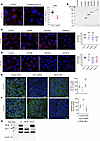
Apolipoprotein B–containing (APOB-containing) lipoproteins contribute to atherosclerosis by entering the arterial wall through the endothelial cell (EC) surface receptors scavenger receptor-BI (SR-BI) and activin receptor-like kinase 1 (ALK1). We used N-terminal fragments of APOB, molecular modeling, and site-directed mutagenesis to identify and block the binding of chylomicrons and LDL to these receptors in cells and mice. We discovered that different APOB regions interact with SR-BI and ALK1 expressed on ECs. APOB48 lipoproteins were only internalized by SR-BI. A fragment of APOB comprising 18% of the N-terminal sequence, APOB18, reduced the uptake and transport of both chylomicrons and LDL by ECs, whereas a shorter fragment, APOB12, only blocked ALK1-mediated uptake of APOB100-containing lipoproteins. Importantly, overexpressing APOB18 decreased atherosclerosis in hypercholesterolemic mice. These findings identify the N-terminal region of APOB as the cause of atherosclerosis and illustrate an approach to treating or preventing vascular disease.

Authors

Ainara G. Cabodevilla, Camila Calistru, Waqas Younis, Dimitris Nasias, Tse W.W. Ho, Narasimha Anaganti, Swati Valmiki, Sujith Rajan, Jana Gjini, Rufina Kore, Carmen Hannemann, Nicholas O. Davidson, Tomas Vaisar, Jenny E. Kanter, Karin E. Bornfeldt, Edward A. Fisher, Warren L. Lee, Tobias Madl, M. Mahmood Hussain, Ira J. Goldberg

×
Problems with a PDF?

This file is in Adobe Acrobat (PDF) format. If you have not installed and configured the Adobe Acrobat Reader on your system.

Having trouble reading a PDF?

PDFs are designed to be printed out and read, but if you prefer to read them online, you may find it easier if you increase the view size to 125%.

Having trouble saving a PDF?

Many versions of the free Acrobat Reader do not allow Save. You must instead save the PDF from the JCI Online page you downloaded it from. PC users: Right-click on the Download link and choose the option that says something like "Save Link As...". Mac users should hold the mouse button down on the link to get these same options.

Having trouble printing a PDF?

  1. Try printing one page at a time or to a newer printer.
  2. Try saving the file to disk before printing rather than opening it "on the fly." This requires that you configure your browser to "Save" rather than "Launch Application" for the file type "application/pdf", and can usually be done in the "Helper Applications" options.
  3. Make sure you are using the latest version of Adobe's Acrobat Reader.

Supplemental data - Download (580.18 KB)

Advertisement

Copyright © 2026 American Society for Clinical Investigation
ISSN: 0021-9738 (print), 1558-8238 (online)

Sign up for email alerts