
Advertisement
Research ArticleClinical ResearchMetabolism
Open Access |  10.1172/JCI181299
Sulfite oxidase deficiency causes persulfidation loss and hydrogen sulfide release
Chun-Yu Fu,1 Joshua B. Kohl,1 Filip Liebsch,1 Davide D’Andrea,2 Tamás Ditrói,3 Seiryo Ogata,4 Franziska Neuser,1 Max Mai,1 Anna T. Mellis,1 Emilia Kouroussis,2 Masanobu Morita,4 Titus Gehling,1 José Angel Santamaria-Araujo,1 Sin Yuin Yeo,5 Heike Endepols,6,7,8 Michaela Křížková,9 Viktor Kozich,9 Marcus Krueger,10 Julia B. Hennermann,11 Uladzimir Barayeu,4,12 Takaaki Akaike,4 Peter Nagy,3,13,14 Milos Filipovic,2,15 and Guenter Schwarz1,16
1Institute of Biochemistry, Department of Chemistry and Biochemistry, University of Cologne, Cologne, Germany.
2Leibniz Institute for Analytical Sciences, ISAS e.V., Dortmund, Germany.
3Department of Molecular Immunology and Toxicology and the National Tumor Biology Laboratory, National Institute of Oncology, Budapest, Hungary.
4Department of Environmental Medicine and Molecular Toxicology, Tohoku University Graduate School of Medicine, Sendai, Japan.
5Institute of Diagnostic and Interventional Radiology,
6Institute of Radiochemistry and Experimental Molecular Imaging and
7Department of Nuclear Medicine, University of Cologne, Faculty of Medicine, and University Hospital Cologne, Cologne, Germany.
8Forschungszentrum Jülich GmbH, Institute of Neuroscience and Medicine, Nuclear Chemistry (INM-5), Jülich, Germany.
9Department of Pediatrics and Inherited Metabolic Disorders, Charles University, First Faculty of Medicine, and General University Hospital in Prague, Prague, Czech Republic.
10Institute of Genetics, Department of Biology and CECAD, University of Cologne, Cologne, Germany.
11Center for Pediatric and Adolescent Medicine, University Medical Center Mainz, Mainz, Germany.
12Max-Planck-Institute for Polymer Research, Mainz, Germany.
13Department of Anatomy and Histology, Hungarian Research Network–UVMB Laboratory of Redox Biology Research Group, University of Veterinary Medicine, Budapest, Hungary.
14Chemistry Institute, University of Debrecen, Debrecen, Hungary.
15School of Molecular Biosciences, University of Glasgow, Glasgow, United Kingdom.
16Center for Molecular Medicine Cologne, University of Cologne, Cologne, Germany.
Address correspondence to: Guenter Schwarz, Institute of Biochemistry, Department of Chemistry and Biochemistry, University of Cologne, Zuelpicher Str. 47, 50674 Cologne, Germany. Phone: 49.221.470.6440; Email: gschwarz@uni-koeln.de.
Authorship note: CYF and JBK contributed equally to this work.
Find articles by Fu, C. in: PubMed | Google Scholar
1Institute of Biochemistry, Department of Chemistry and Biochemistry, University of Cologne, Cologne, Germany.
2Leibniz Institute for Analytical Sciences, ISAS e.V., Dortmund, Germany.
3Department of Molecular Immunology and Toxicology and the National Tumor Biology Laboratory, National Institute of Oncology, Budapest, Hungary.
4Department of Environmental Medicine and Molecular Toxicology, Tohoku University Graduate School of Medicine, Sendai, Japan.
5Institute of Diagnostic and Interventional Radiology,
6Institute of Radiochemistry and Experimental Molecular Imaging and
7Department of Nuclear Medicine, University of Cologne, Faculty of Medicine, and University Hospital Cologne, Cologne, Germany.
8Forschungszentrum Jülich GmbH, Institute of Neuroscience and Medicine, Nuclear Chemistry (INM-5), Jülich, Germany.
9Department of Pediatrics and Inherited Metabolic Disorders, Charles University, First Faculty of Medicine, and General University Hospital in Prague, Prague, Czech Republic.
10Institute of Genetics, Department of Biology and CECAD, University of Cologne, Cologne, Germany.
11Center for Pediatric and Adolescent Medicine, University Medical Center Mainz, Mainz, Germany.
12Max-Planck-Institute for Polymer Research, Mainz, Germany.
13Department of Anatomy and Histology, Hungarian Research Network–UVMB Laboratory of Redox Biology Research Group, University of Veterinary Medicine, Budapest, Hungary.
14Chemistry Institute, University of Debrecen, Debrecen, Hungary.
15School of Molecular Biosciences, University of Glasgow, Glasgow, United Kingdom.
16Center for Molecular Medicine Cologne, University of Cologne, Cologne, Germany.
Address correspondence to: Guenter Schwarz, Institute of Biochemistry, Department of Chemistry and Biochemistry, University of Cologne, Zuelpicher Str. 47, 50674 Cologne, Germany. Phone: 49.221.470.6440; Email: gschwarz@uni-koeln.de.
Authorship note: CYF and JBK contributed equally to this work.
Find articles by Kohl, J. in: PubMed | Google Scholar
1Institute of Biochemistry, Department of Chemistry and Biochemistry, University of Cologne, Cologne, Germany.
2Leibniz Institute for Analytical Sciences, ISAS e.V., Dortmund, Germany.
3Department of Molecular Immunology and Toxicology and the National Tumor Biology Laboratory, National Institute of Oncology, Budapest, Hungary.
4Department of Environmental Medicine and Molecular Toxicology, Tohoku University Graduate School of Medicine, Sendai, Japan.
5Institute of Diagnostic and Interventional Radiology,
6Institute of Radiochemistry and Experimental Molecular Imaging and
7Department of Nuclear Medicine, University of Cologne, Faculty of Medicine, and University Hospital Cologne, Cologne, Germany.
8Forschungszentrum Jülich GmbH, Institute of Neuroscience and Medicine, Nuclear Chemistry (INM-5), Jülich, Germany.
9Department of Pediatrics and Inherited Metabolic Disorders, Charles University, First Faculty of Medicine, and General University Hospital in Prague, Prague, Czech Republic.
10Institute of Genetics, Department of Biology and CECAD, University of Cologne, Cologne, Germany.
11Center for Pediatric and Adolescent Medicine, University Medical Center Mainz, Mainz, Germany.
12Max-Planck-Institute for Polymer Research, Mainz, Germany.
13Department of Anatomy and Histology, Hungarian Research Network–UVMB Laboratory of Redox Biology Research Group, University of Veterinary Medicine, Budapest, Hungary.
14Chemistry Institute, University of Debrecen, Debrecen, Hungary.
15School of Molecular Biosciences, University of Glasgow, Glasgow, United Kingdom.
16Center for Molecular Medicine Cologne, University of Cologne, Cologne, Germany.
Address correspondence to: Guenter Schwarz, Institute of Biochemistry, Department of Chemistry and Biochemistry, University of Cologne, Zuelpicher Str. 47, 50674 Cologne, Germany. Phone: 49.221.470.6440; Email: gschwarz@uni-koeln.de.
Authorship note: CYF and JBK contributed equally to this work.
Find articles by Liebsch, F. in: PubMed | Google Scholar
1Institute of Biochemistry, Department of Chemistry and Biochemistry, University of Cologne, Cologne, Germany.
2Leibniz Institute for Analytical Sciences, ISAS e.V., Dortmund, Germany.
3Department of Molecular Immunology and Toxicology and the National Tumor Biology Laboratory, National Institute of Oncology, Budapest, Hungary.
4Department of Environmental Medicine and Molecular Toxicology, Tohoku University Graduate School of Medicine, Sendai, Japan.
5Institute of Diagnostic and Interventional Radiology,
6Institute of Radiochemistry and Experimental Molecular Imaging and
7Department of Nuclear Medicine, University of Cologne, Faculty of Medicine, and University Hospital Cologne, Cologne, Germany.
8Forschungszentrum Jülich GmbH, Institute of Neuroscience and Medicine, Nuclear Chemistry (INM-5), Jülich, Germany.
9Department of Pediatrics and Inherited Metabolic Disorders, Charles University, First Faculty of Medicine, and General University Hospital in Prague, Prague, Czech Republic.
10Institute of Genetics, Department of Biology and CECAD, University of Cologne, Cologne, Germany.
11Center for Pediatric and Adolescent Medicine, University Medical Center Mainz, Mainz, Germany.
12Max-Planck-Institute for Polymer Research, Mainz, Germany.
13Department of Anatomy and Histology, Hungarian Research Network–UVMB Laboratory of Redox Biology Research Group, University of Veterinary Medicine, Budapest, Hungary.
14Chemistry Institute, University of Debrecen, Debrecen, Hungary.
15School of Molecular Biosciences, University of Glasgow, Glasgow, United Kingdom.
16Center for Molecular Medicine Cologne, University of Cologne, Cologne, Germany.
Address correspondence to: Guenter Schwarz, Institute of Biochemistry, Department of Chemistry and Biochemistry, University of Cologne, Zuelpicher Str. 47, 50674 Cologne, Germany. Phone: 49.221.470.6440; Email: gschwarz@uni-koeln.de.
Authorship note: CYF and JBK contributed equally to this work.
Find articles by D’Andrea, D. in: PubMed | Google Scholar
1Institute of Biochemistry, Department of Chemistry and Biochemistry, University of Cologne, Cologne, Germany.
2Leibniz Institute for Analytical Sciences, ISAS e.V., Dortmund, Germany.
3Department of Molecular Immunology and Toxicology and the National Tumor Biology Laboratory, National Institute of Oncology, Budapest, Hungary.
4Department of Environmental Medicine and Molecular Toxicology, Tohoku University Graduate School of Medicine, Sendai, Japan.
5Institute of Diagnostic and Interventional Radiology,
6Institute of Radiochemistry and Experimental Molecular Imaging and
7Department of Nuclear Medicine, University of Cologne, Faculty of Medicine, and University Hospital Cologne, Cologne, Germany.
8Forschungszentrum Jülich GmbH, Institute of Neuroscience and Medicine, Nuclear Chemistry (INM-5), Jülich, Germany.
9Department of Pediatrics and Inherited Metabolic Disorders, Charles University, First Faculty of Medicine, and General University Hospital in Prague, Prague, Czech Republic.
10Institute of Genetics, Department of Biology and CECAD, University of Cologne, Cologne, Germany.
11Center for Pediatric and Adolescent Medicine, University Medical Center Mainz, Mainz, Germany.
12Max-Planck-Institute for Polymer Research, Mainz, Germany.
13Department of Anatomy and Histology, Hungarian Research Network–UVMB Laboratory of Redox Biology Research Group, University of Veterinary Medicine, Budapest, Hungary.
14Chemistry Institute, University of Debrecen, Debrecen, Hungary.
15School of Molecular Biosciences, University of Glasgow, Glasgow, United Kingdom.
16Center for Molecular Medicine Cologne, University of Cologne, Cologne, Germany.
Address correspondence to: Guenter Schwarz, Institute of Biochemistry, Department of Chemistry and Biochemistry, University of Cologne, Zuelpicher Str. 47, 50674 Cologne, Germany. Phone: 49.221.470.6440; Email: gschwarz@uni-koeln.de.
Authorship note: CYF and JBK contributed equally to this work.
Find articles by Ditrói, T. in: PubMed | Google Scholar
1Institute of Biochemistry, Department of Chemistry and Biochemistry, University of Cologne, Cologne, Germany.
2Leibniz Institute for Analytical Sciences, ISAS e.V., Dortmund, Germany.
3Department of Molecular Immunology and Toxicology and the National Tumor Biology Laboratory, National Institute of Oncology, Budapest, Hungary.
4Department of Environmental Medicine and Molecular Toxicology, Tohoku University Graduate School of Medicine, Sendai, Japan.
5Institute of Diagnostic and Interventional Radiology,
6Institute of Radiochemistry and Experimental Molecular Imaging and
7Department of Nuclear Medicine, University of Cologne, Faculty of Medicine, and University Hospital Cologne, Cologne, Germany.
8Forschungszentrum Jülich GmbH, Institute of Neuroscience and Medicine, Nuclear Chemistry (INM-5), Jülich, Germany.
9Department of Pediatrics and Inherited Metabolic Disorders, Charles University, First Faculty of Medicine, and General University Hospital in Prague, Prague, Czech Republic.
10Institute of Genetics, Department of Biology and CECAD, University of Cologne, Cologne, Germany.
11Center for Pediatric and Adolescent Medicine, University Medical Center Mainz, Mainz, Germany.
12Max-Planck-Institute for Polymer Research, Mainz, Germany.
13Department of Anatomy and Histology, Hungarian Research Network–UVMB Laboratory of Redox Biology Research Group, University of Veterinary Medicine, Budapest, Hungary.
14Chemistry Institute, University of Debrecen, Debrecen, Hungary.
15School of Molecular Biosciences, University of Glasgow, Glasgow, United Kingdom.
16Center for Molecular Medicine Cologne, University of Cologne, Cologne, Germany.
Address correspondence to: Guenter Schwarz, Institute of Biochemistry, Department of Chemistry and Biochemistry, University of Cologne, Zuelpicher Str. 47, 50674 Cologne, Germany. Phone: 49.221.470.6440; Email: gschwarz@uni-koeln.de.
Authorship note: CYF and JBK contributed equally to this work.
Find articles by Ogata, S. in: PubMed | Google Scholar
1Institute of Biochemistry, Department of Chemistry and Biochemistry, University of Cologne, Cologne, Germany.
2Leibniz Institute for Analytical Sciences, ISAS e.V., Dortmund, Germany.
3Department of Molecular Immunology and Toxicology and the National Tumor Biology Laboratory, National Institute of Oncology, Budapest, Hungary.
4Department of Environmental Medicine and Molecular Toxicology, Tohoku University Graduate School of Medicine, Sendai, Japan.
5Institute of Diagnostic and Interventional Radiology,
6Institute of Radiochemistry and Experimental Molecular Imaging and
7Department of Nuclear Medicine, University of Cologne, Faculty of Medicine, and University Hospital Cologne, Cologne, Germany.
8Forschungszentrum Jülich GmbH, Institute of Neuroscience and Medicine, Nuclear Chemistry (INM-5), Jülich, Germany.
9Department of Pediatrics and Inherited Metabolic Disorders, Charles University, First Faculty of Medicine, and General University Hospital in Prague, Prague, Czech Republic.
10Institute of Genetics, Department of Biology and CECAD, University of Cologne, Cologne, Germany.
11Center for Pediatric and Adolescent Medicine, University Medical Center Mainz, Mainz, Germany.
12Max-Planck-Institute for Polymer Research, Mainz, Germany.
13Department of Anatomy and Histology, Hungarian Research Network–UVMB Laboratory of Redox Biology Research Group, University of Veterinary Medicine, Budapest, Hungary.
14Chemistry Institute, University of Debrecen, Debrecen, Hungary.
15School of Molecular Biosciences, University of Glasgow, Glasgow, United Kingdom.
16Center for Molecular Medicine Cologne, University of Cologne, Cologne, Germany.
Address correspondence to: Guenter Schwarz, Institute of Biochemistry, Department of Chemistry and Biochemistry, University of Cologne, Zuelpicher Str. 47, 50674 Cologne, Germany. Phone: 49.221.470.6440; Email: gschwarz@uni-koeln.de.
Authorship note: CYF and JBK contributed equally to this work.
Find articles by Neuser, F. in: PubMed | Google Scholar
1Institute of Biochemistry, Department of Chemistry and Biochemistry, University of Cologne, Cologne, Germany.
2Leibniz Institute for Analytical Sciences, ISAS e.V., Dortmund, Germany.
3Department of Molecular Immunology and Toxicology and the National Tumor Biology Laboratory, National Institute of Oncology, Budapest, Hungary.
4Department of Environmental Medicine and Molecular Toxicology, Tohoku University Graduate School of Medicine, Sendai, Japan.
5Institute of Diagnostic and Interventional Radiology,
6Institute of Radiochemistry and Experimental Molecular Imaging and
7Department of Nuclear Medicine, University of Cologne, Faculty of Medicine, and University Hospital Cologne, Cologne, Germany.
8Forschungszentrum Jülich GmbH, Institute of Neuroscience and Medicine, Nuclear Chemistry (INM-5), Jülich, Germany.
9Department of Pediatrics and Inherited Metabolic Disorders, Charles University, First Faculty of Medicine, and General University Hospital in Prague, Prague, Czech Republic.
10Institute of Genetics, Department of Biology and CECAD, University of Cologne, Cologne, Germany.
11Center for Pediatric and Adolescent Medicine, University Medical Center Mainz, Mainz, Germany.
12Max-Planck-Institute for Polymer Research, Mainz, Germany.
13Department of Anatomy and Histology, Hungarian Research Network–UVMB Laboratory of Redox Biology Research Group, University of Veterinary Medicine, Budapest, Hungary.
14Chemistry Institute, University of Debrecen, Debrecen, Hungary.
15School of Molecular Biosciences, University of Glasgow, Glasgow, United Kingdom.
16Center for Molecular Medicine Cologne, University of Cologne, Cologne, Germany.
Address correspondence to: Guenter Schwarz, Institute of Biochemistry, Department of Chemistry and Biochemistry, University of Cologne, Zuelpicher Str. 47, 50674 Cologne, Germany. Phone: 49.221.470.6440; Email: gschwarz@uni-koeln.de.
Authorship note: CYF and JBK contributed equally to this work.
Find articles by Mai, M. in: PubMed | Google Scholar
1Institute of Biochemistry, Department of Chemistry and Biochemistry, University of Cologne, Cologne, Germany.
2Leibniz Institute for Analytical Sciences, ISAS e.V., Dortmund, Germany.
3Department of Molecular Immunology and Toxicology and the National Tumor Biology Laboratory, National Institute of Oncology, Budapest, Hungary.
4Department of Environmental Medicine and Molecular Toxicology, Tohoku University Graduate School of Medicine, Sendai, Japan.
5Institute of Diagnostic and Interventional Radiology,
6Institute of Radiochemistry and Experimental Molecular Imaging and
7Department of Nuclear Medicine, University of Cologne, Faculty of Medicine, and University Hospital Cologne, Cologne, Germany.
8Forschungszentrum Jülich GmbH, Institute of Neuroscience and Medicine, Nuclear Chemistry (INM-5), Jülich, Germany.
9Department of Pediatrics and Inherited Metabolic Disorders, Charles University, First Faculty of Medicine, and General University Hospital in Prague, Prague, Czech Republic.
10Institute of Genetics, Department of Biology and CECAD, University of Cologne, Cologne, Germany.
11Center for Pediatric and Adolescent Medicine, University Medical Center Mainz, Mainz, Germany.
12Max-Planck-Institute for Polymer Research, Mainz, Germany.
13Department of Anatomy and Histology, Hungarian Research Network–UVMB Laboratory of Redox Biology Research Group, University of Veterinary Medicine, Budapest, Hungary.
14Chemistry Institute, University of Debrecen, Debrecen, Hungary.
15School of Molecular Biosciences, University of Glasgow, Glasgow, United Kingdom.
16Center for Molecular Medicine Cologne, University of Cologne, Cologne, Germany.
Address correspondence to: Guenter Schwarz, Institute of Biochemistry, Department of Chemistry and Biochemistry, University of Cologne, Zuelpicher Str. 47, 50674 Cologne, Germany. Phone: 49.221.470.6440; Email: gschwarz@uni-koeln.de.
Authorship note: CYF and JBK contributed equally to this work.
Find articles by Mellis, A. in: PubMed | Google Scholar
1Institute of Biochemistry, Department of Chemistry and Biochemistry, University of Cologne, Cologne, Germany.
2Leibniz Institute for Analytical Sciences, ISAS e.V., Dortmund, Germany.
3Department of Molecular Immunology and Toxicology and the National Tumor Biology Laboratory, National Institute of Oncology, Budapest, Hungary.
4Department of Environmental Medicine and Molecular Toxicology, Tohoku University Graduate School of Medicine, Sendai, Japan.
5Institute of Diagnostic and Interventional Radiology,
6Institute of Radiochemistry and Experimental Molecular Imaging and
7Department of Nuclear Medicine, University of Cologne, Faculty of Medicine, and University Hospital Cologne, Cologne, Germany.
8Forschungszentrum Jülich GmbH, Institute of Neuroscience and Medicine, Nuclear Chemistry (INM-5), Jülich, Germany.
9Department of Pediatrics and Inherited Metabolic Disorders, Charles University, First Faculty of Medicine, and General University Hospital in Prague, Prague, Czech Republic.
10Institute of Genetics, Department of Biology and CECAD, University of Cologne, Cologne, Germany.
11Center for Pediatric and Adolescent Medicine, University Medical Center Mainz, Mainz, Germany.
12Max-Planck-Institute for Polymer Research, Mainz, Germany.
13Department of Anatomy and Histology, Hungarian Research Network–UVMB Laboratory of Redox Biology Research Group, University of Veterinary Medicine, Budapest, Hungary.
14Chemistry Institute, University of Debrecen, Debrecen, Hungary.
15School of Molecular Biosciences, University of Glasgow, Glasgow, United Kingdom.
16Center for Molecular Medicine Cologne, University of Cologne, Cologne, Germany.
Address correspondence to: Guenter Schwarz, Institute of Biochemistry, Department of Chemistry and Biochemistry, University of Cologne, Zuelpicher Str. 47, 50674 Cologne, Germany. Phone: 49.221.470.6440; Email: gschwarz@uni-koeln.de.
Authorship note: CYF and JBK contributed equally to this work.
Find articles by Kouroussis, E. in: PubMed | Google Scholar
1Institute of Biochemistry, Department of Chemistry and Biochemistry, University of Cologne, Cologne, Germany.
2Leibniz Institute for Analytical Sciences, ISAS e.V., Dortmund, Germany.
3Department of Molecular Immunology and Toxicology and the National Tumor Biology Laboratory, National Institute of Oncology, Budapest, Hungary.
4Department of Environmental Medicine and Molecular Toxicology, Tohoku University Graduate School of Medicine, Sendai, Japan.
5Institute of Diagnostic and Interventional Radiology,
6Institute of Radiochemistry and Experimental Molecular Imaging and
7Department of Nuclear Medicine, University of Cologne, Faculty of Medicine, and University Hospital Cologne, Cologne, Germany.
8Forschungszentrum Jülich GmbH, Institute of Neuroscience and Medicine, Nuclear Chemistry (INM-5), Jülich, Germany.
9Department of Pediatrics and Inherited Metabolic Disorders, Charles University, First Faculty of Medicine, and General University Hospital in Prague, Prague, Czech Republic.
10Institute of Genetics, Department of Biology and CECAD, University of Cologne, Cologne, Germany.
11Center for Pediatric and Adolescent Medicine, University Medical Center Mainz, Mainz, Germany.
12Max-Planck-Institute for Polymer Research, Mainz, Germany.
13Department of Anatomy and Histology, Hungarian Research Network–UVMB Laboratory of Redox Biology Research Group, University of Veterinary Medicine, Budapest, Hungary.
14Chemistry Institute, University of Debrecen, Debrecen, Hungary.
15School of Molecular Biosciences, University of Glasgow, Glasgow, United Kingdom.
16Center for Molecular Medicine Cologne, University of Cologne, Cologne, Germany.
Address correspondence to: Guenter Schwarz, Institute of Biochemistry, Department of Chemistry and Biochemistry, University of Cologne, Zuelpicher Str. 47, 50674 Cologne, Germany. Phone: 49.221.470.6440; Email: gschwarz@uni-koeln.de.
Authorship note: CYF and JBK contributed equally to this work.
Find articles by Morita, M. in: PubMed | Google Scholar
1Institute of Biochemistry, Department of Chemistry and Biochemistry, University of Cologne, Cologne, Germany.
2Leibniz Institute for Analytical Sciences, ISAS e.V., Dortmund, Germany.
3Department of Molecular Immunology and Toxicology and the National Tumor Biology Laboratory, National Institute of Oncology, Budapest, Hungary.
4Department of Environmental Medicine and Molecular Toxicology, Tohoku University Graduate School of Medicine, Sendai, Japan.
5Institute of Diagnostic and Interventional Radiology,
6Institute of Radiochemistry and Experimental Molecular Imaging and
7Department of Nuclear Medicine, University of Cologne, Faculty of Medicine, and University Hospital Cologne, Cologne, Germany.
8Forschungszentrum Jülich GmbH, Institute of Neuroscience and Medicine, Nuclear Chemistry (INM-5), Jülich, Germany.
9Department of Pediatrics and Inherited Metabolic Disorders, Charles University, First Faculty of Medicine, and General University Hospital in Prague, Prague, Czech Republic.
10Institute of Genetics, Department of Biology and CECAD, University of Cologne, Cologne, Germany.
11Center for Pediatric and Adolescent Medicine, University Medical Center Mainz, Mainz, Germany.
12Max-Planck-Institute for Polymer Research, Mainz, Germany.
13Department of Anatomy and Histology, Hungarian Research Network–UVMB Laboratory of Redox Biology Research Group, University of Veterinary Medicine, Budapest, Hungary.
14Chemistry Institute, University of Debrecen, Debrecen, Hungary.
15School of Molecular Biosciences, University of Glasgow, Glasgow, United Kingdom.
16Center for Molecular Medicine Cologne, University of Cologne, Cologne, Germany.
Address correspondence to: Guenter Schwarz, Institute of Biochemistry, Department of Chemistry and Biochemistry, University of Cologne, Zuelpicher Str. 47, 50674 Cologne, Germany. Phone: 49.221.470.6440; Email: gschwarz@uni-koeln.de.
Authorship note: CYF and JBK contributed equally to this work.
Find articles by Gehling, T. in: PubMed | Google Scholar
1Institute of Biochemistry, Department of Chemistry and Biochemistry, University of Cologne, Cologne, Germany.
2Leibniz Institute for Analytical Sciences, ISAS e.V., Dortmund, Germany.
3Department of Molecular Immunology and Toxicology and the National Tumor Biology Laboratory, National Institute of Oncology, Budapest, Hungary.
4Department of Environmental Medicine and Molecular Toxicology, Tohoku University Graduate School of Medicine, Sendai, Japan.
5Institute of Diagnostic and Interventional Radiology,
6Institute of Radiochemistry and Experimental Molecular Imaging and
7Department of Nuclear Medicine, University of Cologne, Faculty of Medicine, and University Hospital Cologne, Cologne, Germany.
8Forschungszentrum Jülich GmbH, Institute of Neuroscience and Medicine, Nuclear Chemistry (INM-5), Jülich, Germany.
9Department of Pediatrics and Inherited Metabolic Disorders, Charles University, First Faculty of Medicine, and General University Hospital in Prague, Prague, Czech Republic.
10Institute of Genetics, Department of Biology and CECAD, University of Cologne, Cologne, Germany.
11Center for Pediatric and Adolescent Medicine, University Medical Center Mainz, Mainz, Germany.
12Max-Planck-Institute for Polymer Research, Mainz, Germany.
13Department of Anatomy and Histology, Hungarian Research Network–UVMB Laboratory of Redox Biology Research Group, University of Veterinary Medicine, Budapest, Hungary.
14Chemistry Institute, University of Debrecen, Debrecen, Hungary.
15School of Molecular Biosciences, University of Glasgow, Glasgow, United Kingdom.
16Center for Molecular Medicine Cologne, University of Cologne, Cologne, Germany.
Address correspondence to: Guenter Schwarz, Institute of Biochemistry, Department of Chemistry and Biochemistry, University of Cologne, Zuelpicher Str. 47, 50674 Cologne, Germany. Phone: 49.221.470.6440; Email: gschwarz@uni-koeln.de.
Authorship note: CYF and JBK contributed equally to this work.
Find articles by Santamaria-Araujo, J. in: PubMed | Google Scholar
1Institute of Biochemistry, Department of Chemistry and Biochemistry, University of Cologne, Cologne, Germany.
2Leibniz Institute for Analytical Sciences, ISAS e.V., Dortmund, Germany.
3Department of Molecular Immunology and Toxicology and the National Tumor Biology Laboratory, National Institute of Oncology, Budapest, Hungary.
4Department of Environmental Medicine and Molecular Toxicology, Tohoku University Graduate School of Medicine, Sendai, Japan.
5Institute of Diagnostic and Interventional Radiology,
6Institute of Radiochemistry and Experimental Molecular Imaging and
7Department of Nuclear Medicine, University of Cologne, Faculty of Medicine, and University Hospital Cologne, Cologne, Germany.
8Forschungszentrum Jülich GmbH, Institute of Neuroscience and Medicine, Nuclear Chemistry (INM-5), Jülich, Germany.
9Department of Pediatrics and Inherited Metabolic Disorders, Charles University, First Faculty of Medicine, and General University Hospital in Prague, Prague, Czech Republic.
10Institute of Genetics, Department of Biology and CECAD, University of Cologne, Cologne, Germany.
11Center for Pediatric and Adolescent Medicine, University Medical Center Mainz, Mainz, Germany.
12Max-Planck-Institute for Polymer Research, Mainz, Germany.
13Department of Anatomy and Histology, Hungarian Research Network–UVMB Laboratory of Redox Biology Research Group, University of Veterinary Medicine, Budapest, Hungary.
14Chemistry Institute, University of Debrecen, Debrecen, Hungary.
15School of Molecular Biosciences, University of Glasgow, Glasgow, United Kingdom.
16Center for Molecular Medicine Cologne, University of Cologne, Cologne, Germany.
Address correspondence to: Guenter Schwarz, Institute of Biochemistry, Department of Chemistry and Biochemistry, University of Cologne, Zuelpicher Str. 47, 50674 Cologne, Germany. Phone: 49.221.470.6440; Email: gschwarz@uni-koeln.de.
Authorship note: CYF and JBK contributed equally to this work.
Find articles by Yeo, S. in: PubMed | Google Scholar
1Institute of Biochemistry, Department of Chemistry and Biochemistry, University of Cologne, Cologne, Germany.
2Leibniz Institute for Analytical Sciences, ISAS e.V., Dortmund, Germany.
3Department of Molecular Immunology and Toxicology and the National Tumor Biology Laboratory, National Institute of Oncology, Budapest, Hungary.
4Department of Environmental Medicine and Molecular Toxicology, Tohoku University Graduate School of Medicine, Sendai, Japan.
5Institute of Diagnostic and Interventional Radiology,
6Institute of Radiochemistry and Experimental Molecular Imaging and
7Department of Nuclear Medicine, University of Cologne, Faculty of Medicine, and University Hospital Cologne, Cologne, Germany.
8Forschungszentrum Jülich GmbH, Institute of Neuroscience and Medicine, Nuclear Chemistry (INM-5), Jülich, Germany.
9Department of Pediatrics and Inherited Metabolic Disorders, Charles University, First Faculty of Medicine, and General University Hospital in Prague, Prague, Czech Republic.
10Institute of Genetics, Department of Biology and CECAD, University of Cologne, Cologne, Germany.
11Center for Pediatric and Adolescent Medicine, University Medical Center Mainz, Mainz, Germany.
12Max-Planck-Institute for Polymer Research, Mainz, Germany.
13Department of Anatomy and Histology, Hungarian Research Network–UVMB Laboratory of Redox Biology Research Group, University of Veterinary Medicine, Budapest, Hungary.
14Chemistry Institute, University of Debrecen, Debrecen, Hungary.
15School of Molecular Biosciences, University of Glasgow, Glasgow, United Kingdom.
16Center for Molecular Medicine Cologne, University of Cologne, Cologne, Germany.
Address correspondence to: Guenter Schwarz, Institute of Biochemistry, Department of Chemistry and Biochemistry, University of Cologne, Zuelpicher Str. 47, 50674 Cologne, Germany. Phone: 49.221.470.6440; Email: gschwarz@uni-koeln.de.
Authorship note: CYF and JBK contributed equally to this work.
Find articles by Endepols, H. in: PubMed | Google Scholar
1Institute of Biochemistry, Department of Chemistry and Biochemistry, University of Cologne, Cologne, Germany.
2Leibniz Institute for Analytical Sciences, ISAS e.V., Dortmund, Germany.
3Department of Molecular Immunology and Toxicology and the National Tumor Biology Laboratory, National Institute of Oncology, Budapest, Hungary.
4Department of Environmental Medicine and Molecular Toxicology, Tohoku University Graduate School of Medicine, Sendai, Japan.
5Institute of Diagnostic and Interventional Radiology,
6Institute of Radiochemistry and Experimental Molecular Imaging and
7Department of Nuclear Medicine, University of Cologne, Faculty of Medicine, and University Hospital Cologne, Cologne, Germany.
8Forschungszentrum Jülich GmbH, Institute of Neuroscience and Medicine, Nuclear Chemistry (INM-5), Jülich, Germany.
9Department of Pediatrics and Inherited Metabolic Disorders, Charles University, First Faculty of Medicine, and General University Hospital in Prague, Prague, Czech Republic.
10Institute of Genetics, Department of Biology and CECAD, University of Cologne, Cologne, Germany.
11Center for Pediatric and Adolescent Medicine, University Medical Center Mainz, Mainz, Germany.
12Max-Planck-Institute for Polymer Research, Mainz, Germany.
13Department of Anatomy and Histology, Hungarian Research Network–UVMB Laboratory of Redox Biology Research Group, University of Veterinary Medicine, Budapest, Hungary.
14Chemistry Institute, University of Debrecen, Debrecen, Hungary.
15School of Molecular Biosciences, University of Glasgow, Glasgow, United Kingdom.
16Center for Molecular Medicine Cologne, University of Cologne, Cologne, Germany.
Address correspondence to: Guenter Schwarz, Institute of Biochemistry, Department of Chemistry and Biochemistry, University of Cologne, Zuelpicher Str. 47, 50674 Cologne, Germany. Phone: 49.221.470.6440; Email: gschwarz@uni-koeln.de.
Authorship note: CYF and JBK contributed equally to this work.
Find articles by Křížková, M. in: PubMed | Google Scholar
1Institute of Biochemistry, Department of Chemistry and Biochemistry, University of Cologne, Cologne, Germany.
2Leibniz Institute for Analytical Sciences, ISAS e.V., Dortmund, Germany.
3Department of Molecular Immunology and Toxicology and the National Tumor Biology Laboratory, National Institute of Oncology, Budapest, Hungary.
4Department of Environmental Medicine and Molecular Toxicology, Tohoku University Graduate School of Medicine, Sendai, Japan.
5Institute of Diagnostic and Interventional Radiology,
6Institute of Radiochemistry and Experimental Molecular Imaging and
7Department of Nuclear Medicine, University of Cologne, Faculty of Medicine, and University Hospital Cologne, Cologne, Germany.
8Forschungszentrum Jülich GmbH, Institute of Neuroscience and Medicine, Nuclear Chemistry (INM-5), Jülich, Germany.
9Department of Pediatrics and Inherited Metabolic Disorders, Charles University, First Faculty of Medicine, and General University Hospital in Prague, Prague, Czech Republic.
10Institute of Genetics, Department of Biology and CECAD, University of Cologne, Cologne, Germany.
11Center for Pediatric and Adolescent Medicine, University Medical Center Mainz, Mainz, Germany.
12Max-Planck-Institute for Polymer Research, Mainz, Germany.
13Department of Anatomy and Histology, Hungarian Research Network–UVMB Laboratory of Redox Biology Research Group, University of Veterinary Medicine, Budapest, Hungary.
14Chemistry Institute, University of Debrecen, Debrecen, Hungary.
15School of Molecular Biosciences, University of Glasgow, Glasgow, United Kingdom.
16Center for Molecular Medicine Cologne, University of Cologne, Cologne, Germany.
Address correspondence to: Guenter Schwarz, Institute of Biochemistry, Department of Chemistry and Biochemistry, University of Cologne, Zuelpicher Str. 47, 50674 Cologne, Germany. Phone: 49.221.470.6440; Email: gschwarz@uni-koeln.de.
Authorship note: CYF and JBK contributed equally to this work.
Find articles by Kozich, V. in: PubMed | Google Scholar
1Institute of Biochemistry, Department of Chemistry and Biochemistry, University of Cologne, Cologne, Germany.
2Leibniz Institute for Analytical Sciences, ISAS e.V., Dortmund, Germany.
3Department of Molecular Immunology and Toxicology and the National Tumor Biology Laboratory, National Institute of Oncology, Budapest, Hungary.
4Department of Environmental Medicine and Molecular Toxicology, Tohoku University Graduate School of Medicine, Sendai, Japan.
5Institute of Diagnostic and Interventional Radiology,
6Institute of Radiochemistry and Experimental Molecular Imaging and
7Department of Nuclear Medicine, University of Cologne, Faculty of Medicine, and University Hospital Cologne, Cologne, Germany.
8Forschungszentrum Jülich GmbH, Institute of Neuroscience and Medicine, Nuclear Chemistry (INM-5), Jülich, Germany.
9Department of Pediatrics and Inherited Metabolic Disorders, Charles University, First Faculty of Medicine, and General University Hospital in Prague, Prague, Czech Republic.
10Institute of Genetics, Department of Biology and CECAD, University of Cologne, Cologne, Germany.
11Center for Pediatric and Adolescent Medicine, University Medical Center Mainz, Mainz, Germany.
12Max-Planck-Institute for Polymer Research, Mainz, Germany.
13Department of Anatomy and Histology, Hungarian Research Network–UVMB Laboratory of Redox Biology Research Group, University of Veterinary Medicine, Budapest, Hungary.
14Chemistry Institute, University of Debrecen, Debrecen, Hungary.
15School of Molecular Biosciences, University of Glasgow, Glasgow, United Kingdom.
16Center for Molecular Medicine Cologne, University of Cologne, Cologne, Germany.
Address correspondence to: Guenter Schwarz, Institute of Biochemistry, Department of Chemistry and Biochemistry, University of Cologne, Zuelpicher Str. 47, 50674 Cologne, Germany. Phone: 49.221.470.6440; Email: gschwarz@uni-koeln.de.
Authorship note: CYF and JBK contributed equally to this work.
Find articles by Krueger, M. in: PubMed | Google Scholar
1Institute of Biochemistry, Department of Chemistry and Biochemistry, University of Cologne, Cologne, Germany.
2Leibniz Institute for Analytical Sciences, ISAS e.V., Dortmund, Germany.
3Department of Molecular Immunology and Toxicology and the National Tumor Biology Laboratory, National Institute of Oncology, Budapest, Hungary.
4Department of Environmental Medicine and Molecular Toxicology, Tohoku University Graduate School of Medicine, Sendai, Japan.
5Institute of Diagnostic and Interventional Radiology,
6Institute of Radiochemistry and Experimental Molecular Imaging and
7Department of Nuclear Medicine, University of Cologne, Faculty of Medicine, and University Hospital Cologne, Cologne, Germany.
8Forschungszentrum Jülich GmbH, Institute of Neuroscience and Medicine, Nuclear Chemistry (INM-5), Jülich, Germany.
9Department of Pediatrics and Inherited Metabolic Disorders, Charles University, First Faculty of Medicine, and General University Hospital in Prague, Prague, Czech Republic.
10Institute of Genetics, Department of Biology and CECAD, University of Cologne, Cologne, Germany.
11Center for Pediatric and Adolescent Medicine, University Medical Center Mainz, Mainz, Germany.
12Max-Planck-Institute for Polymer Research, Mainz, Germany.
13Department of Anatomy and Histology, Hungarian Research Network–UVMB Laboratory of Redox Biology Research Group, University of Veterinary Medicine, Budapest, Hungary.
14Chemistry Institute, University of Debrecen, Debrecen, Hungary.
15School of Molecular Biosciences, University of Glasgow, Glasgow, United Kingdom.
16Center for Molecular Medicine Cologne, University of Cologne, Cologne, Germany.
Address correspondence to: Guenter Schwarz, Institute of Biochemistry, Department of Chemistry and Biochemistry, University of Cologne, Zuelpicher Str. 47, 50674 Cologne, Germany. Phone: 49.221.470.6440; Email: gschwarz@uni-koeln.de.
Authorship note: CYF and JBK contributed equally to this work.
Find articles by Hennermann, J. in: PubMed | Google Scholar
1Institute of Biochemistry, Department of Chemistry and Biochemistry, University of Cologne, Cologne, Germany.
2Leibniz Institute for Analytical Sciences, ISAS e.V., Dortmund, Germany.
3Department of Molecular Immunology and Toxicology and the National Tumor Biology Laboratory, National Institute of Oncology, Budapest, Hungary.
4Department of Environmental Medicine and Molecular Toxicology, Tohoku University Graduate School of Medicine, Sendai, Japan.
5Institute of Diagnostic and Interventional Radiology,
6Institute of Radiochemistry and Experimental Molecular Imaging and
7Department of Nuclear Medicine, University of Cologne, Faculty of Medicine, and University Hospital Cologne, Cologne, Germany.
8Forschungszentrum Jülich GmbH, Institute of Neuroscience and Medicine, Nuclear Chemistry (INM-5), Jülich, Germany.
9Department of Pediatrics and Inherited Metabolic Disorders, Charles University, First Faculty of Medicine, and General University Hospital in Prague, Prague, Czech Republic.
10Institute of Genetics, Department of Biology and CECAD, University of Cologne, Cologne, Germany.
11Center for Pediatric and Adolescent Medicine, University Medical Center Mainz, Mainz, Germany.
12Max-Planck-Institute for Polymer Research, Mainz, Germany.
13Department of Anatomy and Histology, Hungarian Research Network–UVMB Laboratory of Redox Biology Research Group, University of Veterinary Medicine, Budapest, Hungary.
14Chemistry Institute, University of Debrecen, Debrecen, Hungary.
15School of Molecular Biosciences, University of Glasgow, Glasgow, United Kingdom.
16Center for Molecular Medicine Cologne, University of Cologne, Cologne, Germany.
Address correspondence to: Guenter Schwarz, Institute of Biochemistry, Department of Chemistry and Biochemistry, University of Cologne, Zuelpicher Str. 47, 50674 Cologne, Germany. Phone: 49.221.470.6440; Email: gschwarz@uni-koeln.de.
Authorship note: CYF and JBK contributed equally to this work.
Find articles by Barayeu, U. in: PubMed | Google Scholar
1Institute of Biochemistry, Department of Chemistry and Biochemistry, University of Cologne, Cologne, Germany.
2Leibniz Institute for Analytical Sciences, ISAS e.V., Dortmund, Germany.
3Department of Molecular Immunology and Toxicology and the National Tumor Biology Laboratory, National Institute of Oncology, Budapest, Hungary.
4Department of Environmental Medicine and Molecular Toxicology, Tohoku University Graduate School of Medicine, Sendai, Japan.
5Institute of Diagnostic and Interventional Radiology,
6Institute of Radiochemistry and Experimental Molecular Imaging and
7Department of Nuclear Medicine, University of Cologne, Faculty of Medicine, and University Hospital Cologne, Cologne, Germany.
8Forschungszentrum Jülich GmbH, Institute of Neuroscience and Medicine, Nuclear Chemistry (INM-5), Jülich, Germany.
9Department of Pediatrics and Inherited Metabolic Disorders, Charles University, First Faculty of Medicine, and General University Hospital in Prague, Prague, Czech Republic.
10Institute of Genetics, Department of Biology and CECAD, University of Cologne, Cologne, Germany.
11Center for Pediatric and Adolescent Medicine, University Medical Center Mainz, Mainz, Germany.
12Max-Planck-Institute for Polymer Research, Mainz, Germany.
13Department of Anatomy and Histology, Hungarian Research Network–UVMB Laboratory of Redox Biology Research Group, University of Veterinary Medicine, Budapest, Hungary.
14Chemistry Institute, University of Debrecen, Debrecen, Hungary.
15School of Molecular Biosciences, University of Glasgow, Glasgow, United Kingdom.
16Center for Molecular Medicine Cologne, University of Cologne, Cologne, Germany.
Address correspondence to: Guenter Schwarz, Institute of Biochemistry, Department of Chemistry and Biochemistry, University of Cologne, Zuelpicher Str. 47, 50674 Cologne, Germany. Phone: 49.221.470.6440; Email: gschwarz@uni-koeln.de.
Authorship note: CYF and JBK contributed equally to this work.
Find articles by
Akaike, T.
in:
PubMed
|
Google Scholar
|

1Institute of Biochemistry, Department of Chemistry and Biochemistry, University of Cologne, Cologne, Germany.
2Leibniz Institute for Analytical Sciences, ISAS e.V., Dortmund, Germany.
3Department of Molecular Immunology and Toxicology and the National Tumor Biology Laboratory, National Institute of Oncology, Budapest, Hungary.
4Department of Environmental Medicine and Molecular Toxicology, Tohoku University Graduate School of Medicine, Sendai, Japan.
5Institute of Diagnostic and Interventional Radiology,
6Institute of Radiochemistry and Experimental Molecular Imaging and
7Department of Nuclear Medicine, University of Cologne, Faculty of Medicine, and University Hospital Cologne, Cologne, Germany.
8Forschungszentrum Jülich GmbH, Institute of Neuroscience and Medicine, Nuclear Chemistry (INM-5), Jülich, Germany.
9Department of Pediatrics and Inherited Metabolic Disorders, Charles University, First Faculty of Medicine, and General University Hospital in Prague, Prague, Czech Republic.
10Institute of Genetics, Department of Biology and CECAD, University of Cologne, Cologne, Germany.
11Center for Pediatric and Adolescent Medicine, University Medical Center Mainz, Mainz, Germany.
12Max-Planck-Institute for Polymer Research, Mainz, Germany.
13Department of Anatomy and Histology, Hungarian Research Network–UVMB Laboratory of Redox Biology Research Group, University of Veterinary Medicine, Budapest, Hungary.
14Chemistry Institute, University of Debrecen, Debrecen, Hungary.
15School of Molecular Biosciences, University of Glasgow, Glasgow, United Kingdom.
16Center for Molecular Medicine Cologne, University of Cologne, Cologne, Germany.
Address correspondence to: Guenter Schwarz, Institute of Biochemistry, Department of Chemistry and Biochemistry, University of Cologne, Zuelpicher Str. 47, 50674 Cologne, Germany. Phone: 49.221.470.6440; Email: gschwarz@uni-koeln.de.
Authorship note: CYF and JBK contributed equally to this work.
Find articles by Nagy, P. in: PubMed | Google Scholar
1Institute of Biochemistry, Department of Chemistry and Biochemistry, University of Cologne, Cologne, Germany.
2Leibniz Institute for Analytical Sciences, ISAS e.V., Dortmund, Germany.
3Department of Molecular Immunology and Toxicology and the National Tumor Biology Laboratory, National Institute of Oncology, Budapest, Hungary.
4Department of Environmental Medicine and Molecular Toxicology, Tohoku University Graduate School of Medicine, Sendai, Japan.
5Institute of Diagnostic and Interventional Radiology,
6Institute of Radiochemistry and Experimental Molecular Imaging and
7Department of Nuclear Medicine, University of Cologne, Faculty of Medicine, and University Hospital Cologne, Cologne, Germany.
8Forschungszentrum Jülich GmbH, Institute of Neuroscience and Medicine, Nuclear Chemistry (INM-5), Jülich, Germany.
9Department of Pediatrics and Inherited Metabolic Disorders, Charles University, First Faculty of Medicine, and General University Hospital in Prague, Prague, Czech Republic.
10Institute of Genetics, Department of Biology and CECAD, University of Cologne, Cologne, Germany.
11Center for Pediatric and Adolescent Medicine, University Medical Center Mainz, Mainz, Germany.
12Max-Planck-Institute for Polymer Research, Mainz, Germany.
13Department of Anatomy and Histology, Hungarian Research Network–UVMB Laboratory of Redox Biology Research Group, University of Veterinary Medicine, Budapest, Hungary.
14Chemistry Institute, University of Debrecen, Debrecen, Hungary.
15School of Molecular Biosciences, University of Glasgow, Glasgow, United Kingdom.
16Center for Molecular Medicine Cologne, University of Cologne, Cologne, Germany.
Address correspondence to: Guenter Schwarz, Institute of Biochemistry, Department of Chemistry and Biochemistry, University of Cologne, Zuelpicher Str. 47, 50674 Cologne, Germany. Phone: 49.221.470.6440; Email: gschwarz@uni-koeln.de.
Authorship note: CYF and JBK contributed equally to this work.
Find articles by Filipovic, M. in: PubMed | Google Scholar
1Institute of Biochemistry, Department of Chemistry and Biochemistry, University of Cologne, Cologne, Germany.
2Leibniz Institute for Analytical Sciences, ISAS e.V., Dortmund, Germany.
3Department of Molecular Immunology and Toxicology and the National Tumor Biology Laboratory, National Institute of Oncology, Budapest, Hungary.
4Department of Environmental Medicine and Molecular Toxicology, Tohoku University Graduate School of Medicine, Sendai, Japan.
5Institute of Diagnostic and Interventional Radiology,
6Institute of Radiochemistry and Experimental Molecular Imaging and
7Department of Nuclear Medicine, University of Cologne, Faculty of Medicine, and University Hospital Cologne, Cologne, Germany.
8Forschungszentrum Jülich GmbH, Institute of Neuroscience and Medicine, Nuclear Chemistry (INM-5), Jülich, Germany.
9Department of Pediatrics and Inherited Metabolic Disorders, Charles University, First Faculty of Medicine, and General University Hospital in Prague, Prague, Czech Republic.
10Institute of Genetics, Department of Biology and CECAD, University of Cologne, Cologne, Germany.
11Center for Pediatric and Adolescent Medicine, University Medical Center Mainz, Mainz, Germany.
12Max-Planck-Institute for Polymer Research, Mainz, Germany.
13Department of Anatomy and Histology, Hungarian Research Network–UVMB Laboratory of Redox Biology Research Group, University of Veterinary Medicine, Budapest, Hungary.
14Chemistry Institute, University of Debrecen, Debrecen, Hungary.
15School of Molecular Biosciences, University of Glasgow, Glasgow, United Kingdom.
16Center for Molecular Medicine Cologne, University of Cologne, Cologne, Germany.
Address correspondence to: Guenter Schwarz, Institute of Biochemistry, Department of Chemistry and Biochemistry, University of Cologne, Zuelpicher Str. 47, 50674 Cologne, Germany. Phone: 49.221.470.6440; Email: gschwarz@uni-koeln.de.
Authorship note: CYF and JBK contributed equally to this work.
Find articles by Schwarz, G. in: PubMed | Google Scholar
Published November 3, 2025 - More info
J Clin Invest. 2025;135(21):e181299. https://doi.org/10.1172/JCI181299.
© 2025 Fu et al. This work is licensed under the Creative Commons Attribution 4.0 International License. To view a copy of this license, visit http://creativecommons.org/licenses/by/4.0/.
Received: April 9, 2024; Accepted: August 22, 2025

-
Introduction
Sulfite oxidase (SOX) deficiencies are life-threatening disorders of sulfur metabolism, impacting the terminal step of cysteine degradation: the oxidation of toxic sulfite to sulfate (Figure 1A). SOX is a molybdenum- and heme-containing dimeric enzyme localized to the intermembrane space of mitochondria, where it transfers electrons derived from sulfite oxidation to cytochrome c, thus contributing to mitochondrial respiration. SOX deficiency (SOXD) may either be caused by pathogenic variants in the SUOX gene encoding the SOX protein (1, 2), resulting in the so-called isolated SOXD (3), or by defects in the biosynthesis of its molybdenum cofactor (Moco), which is synthesized by a multistep pathway (4) leading to Moco deficiency (MoCD) (5). Both disorders, SOXD and MoCD, are symptomatically similar, underscoring the importance of SOX. Patients with SOXD and MoCD display neonatal feeding difficulties, pharmaco-resistant seizures, severe white matter abnormalities, enlarged ventricles, subcortical cavities, microcephaly, and dysmorphic changes (1, 2, 6, 7). Patients with MoCD also exhibit xanthine urolithiasis due to secondary xanthine oxidase deficiency. The vast majority of all patients exhibit a complete loss of function, and only a minor group represent residual SOX activity causing a delayed onset of the disease with milder symptoms (8).
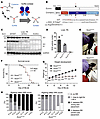 Figure 1
Generation and characterization of Suox-KO in C57BL6/J mice. (A) Schematic representation of the catalytic function of SOX. (B) Schematic representation of murine Suox exon structure and SOX domain structure. Asterisks indicate CRISPR/Cas9 targeting site. MTS, mitochondrial targeting sequence. (C) Western blot for SOX in liver lysates of littermates from SuoxWT/KO × SuoxWT/KO breedings using 2 different antibodies (n = 4). (D) Cytochrome c:sulfite SOX acitivity detected in liver lysates of littermates from SuoxWT/KO × SuoxWT/KO breedings (n = 8). Student’s t test was performed. **P < 0.01; *P < 0.05; NS > 0.05. (E) Phenotype of SuoxWT/WT and SuoxKO/KO mice at P9. Display of potential front paw spasticity and stunted growth in SuoxKO/KO mice (bottom) compared with SuoxWT/WT mice (top). (F) Kaplan-Meier plot for survival of SuoxKO/KO mice (n = 28) compared with SuoxWT/WT (n = 25) and SuoxWT/KO (n = 60) littermates. (G) Weight development of all genotypes of the SOX-deficient line, starting at P4.5. Asterisks indicate difference of SuoxKO/KO mice compared with SuoxWT/WT and SuoxWT/KO mice. ***P < 0.001, Student’s t test. (H) Righting reflex evaluation over time according to criteria modified from Didonato and Bogdanik (61) for SuoxWT/WT and SuoxKO/KO mice. Testing was performed at least 3 times per animal and day (technical replicates), with at least 4 animals per genotype and day (biological replicates).
Sulfite was early recognized to accumulate in urine of patients (9) and later shown to be a reactive, cell-toxic agent (10). We have shown that the accumulating sulfite-cystine adduct S-sulfocysteine (SSC) is the key causative factor of neurodegeneration in the disease (11). SSC was found to act as an NMDA receptor agonist, whose effect could be blocked by the application of the NMDA receptor antagonist memantine, inhibiting phenotype development in a pharmacologically induced mouse model of MoCD (11). As a result of SSC accumulation, cysteine/cystine and homocysteine were found to be depleted in SOXD/MoCD patients, suggesting major changes in the overall cysteine homeostasis.
A third accumulating biomarker in SOXD/MoCD is thiosulfate, a catabolic product of sulfur metabolism, which is derived from hydrogen sulfide (H2S). H2S is synthesized by various enzymes following noncanonical reactions in the trans-sulfuration pathway (cystathionine β-synthase [CBS] and cystathionine γ-lyase [CSE]). In addition, mercaptopyruvate sulfur transferase forms a protein-bound persulfide also contributing to H2S formation (12). H2S is an important signaling molecule with versatile biological implications. The 2 most well studied mechanisms of its actions are (a) interactions with metalloproteins (13) and (b) redox reactions with thiols in proteins and low molecular compounds (14, 15). H2S, cysteine, and thiosulfate metabolic pathways are tightly linked to cysteine persulfidation. This posttranslational modification was reported to have a pivotal role by regulating and protecting functions on thiol residues in proteins (16–18).
Interestingly, thiosulfate also accumulates in ethylmalonic encephalopathy (EE) caused by defects in the enzyme persulfide dioxygenase encoded by the ETHE1 gene (19). Thiosulfate accumulation in EE is due to accumulating low molecular persulfides formed by sulfide quinone oxidoreductase (SQOR) that are substrates of thiosulfate sulfur transferase forming thiosulfate in a sulfite-dependent manner. EE results in mitochondrial dysfunction, neurodegeneration, and childhood death (20). In addition, SQOR is also able to form thiosulfate in a sulfite- and H2S-dependent manner (21). Targeted sulfur metabolome profiling in humans suffering from ultrarare enzyme deficiencies of sulfur metabolic pathways was reported recently, which highlighted that the homeostasis of sulfur metabolites largely relies on catabolic pathways, while H2S-synthesizing routes can efficiently compensate for each other’s activity (22).
To date, there are 3 mouse models recapitulating the different forms of MoCD (types A, B, and C) generated by whole-body gene knockouts in Mocs1, Mocs2, and gphn genes (23–25), all presenting with a severe phenotype causing death at the age of 1–8 days. In addition, mice treated with high dosages of tungstate represent a pharmacological model for MoCD (11). All models have in common that in addition to the lack of SOX activity, other Moco-containing enzymes are also dysfunctional. In the case of xanthine oxidoreductase deficiency, accumulating xanthine deposits as kidney stones that may trigger acute kidney failure (25), potentially contributing to the lethality in MoCD mice.
Here, we have generated an animal model for SOXD using CRISPR/Cas9 genome editing to disrupt the murine Suox gene. We report the phenotypic characterization and detailed biomarker profile that enabled us to identify a novel contribution of H2S biology in the underlying pathomechanism of SOXD. We found a sulfite-dependent liberation of H2S from persulfides leading to massive metabolic alterations in SOX-deficient mice.
-
Results
SuoxKO/KO mice show a severe phenotype without signs of neurodegeneration. Using a CRISPR/Cas9 approach, we generated a mouse line with a 7 bp deletion in the Suox gene starting at position c.809, causing a frameshift and resulting in a stop codon at position p.Arg269GlnX1 of the SOX protein (Figure 1B). The resulting offsprings segregated as expected in a 1:2:1 manner into SuoxWT/WT, SuoxWT/KO, and SuoxKO/KO, suggesting no lethality during embryo development (Supplemental Figure 1; supplemental material available online with this article; https://doi.org/10.1172/JCI181299DS1). We also observed no sex difference and therefore worked with male and female mice as obtained from breeding. In extracts of liver, the organ with the highest SOX expression (26), we found neither SOX protein nor any detectable SOX activity in SuoxKO/KO, while in SuoxWT/KO, approximately 50% reduced SOX expression was observed (Figure 1, C and D), confirming the successful deletion of the enzyme in SuoxKO/KO animals.
Phenotypically, SuoxKO/KO animals displayed delayed fur and whisker development (Figure 1E), similar to Mocs1- and Mocs2-deficient mice (25). Survival of SuoxKO/KO mice was significantly impaired, with a lifespan ranging from 5 to 12 days and a median survival of 9.5 days (Figure 1F), which was longer by 1–2 days when compared with Mocs1- and Mocs2-deficient animals (24, 25), suggesting a minor contribution of the other Moco-dependent enzymes to the pathology of MoCD mice (24, 25). SuoxKO/KO animals showed postnatal milk spots but failed to thrive starting from P4. Weight gain was significantly impaired following day 4 and was halted or started to decline 1 day before death or reaching a score requiring sacrificing (Figure 1G). Mice used for subsequent analysis were sacrificed at day 8, if not stated otherwise.
Given the neurodegenerative phenotype of human patients (1, 2, 6, 7), we first analyzed mice heads by MRI. SuoxKO/KO brains appeared round, while the shape of their WT littermates was elliptical, and total brain volume of SuoxKO/KO mice was decreased by 29.5% when compared with SuoxWT/WT (Supplemental Figure 2, A and B). Immunohistochemistry for microtubule-associated protein 2 (MAP2) and for the neuronal nuclear antigen (NeuN) revealed no differences between SuoxKO/KO mice and their WT littermates, as judged by a quantitative analysis in motor cortex layer V (Supplemental Figure 2, C and D). However, when we assessed motor skill development using surface righting reflex testing at P4.5, the scores of the SuoxKO/KO animals were not strikingly different from SuoxWT/WT littermates, while motor skill development appeared halted on P5.5 and worsened on subsequent days of testing. At P9.5, approximately 50% of surviving SuoxKO/KO animals lost any righting reflex, while the remaining animals attempted for longer than 60 s (Figure 1H). In comparison, by P8.5 all WT littermates performed the reflex with correct paw placement (Figure 1H). Inspection of liver and kidney tissue slices representing organs with highest SOX expression did not show any changes in liver (Supplemental Figure 3A), while kidney (Supplemental Figure 3B) showed enhanced focally segmented glomeruli accompanied by minor impairments of filtration function with increased creatinine retention and mild proteinuria (Supplemental Figure 3, B and C). In conclusion, we found that SuoxKO/KO presented with a severe phenotype, short lifespan and arrest in motor skill development, while no signs of morphological changes in the brain and liver were observed within the first 8 days of life.
Thiosulfate is the major S-metabolite excreted in SuoxKO/KO mice. MoCD and SOXD patients display increased urinary sulfite, SSC, S-sulfohomocysteine, and thiosulfate (Figure 2A) (22). To understand the flux and organ contribution of these biomarkers, we determined their levels in brain, liver, and kidney as well as in plasma and urine of SuoxKO/KO mice and control mice (Figure 2, B–D and G–I, and Supplemental Figure 4) and compared these with total cysteine (Figure 2E) and bioavailable H2S levels in plasma (Figure 2F).
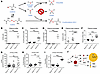 Figure 2
Levels of main biomarkers of SOXD and metabolites of cysteine catabolism in Suox mice. (A) Schematic representation of cysteine catabolism. Levels of highlighted metabolites (sulfite, SSC, thiosulfate, and H2S) and free cysteine determined in this study. (B) Determination of plasma sulfite levels in Suox mice. (C) Determination of plasma SSC levels in Suox mice. (D) Determination of plasma thiosulfate levels in Suox mice. (E) Determination of plasma-free cysteine levels in Suox strain mice. (F) Determination of plasma H2S levels in Suox mice. (G) Determination of urinary sulfite levels in Suox mice. (H) Determination of urinary SSC levels in Suox mice. (I) Determination of urinary thiosulfate levels in Suox mice. One-way ANOVA with Tukey’s post hoc test for pairwise comparisons was performed. ***P < 0.001; **P < 0.01; *P < 0.05; NS > 0.05. (J) Cartoon highlighting the flux of sulfur-containing metabolites in SuoxKO/KO mice (red circles, plasma; yellow circles, urine) compared with WT mice (gray circles). Circles are drawn in scale to their respective concentrations in plasma and urine, with the exception for H2S, which is 10-fold enlarged.
Sulfite accumulated in all 3 organs, with liver showing the highest sulfite level, as expected for the major SOX-expressing organ (Supplemental Figure 4A). In plasma, sulfite showed the highest level of accumulation, reaching nearly 300 μM (Figure 2B), while urinary sulfite (Figure 2G) was only moderately increased (2-fold), suggesting a poor clearance. For SSC, we found no alteration in liver and kidney and a minor increase in brain (1.6-fold), while in plasma, SSC levels were strongly elevated (4-fold of WT), reaching 8.6 ± 3.4 μM. In contrast, urinary excretion was again only 2-fold increased, when compared with the WT, which is much lower than levels in human patients that show strong accumulation in urine, ranging from 100 to 500 μmol SSC/mmol creatinine (22). Levels of SSC in plasma mirrored the drop in total plasma-free cysteine in SuoxKO/KO mice, which was not detectable, while WT mice showed 6.3 ± 2.2 μM free cysteine. Based on these data, we conclude that the SSC level reached saturation due to a quantitative conversion of cystine by accumulating sulfite (22, 25).
Thiosulfate, a biomarker of H2S catabolism, accumulated in all 3 organs, with the highest levels detected in kidney (Supplemental Figure 4C). Total thiosulfate in plasma reached 42.3 ± 4.4 μM, which was 5 times higher than SSC but much lower than circulating sulfite. To our great surprise, thiosulfate excretion was the highest of all biomarkers, representing 45-fold more than that observed in WT mice. An excretion of 2,200 μmol thiosulfate/mmol creatinine exceeds that of sulfite by almost 40-fold, suggesting that the vast majority of excreted sulfur is derived from H2S and related species. Finally, we measured bioavailable H2S in plasma (27) and found a significant 2-fold increase in SuoxKO/KO mice, clearly indicating an alteration in H2S metabolic pathways (Figure 2F). Taken together, all biomarker analyses collectively identified a major route for sulfur excretion from accumulating sulfite into thiosulfate (Figure 2J).
Given the metabolic link between thiosulfate and H2S, we next investigated H2S biogenesis, homeostasis, and catabolism in SuoxKO/KO mice. In a proteome-wide analysis (Supplemental Figure 4), we inspected levels of enzymes involved in H2S biogenesis and found no biologically relevant alteration for CBS, CSE, and 3-mercaptopyruvate sulfurtransferase in liver and kidney, thus excluding increased H2S biosynthesis as a source of H2S and thiosulfate (Supplemental Figure 5A). SQOR, persulfide dioxygenase, and thiosulfate sulfurtransferase (TST) catalyze individual steps in the H2S oxidative pathway, producing glutathione and other low–molecular weight persulfides that are further converted into sulfite and thiosulfate (28, 29). To further inspect the expression level of these H2S-metabolizing enzymes, we performed Western blot analyses to detect SQOR and TST expression in liver and kidney (Supplemental Figure 5B) as well as in tungstate-treated HEK293 cells and patient fibroblasts (Supplemental Figure 5, C and D). We found a significant reduction in SQR expression (except in liver) and a minor reduction of TST in patient cells; neither finding explained the massively increased thiosulfate excretion.
Out of all the proteins involved in cysteine metabolism, there was only 1 enzyme showing a significant change in our proteomic study (Supplemental Figure 5A): cysteine dioxygenase 1, the first enzyme in oxidative cysteine catabolism, was 7.3-fold reduced, which is in line with the loss of free cysteine in plasma (30). Therefore, the observed increase in H2S and the massive excretion of thiosulfate should have a different origin, which we investigated next.
Sulfite induces a release of H2S from persulfides. In light of the accumulation of sulfite observed in all investigated organs, with the highest concentration in plasma, we raised the question whether sulfite reacts with persulfidated small molecules and proteins known to contribute significantly to the overall pool of labile H2S in the organism (18, 31). We hypothesized that sulfite treatment of persulfides could result in the formation of S-sulfonylated species with the concomitant release of H2S (Figure 3A) (18). First, we tested the reactivity of sulfite toward persulfides using an H2S electrode and various low–molecular weight and protein persulfide models. N-acetylpenicillamine persulfide (NAP-SSH) was reported to display slow H2S dissociation kinetics at pH 7.4 (32). When adding of 20-fold molar excess of sulfite (1 mM) to 50 μM NAP-SSH, the dissociation rate of H2S was greatly increased within seconds, leading to a rapid reequilibration (Figure 3B). Next, we investigated 2 different protein model substrates previously reported to be persulfidated at key cysteine residues (33): HSA (Figure 3C) and GAPDH (Figure 3D) (34–36). Similar to NAP-SSH, sulfite-dependent H2S release from GAPDH was observed with a rapid H2S spike and reequilibration (Figure 3D), collectively confirming a nonenzymatic release of H2S from various persulfidated targets.
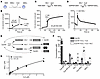 Figure 3
Sulfite triggers protein depersulfidation and releases H2S. (A) Schematic reaction of persulfides with HSO3– at pH 7.4, producing persulfonates (S-sulfonates) and releasing H2S. (B) Representative reaction of 50 μM NAP-SSH with 1 mM HSO3– at pH 7.4, measuring H2S release. (C) H2S electrode signal of 50 μM HSA-SSH in 50 mM PBS, pH 7.4, reacting with a 20-fold molar excess of sulfite (n = 3). (D) H2S electrode signal of 50 μM GAPDH-SSH in 50 mM PBS, pH 7.4, reacting with 20-fold molar excess of sulfite (n = 3). (E) Schematic representation of cysteine persulfides depersulfidated by sulfite and formed H2S. (F) End-product measurements of in vitro interaction between sulfite and cysteine persulfides. Error bars indicate SD. (G) H2S-dependent nonenzymatic thiosulfate formation with a high level of sulfite.
The reaction of sulfite with persulfides also displays a path toward S-sulfonylation other than the oxidation of persulfides (17, 18). To monitor this half of the reaction and to answer the question as to which extent sulfite reacts with the outer-sphere sulfur of the persulfide leading to thiosulfate and free thiol release, we designed another in vitro experiment (Figure 3E). As described before, mild oxidation of cysteine to sulfenic acids increased the reactivity of thiols toward H2S, thus forming cysteine persulfides in vitro (18).
We treated 100 μM cysteine with equimolar amounts of H2O2 and H2S for 1 h and determined the amount of cysteine, cystine, sulfite, SSC, and thiosulfate (Figure 3F). As expected, we found 30 μM cystine, representing 60% of cysteine being oxidized by H2O2. However, approximately 18 μM SSC and 7 μM thiosulfate were also formed, leaving only approximately 15% of the remaining cysteine to be potentially persulfidated. When treating this mixture with 100 μM sulfite, approximately 10 μM cystine was depleted, resulting in the formation of SSC and cysteine. The fact that 30 μM additional SSC was formed suggests that cysteine-persulfide donated a significant fraction (~10 μM) to this reaction. The fact that only 20 μM remaining sulfite was detected suggests that a large fraction of sulfite was bound in SSC. In addition, we found an increase in thiosulfate formation that could either suggest an abstraction of the persulfide’s outer sulfur by sulfite and/or an H2S-dependent formation of thiosulfate with sulfite. We have shown the existence of the latter reaction by titrating sulfite with substoichiometric amounts of H2S leading to a thiosulfate/H2S ratio of approximately 1:4 in the presence of sulfite excess (200 μM; Figure 3G), conditions representing levels in SuoxKO/KO mice. In aggregate, our in vitro studies demonstrate that at pathological sulfite concentrations, various persulfides release H2S, resulting in the formation of S-sulfonylated reaction products.
Sulfite changes the persulfidome of SuoxKO/KO mice. Following our findings that sulfite reacts with persulfides, we wanted to test how accumulation of sulfite affects the global persulfidome landscape. Using the dimedone switch method (18) for selective persulfide labeling (Figure 4A), we first observed, in gel, that liver samples from SuoxKO/KO mice show significantly lower protein persulfide levels (Figure 4, B and C). To quantify this change and understand its biological effect, we next performed a label-free persulfidome analysis (37) and identified 2,457 persulfidated proteins in both WT and SuoxKO/KO mouse liver samples (Supplemental Table 1). Among these, 571 proteins passed the significance threshold (presence in 3 out 4 samples, at least 30% change and P < 0.05), of which 441 proteins showed a clear decrease in protein persulfidation (Figure 4, D and E, and Supplemental Figure 6, A and B). To exclude that this change originates from the change in total protein level, we also performed label-free total proteome analysis (Supplemental Figure 6, C and D) and double plotted the persulfidome change to the total proteome change (Supplemental Figure 6E). Indeed, a majority of identified proteins seems to be unaffected by the change in protein expression levels.
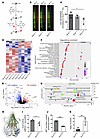 Figure 4
Persulfidome remodeling in SuoxKO/KO mice. (A) Setup for the detection of protein-bound persulfides in the assay described by Zivanovic et al. (18). Crude extract from liver was treated with 4-chloro-7-nitrobenzofurazan (NBF-Cl), which reacts with persulfides, free thiols, sulfenic acids, and amine groups. The NBF-blocked persulfides undergo nucleophilic attack by the DAz-2 moiety, which in turn is cross-linked to a fluorescent Cy5 moiety via click chemistry. (B) Representative Cy5 (persulfonate) and NBF-Cl (control) fluorescence signals measured by a fluorescence scanner (Cy5, red; NBF-Cl, green). (C) Quantification of a specific rectangular area identical for all lanes. All Cy5 signals were normalized to their respective NBF-Cl signals and further normalized to the mean of SuoxWT/WT signals (n = 3). Error bars indicate SD. One-way ANOVA was performed. (D) Heatmap showing the significant changes of protein persulfidation in SuoxKO/KO mouse livers compared with WT animals (Welch’s test, P < 0.05). (E) Volcano plot depicting statistical significance plotted against the log2 fold change of persulfidated proteins in SuoxKO/KO mouse liver relative to WT animals. Significance was established using Welch’s t test (2 sided), with a P value threshold of <0.05. Fold change cutoffs were established at 30%. The numbers of proteins with significantly altered persulfidation states are indicated. (F) KEGG pathway enrichment analysis using DAVID. The graph shows the top 30 significant (Benjamini’s adjusted P value < 0.01) and most enriched terms, with color gradient signifying the adjusted P value and circle size the number of proteins. (G) GO (Biological Process) term enrichment analysis of the 441 proteins found to have decreased persulfidation levels in SuoxKO/KO mice. REVIGO was used to plot the enrichment analysis performed in DAVID. Circle dimensions denote the protein count within specific GO terms, while color gradients depict the degree of significance. Similar biological processes are grouped together with a dashed line. (H) AlphaFold model of human ABCB7 protein with the C-terminal helix pointing into the transport pore. The C-terminal Cys residues are highlighted in a spheres model. (I) Determination of cytosolic Aco2 activity, (J) molybdopterin (MPT)/Moco content via HPLC Form A analysis, and (K) urinary uric acid/xanthine (UA/XA) ratio. ***P < 0.001; **P < 0.01; *P < 0.05.
Kyoto Encyclopedia of Genes and Genomes (KEGG) pathway enrichment analysis of proteins that showed significant decrease in protein persulfidation suggested that a variety of metabolic processes are affected, such as amino acid metabolic pathways, lipid metabolism, and pyruvate metabolism, but also ferroptosis, DNA replication, and PPAR signaling, etc. (Figure 4F). A complementary Gene Ontology (GO) term enrichment analysis identified similar pathways (Figure 4G). Finally, the loss in S-persulfidation in the proteome was also accompanied by an increase S-sulfonylation (Supplemental Figure 7).
When inspecting the list of depersulfidated proteins, the mitochondrial Fe-S cluster transporter ABCB7 caught our attention. ABCB7 is involved in the export of an Fe-S cluster species to the cytosol, serving as precursor for the cytosolic Fe-S cluster biogenesis (38), and levels of ABCB7 persulfidation were decreased 5-fold (rank 13). Recent structural studies provided evidence that glutathione-complexed [2Fe-2S] clusters serve as substrates of the transporter (39). Mouse and human ABCB7 harbor 6 cysteine residues, 3 of which are located at the C-terminal tail of the transporter for which structural information is missing as of today. Modeling the structure of mouse ABCB7 using AlphaFold predicted the C-terminal helix to be localized within the transport pocket, with its terminal 3 cysteines pointing to the center of the complex (Figure 4H). Therefore, we probed the impact of sulfite-induced depersulfidation on cytosolic Fe-S clusters. Cytosolic aconitase activity was reduced by approximately 30% (Figure 4I). Total Moco/molybdopterin content showed a more than 50% reduction (Figure 4J), which was consistent with earlier studies using ATM1/ABCB7-deficient plants (40). Finally, we determined levels of xanthine and uric acid, substrates and products of xanthine oxidase, a cytosolic Moco and Fe-S cluster–dependent enzyme. Again, we found a highly significant and strongly increased ratio of uric acid to xanthine, suggesting a reduction of xanthine oxidase activity in our SOX-deficient mouse (Figure 4K). Therefore, we conclude that sulfite-induced depersulfidation compromises cytosolic Fe-S cluster biogenesis, thus underlining the pleiotropic effect of accumulating sulfite in various downstream pathways.
Changes in the amino acid profile suggest metabolic rewiring. We have conclusively demonstrated that sulfite toxicity in mice resulted in H2S release from S-persulfidated stores, leading to a massive excretion of thiosulfate. H2S toxicity has been attributed to the inhibition of mitochondrial respiration due to the blockage in complex IV (41). A recent study by Banerjee and coworkers showed that H2S excess may cause reversal of the respiratory chain and an increase in mitochondrial NADH pool, thus leading to a partial reversal of the TCA cycle with increased glycolysis to generate the required ATP (42). To feed the TCA cycle, increased glutaminolysis acts as the major source for α-ketoglutarate (42).
To obtain further insights into the metabolic changes in SuoxKO/KO mice, we determined the amino acid profile in urine (Figure 5A) and plasma (Supplemental Figure 8). Remarkably, levels of nearly all amino acids were decreased in SuoxKO/KO mice, with cystine and glutamine showing the strongest reduction (Figure 5A). While cystine depletion is directly related to quantitative conversion to SSC, an over 10-fold reduction in glutamine supports the above-mentioned consequences of H2S toxicity on mitochondrial respiration. In addition, all other catabolic amino acid precursors (Glu, His, Arg, and Pro) of α-ketoglutarate were also reduced (Figure 5A). Furthermore, amino acids contributing to acetyl-CoA and pyruvate formation (Ala, Ser, Gly, Thr, and Cys) were also depleted, collectively arguing for a metabolic arrest in SuoxKO/KO mice. This is in line with the persulfidome data and the observation that animals stop gaining weight at day 4, suggesting a catabolic state of metabolism.
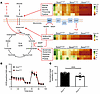 Figure 5
Metabolic impacts of elevated H2S in SuoxKO/KO mice. (A) Schematic representation of partial reversal of TCA cycle and relative changes (n = 6) of urinary amino acids compared with SuoxWT/WT. Amino acids are grouped according to their contribution as catabolic precursors of α-ketoglutarate, acetyl-CoA, and pyruvate. (B and C) Mitochondrial respiration of mouse embryonic fibroblasts from SuoxWT/WT and SuoxKO/KO mice showing a representative trace (B) and normalized basal oxygen consumption rate (OCR) (C). Two-tailed unpaired Student’s t test was used to compare 2 groups. Data are presented as mean ± SEM. ****P < 0.0001.
We also investigated embryonic fibroblasts generated from our SuoxKO/KO mice and performed mitochondrial respiration studies (Figure 5B). Basal respiration was significantly compromised in SuoxKO/KO cells (Figure 5, B and C), which is consistent with a sulfite-dependent release of H2S, thus blocking complex IV.
Therapeutic sulfite-scavenging approach. After showing that sulfite reacts with persulfides, we wanted to probe whether externally applied disulfide and polysulfides could efficiently scavenge accumulating sulfite in SuoxKO/KO mice. Therefore, we used oxidized glutathione (GSSG), which is known to be excreted from cells (43, 44). In addition, we used glutathione trisulfide (GSSSG), which produces GSSH upon reaction with endogenous GSH (45, 46). We first tested the in vitro reactivity of 100 μM sulfite incubated with equimolar amounts of GSSG and GSSSG for up to 60 min (Figure 6 and Supplemental Figure 8) and expected the formation of GSH, sulfoxidated GSSO3–, and various persulfidated species and hydrosulfides (Figure 6A). While GSSG was only partially depleted (Figure 6B), GSSSG was rapidly consumed in a sulfite-dependent manner, thus suggesting a much higher reactivity with sulfite (Figure 6C and Supplemental Figure 8). In parallel, GSH accumulated over time in the reaction of GSSG, while it accumulated much less with GSSSG (Figure 6D), with the initial fast formation of GSSH (Figure 6E) and slow accumulation of GSSSH (Figure 6F). Consistently, more sulfite was depleted in the presence of GSSSG (Figure 6G), which was accompanied by the formation of thiosulfate (Figure 6H and Supplemental Figure 9), thus suggesting a sulfite-dependent release from the reactive persulfide intermediate GSSH. Finally, H2S and hydropolysulfides were also formed following the reaction of GSSSG with sulfite at low micromolar (H2S and H2S2) to nanomolar levels (H2S3; Figure 6, I–K). In aggregate, when summing up reactants consumed and products formed, we conclude a quantitative interconversion of GSSSG into GSSG and thiosulfate (Supplemental Figure 9, K–M).
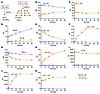 Figure 6
In vitro reaction of sulfite with GSSG and GSSSG. (A) Expected species formed by the reaction with sulfite. (B–F) Determination of glutathione products and (G–K) sulfite and S-related products using mass spectrometry following 1 h of incubation. The kinetics of the reaction are shown in Supplemental Figure 8.
Next, we treated newborn mice derived from SuoxKO/WT breeding with either PBS or PBS containing 2 mM GSSG or GSSSG intraperitoneally. The amount was calculated based on the sulfite concentration determined in SuoxKO/KO mice (~250 μM), aiming to neutralize sulfite excess with the applied sulfite-scavenging glutathione species. We observed an extension in lifespan of SuoxKO/KO mice treated either with GSSG or GSSSG by 2 and 3 days, respectively (Figure 7, A and C). The extension in lifespan was highly significant for GSSSG-treated animals, while the improved body weight gain was higher for animals treated with GSSG (Figure 7B). WT animals showed no alteration in survival (data not shown) or growth (Figure 7, B and C). Biomarker analysis showed that kidney function improved in both cohorts (Figure 7D), while sulfite and thiosulfate accumulation did not change under GSSG treatment or even further increased following GSSSG exposure (Figure 7, E and F). Although both sulfite-scavenging molecules were able to extend lifespan, the additional intake of glutathione as a cysteine-containing metabolite further exaggerated cysteine catabolism, leading to even more sulfite intoxication. The fact that lifespan was extended suggests a minor delay in reaching the pathological concentration of sulfite and underlines the high reactivity of sulfite toward oxidized and persulfidated thiols.
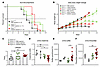 Figure 7
Treatment of WT and SuoxKO/KO mice with GSSG and GSSSG. (A) Kaplan-Meier survival curves were compared using 2-sided log-rank (Mantel-Cox) tests for 2 prespecified pairwise comparisons; unadjusted P values are reported. *P < 0.05. (B) Body weight development for animals treated intraperitoneally with 2 mM GSSG and 2 mM GSSSG. (C) Comparison of lifespan between PBS- and GSSG/GSSSG-treated SuoxKO/KO mice. (D–F) Urinary biomarker analyses of creatinine (D), sulfite (E), and thiosulfate (F). (C–F) One-way ANOVA was performed, with Tukey’s post hoc test for pairwise comparisons; Tukey-adjusted 2-sided P values are reported. ***P < 0.001, **P < 0.01, *P < 0.05.
Taken together, SOX-deficient mice displayed an unexpected rewiring of cysteine catabolism into the H2S pathway caused by a sulfite-induced depersulfidation, H2S release, and thiosulfate accumulation, which together with our pilot treatment studies suggests that sulfite scavenging may provide a new route for treating this ultrarare and devastating metabolic disorder.


Copyright © 2026 American Society for Clinical Investigation
ISSN: 0021-9738 (print), 1558-8238 (online)