
Go to JCI Insight
  • About
  • Editors
  • Consulting Editors
  • For authors
  • Publication ethics
  • Publication alerts by email
  • Advertising
  • Job board
  • Contact
  • Clinical Research and Public Health
  • Current issue
  • Past issues
  • By specialty
    • COVID-19
    • Cardiology
    • Gastroenterology
    • Immunology
    • Metabolism
    • Nephrology
    • Neuroscience
    • Oncology
    • Pulmonology
    • Vascular biology
    • All ...
  • Videos
    • ASCI Milestone Awards
    • Video Abstracts
    • Conversations with Giants in Medicine
  • Reviews
    • View all reviews ...
    • The cGAS-STING pathway: DNA sensing in health and disease (Jun 2026)
    • Neurodegeneration (Mar 2026)
    • Clinical innovation and scientific progress in GLP-1 medicine (Nov 2025)
    • Pancreatic Cancer (Jul 2025)
    • Complement Biology and Therapeutics (May 2025)
    • Evolving insights into MASLD and MASH pathogenesis and treatment (Apr 2025)
    • Microbiome in Health and Disease (Feb 2025)
    • View all review series ...
  • Viewpoint
  • Collections
    • In-Press Preview
    • Clinical Research and Public Health
    • Research Letters
    • Letters to the Editor
    • Editorials
    • Commentaries
    • Editor's notes
    • Reviews
    • Viewpoints
    • 100th anniversary
    • Top read articles

  • Current issue
  • Past issues
  • Specialties
  • Reviews
  • Review series
  • ASCI Milestone Awards
  • Video Abstracts
  • Conversations with Giants in Medicine
  • In-Press Preview
  • Clinical Research and Public Health
  • Research Letters
  • Letters to the Editor
  • Editorials
  • Commentaries
  • Editor's notes
  • Reviews
  • Viewpoints
  • 100th anniversary
  • Top read articles
  • About
  • Editors
  • Consulting Editors
  • For authors
  • Publication ethics
  • Publication alerts by email
  • Advertising
  • Job board
  • Contact
Exploring pathways for memory T cell generation
Federica Sallusto, Antonio Lanzavecchia
View: Text | PDF
Commentary

Exploring pathways for memory T cell generation

  • Text
  • PDF
Abstract

Authors

Federica Sallusto, Antonio Lanzavecchia

×

Figure 1

Options: View larger image (or click on image) Download as PowerPoint
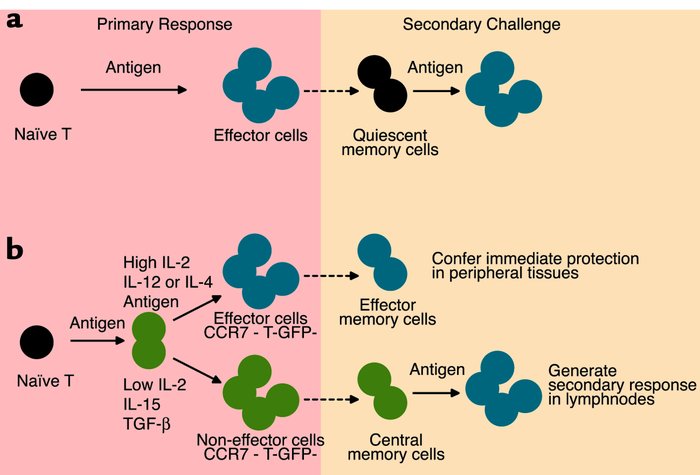
Pathways for memory T cell generation. (a) According to the most convent...
Pathways for memory T cell generation. (a) According to the most conventional model, memory T cells are derived from effector cells that revert to a quiescent state. (b) According to the new model of progressive T cell differentiation, the duration of antigenic stimulation and the type and amount of cytokines present during priming lead either to fully differentiated effector cells that home to peripheral tissues (blue) or to intermediate cells that are devoid of effector function and home to lymph nodes (green). In the system used by Manjunath et al. (7), these two cell types can be identified according to the differential expression of the T-GFP marker transgene and the lymph node–homing receptor CCR7. Both cell types are maintained in the memory pool (dotted arrows) and, upon secondary challenge, mediate immediate protection in nonlymphoid tissues or secondary responses in lymph nodes.

Copyright © 2026 American Society for Clinical Investigation
ISSN: 0021-9738 (print), 1558-8238 (online)

Sign up for email alerts