
Go to JCI Insight
  • About
  • Editors
  • Consulting Editors
  • For authors
  • Publication ethics
  • Publication alerts by email
  • Advertising
  • Job board
  • Contact
  • Clinical Research and Public Health
  • Current issue
  • Past issues
  • By specialty
    • COVID-19
    • Cardiology
    • Gastroenterology
    • Immunology
    • Metabolism
    • Nephrology
    • Neuroscience
    • Oncology
    • Pulmonology
    • Vascular biology
    • All ...
  • Videos
    • Conversations with Giants in Medicine
    • Video Abstracts
  • Reviews
    • View all reviews ...
    • Clinical innovation and scientific progress in GLP-1 medicine (Nov 2025)
    • Pancreatic Cancer (Jul 2025)
    • Complement Biology and Therapeutics (May 2025)
    • Evolving insights into MASLD and MASH pathogenesis and treatment (Apr 2025)
    • Microbiome in Health and Disease (Feb 2025)
    • Substance Use Disorders (Oct 2024)
    • Clonal Hematopoiesis (Oct 2024)
    • View all review series ...
  • Viewpoint
  • Collections
    • In-Press Preview
    • Clinical Research and Public Health
    • Research Letters
    • Letters to the Editor
    • Editorials
    • Commentaries
    • Editor's notes
    • Reviews
    • Viewpoints
    • 100th anniversary
    • Top read articles

  • Current issue
  • Past issues
  • Specialties
  • Reviews
  • Review series
  • Conversations with Giants in Medicine
  • Video Abstracts
  • In-Press Preview
  • Clinical Research and Public Health
  • Research Letters
  • Letters to the Editor
  • Editorials
  • Commentaries
  • Editor's notes
  • Reviews
  • Viewpoints
  • 100th anniversary
  • Top read articles
  • About
  • Editors
  • Consulting Editors
  • For authors
  • Publication ethics
  • Publication alerts by email
  • Advertising
  • Job board
  • Contact

Viral defense, "PAR" excellence
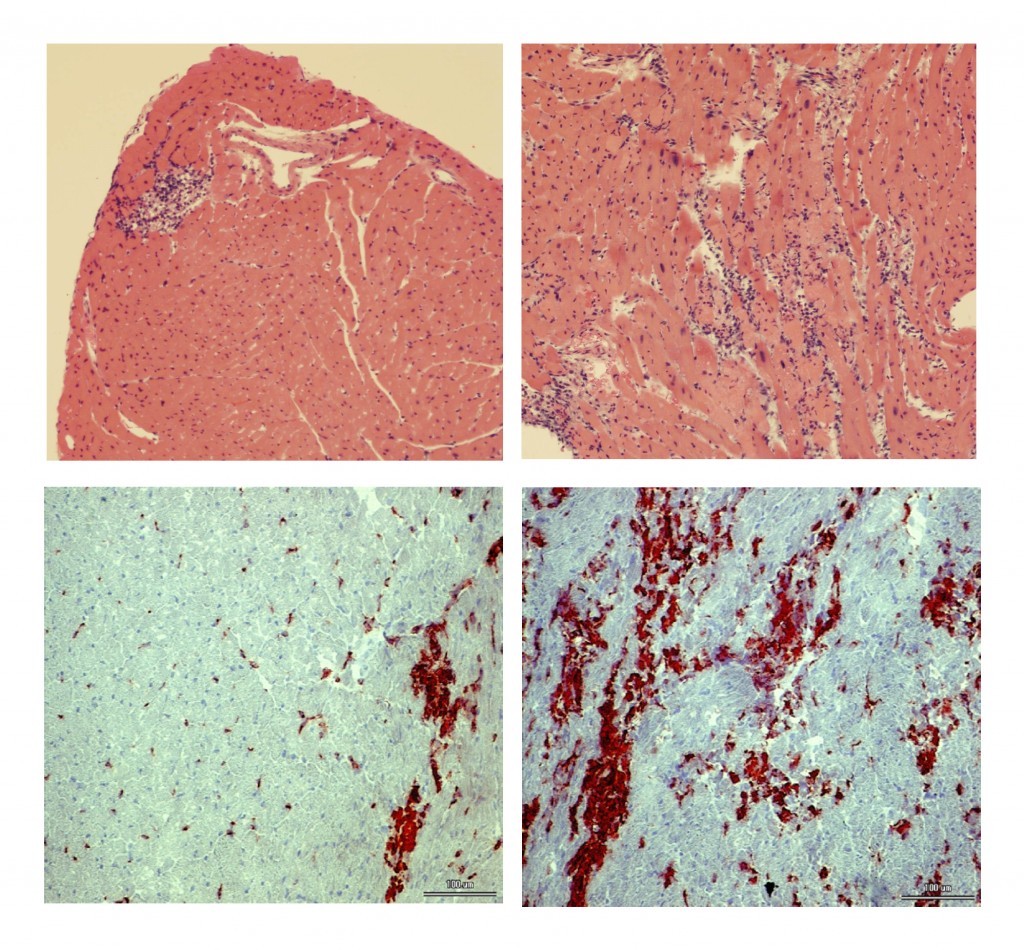

Blood coagulation is a host defense system that prevents the spread of pathogens. It is mediated by a variety of proteases (protein-cleaving enzymes) that also activate cells by cleaving a group of proteins known as PARs.  Silvio Antoniak and colleagues evaluated the role of PAR-1 in the immune response to viral infection. They infected wild type mice and Par1-deficient mice with coxsackievirus B3, an enterovirus that can causes meningitis and pericarditis in humans. Here, they measured inflammation in the hearts of wild type (left) and Par1-deficient (right) mice by staining sections of heart tissue for inflammatory CD68+ cells (lower panels). These results indicate that PAR-1 contributes to the innate immune response during single-stranded RNA viral infection.  

Published February 8, 2013, by Jillian Hurst

Scientific Show Stopper

Related articles

PAR-1 contributes to the innate immune response during viral infection
Silvio Antoniak, A. Phillip Owens III, Martin Baunacke, Julie C. Williams, Rebecca D. Lee, Alice Weithäuser, Patricia A. Sheridan, Ronny Malz, James P. Luyendyk, Denise A. Esserman, JoAnn Trejo, Daniel Kirchhofer, Burns C. Blaxall, Rafal Pawlinski, Melinda A. Beck, Ursula Rauch, Nigel Mackman
View: Text | PDF
Research Article Immunology

PAR-1 contributes to the innate immune response during viral infection

  • Text
  • PDF
Abstract

Coagulation is a host defense system that limits the spread of pathogens. Coagulation proteases, such as thrombin, also activate cells by cleaving PARs. In this study, we analyzed the role of PAR-1 in coxsackievirus B3–induced (CVB3-induced) myocarditis and influenza A infection. CVB3-infected Par1–/– mice expressed reduced levels of IFN-β and CXCL10 during the early phase of infection compared with Par1+/+ mice that resulted in higher viral loads and cardiac injury at day 8 after infection. Inhibition of either tissue factor or thrombin in WT mice also significantly increased CVB3 levels in the heart and cardiac injury compared with controls. BM transplantation experiments demonstrated that PAR-1 in nonhematopoietic cells protected mice from CVB3 infection. Transgenic mice overexpressing PAR-1 in cardiomyocytes had reduced CVB3-induced myocarditis. We found that cooperative signaling between PAR-1 and TLR3 in mouse cardiac fibroblasts enhanced activation of p38 and induction of IFN-β and CXCL10 expression. Par1–/– mice also had decreased CXCL10 expression and increased viral levels in the lung after influenza A infection compared with Par1+/+ mice. Our results indicate that the tissue factor/thrombin/PAR-1 pathway enhances IFN-β expression and contributes to the innate immune response during single-stranded RNA viral infection.

Authors

Silvio Antoniak, A. Phillip Owens III, Martin Baunacke, Julie C. Williams, Rebecca D. Lee, Alice Weithäuser, Patricia A. Sheridan, Ronny Malz, James P. Luyendyk, Denise A. Esserman, JoAnn Trejo, Daniel Kirchhofer, Burns C. Blaxall, Rafal Pawlinski, Melinda A. Beck, Ursula Rauch, Nigel Mackman

×
Advertisement

Copyright © 2025 American Society for Clinical Investigation
ISSN: 0021-9738 (print), 1558-8238 (online)

Sign up for email alerts