
Submit a comment
Abstract
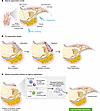
The fingertip is one of the only known complex structures in mammals that can fully regenerate following amputation. This phenomenon can be studied in mice using the amputation of the digit tip, the regenerative success of which has been shown to be reliant on effective bone clearance prior to new bone formation. In this issue of the JCI, Vishlaghi et al. investigated whether local lymphatic vessels are involved in this process. Interestingly, they found that inhibiting lymphangiogenesis resulted in accelerated clearance of damaged tissue and bone, thereby improving subsequent digit regeneration. This study is the first to our knowledge to report lymphatic involvement in digit regeneration and raises questions regarding the underlying mechanisms at play.
Authors
Matthijs Luxen, Francesca Lazzeri-Barcelo, Ralf H. Adams
Guidelines
The Editorial Board will only consider comments that are deemed relevant and of interest to readers. The Journal will not post data that have not been subjected to peer review; or a comment that is essentially a reiteration of another comment.
- Comments appear on the Journal’s website and are linked from the original article’s web page.
- Authors are notified by email if their comments are posted.
- The Journal reserves the right to edit comments for length and clarity.
- No appeals will be considered.
- Comments are not indexed in PubMed.
Specific requirements
- Maximum length, 400 words
- Entered as plain text or HTML
- Author’s name and email address, to be posted with the comment
- Declaration of all potential conflicts of interest (even if these are not ultimately posted); see the Journal’s conflict-of-interest policy
- Comments may not include figures


Copyright © 2026 American Society for Clinical Investigation
ISSN: 0021-9738 (print), 1558-8238 (online)