
Go to JCI Insight
  • About
  • Editors
  • Consulting Editors
  • For authors
  • Publication ethics
  • Publication alerts by email
  • Advertising
  • Job board
  • Contact
  • Clinical Research and Public Health
  • Current issue
  • Past issues
  • By specialty
    • COVID-19
    • Cardiology
    • Gastroenterology
    • Immunology
    • Metabolism
    • Nephrology
    • Neuroscience
    • Oncology
    • Pulmonology
    • Vascular biology
    • All ...
  • Videos
    • Conversations with Giants in Medicine
    • Video Abstracts
  • Reviews
    • View all reviews ...
    • Clinical innovation and scientific progress in GLP-1 medicine (Nov 2025)
    • Pancreatic Cancer (Jul 2025)
    • Complement Biology and Therapeutics (May 2025)
    • Evolving insights into MASLD and MASH pathogenesis and treatment (Apr 2025)
    • Microbiome in Health and Disease (Feb 2025)
    • Substance Use Disorders (Oct 2024)
    • Clonal Hematopoiesis (Oct 2024)
    • View all review series ...
  • Viewpoint
  • Collections
    • In-Press Preview
    • Clinical Research and Public Health
    • Research Letters
    • Letters to the Editor
    • Editorials
    • Commentaries
    • Editor's notes
    • Reviews
    • Viewpoints
    • 100th anniversary
    • Top read articles

  • Current issue
  • Past issues
  • Specialties
  • Reviews
  • Review series
  • Conversations with Giants in Medicine
  • Video Abstracts
  • In-Press Preview
  • Clinical Research and Public Health
  • Research Letters
  • Letters to the Editor
  • Editorials
  • Commentaries
  • Editor's notes
  • Reviews
  • Viewpoints
  • 100th anniversary
  • Top read articles
  • About
  • Editors
  • Consulting Editors
  • For authors
  • Publication ethics
  • Publication alerts by email
  • Advertising
  • Job board
  • Contact
Protein disulfide isomerase acts as an injury response signal that enhances fibrin generation via tissue factor activation
Christoph Reinhardt, … , Steffen Massberg, Bernd Engelmann
Published February 14, 2008
Citation Information: J Clin Invest. 2008;118(3):1110-1122. https://doi.org/10.1172/JCI32376.
View: Text | PDF
Research Article

Protein disulfide isomerase acts as an injury response signal that enhances fibrin generation via tissue factor activation

  • Text
  • PDF
Abstract

The activation of initiator protein tissue factor (TF) is likely to be a crucial step in the blood coagulation process, which leads to fibrin formation. The stimuli responsible for inducing TF activation are largely undefined. Here we show that the oxidoreductase protein disulfide isomerase (PDI) directly promotes TF-dependent fibrin production during thrombus formation in vivo. After endothelial denudation of mouse carotid arteries, PDI was released at the injury site from adherent platelets and disrupted vessel wall cells. Inhibition of PDI decreased TF-triggered fibrin formation in different in vivo murine models of thrombus formation, as determined by intravital fluorescence microscopy. PDI infusion increased — and, under conditions of decreased platelet adhesion, PDI inhibition reduced — fibrin generation at the injury site, indicating that PDI can directly initiate blood coagulation. In vitro, human platelet–secreted PDI contributed to the activation of cryptic TF on microvesicles (microparticles). Mass spectrometry analyses indicated that part of the extracellular cysteine 209 of TF was constitutively glutathionylated. Mixed disulfide formation contributed to maintaining TF in a state of low functionality. We propose that reduced PDI activates TF by isomerization of a mixed disulfide and a free thiol to an intramolecular disulfide. Our findings suggest that disulfide isomerases can act as injury response signals that trigger the activation of fibrin formation following vessel injury.

Authors

Christoph Reinhardt, Marie-Luise von Brühl, Davit Manukyan, Lenka Grahl, Michael Lorenz, Berid Altmann, Silke Dlugai, Sonja Hess, Ildiko Konrad, Lena Orschiedt, Nigel Mackman, Lloyd Ruddock, Steffen Massberg, Bernd Engelmann

×

Figure 9

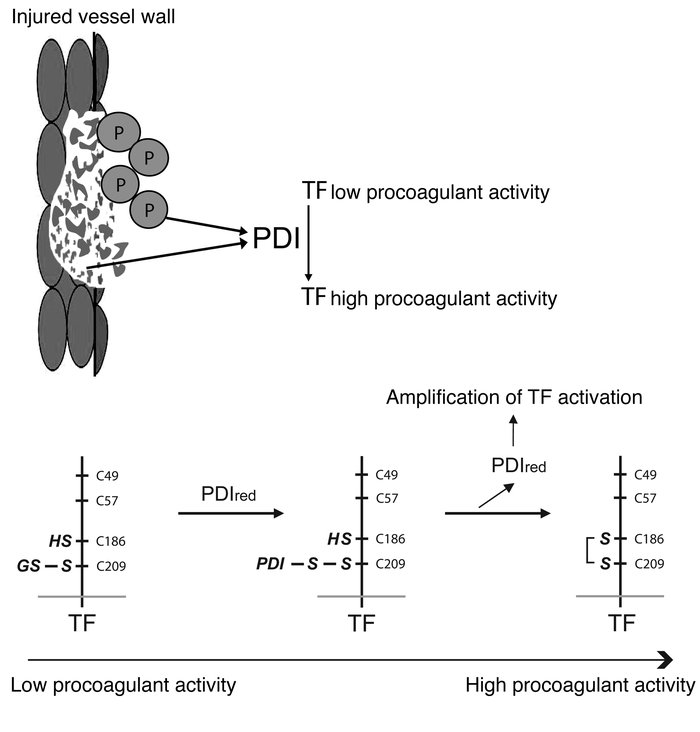
Model for the activation of TF-dependent coagulation start by PDI.
Options: View larger image (or click on image) Download as PowerPoint
Deglutathionylation and TF disulfide bond formation by reduced PDI.
(A) ...
Top: PDI exposure at the vessel injury site contributes to enable the initial step of the extrinsic pathway of blood coagulation, conversion of TF from the functionally inactive to the active form. After vessel injury, PDI can be secreted by activated platelets (P) adhering at the injury site and released from cells of the damaged vessel wall. The exposed PDI might interact with TF expressed by vessel wall cells and TF carrying blood components such as microparticles rapidly recruited to the vessel lesion. In parallel, the exposed PDI can directly contribute to amplify platelet activation. Bottom: Hypothetical molecular mechanism of TF activation by PDI. TF-dependent fibrin formation is low when the Cys186/Cys209 pair of TF is glutathionylated and/or in the free thiol form. Mixed disulfides with glutathione (and other types of linkages) at Cys209 are a constitutive redox form of the protein. PDI can cleave the mixed disulfides of TF when its redox-active cysteines are in the reduced form. This could potentially result in the formation of an unstable PDI-TF intermediate. Through nucleophilic attack by the vicinal free thiol, the intermediate might be disintegrated and be converted into a stable disulfide. The isomerization reaction proposed is thus in principle similar to the PDI-catalyzed isomerization suggested to mediate the correct positioning of protein disulfides in the ER (21). After completing the redox exchange, the same PDI molecule can potentially stimulate additional TF molecules, which would amplify TF activation.

Copyright © 2025 American Society for Clinical Investigation
ISSN: 0021-9738 (print), 1558-8238 (online)

Sign up for email alerts