
Citations to this article
Abstract
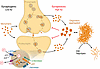
Studies of amyloid-β (Aβ) in Alzheimer’s disease pathology have revealed the peptide’s complex roles in synaptic function. The study by Siddu et al. in this issue clarifies the contexts in which Aβ peptides may be synaptogenic or synaptotoxic. This commentary integrates the study’s major findings with the salient findings of others that, over recent years, have redefined Aβ from a troublesome waste product into a physiological agent of the innate immune response and a modulator of synaptic homeostasis. Convergent evidence demonstrates how free, nonaggregated Aβ supports synaptic structure and activity, whereas oligomeric assemblies enact an adaptive brake on excitatory drive that can become maladaptive with age and inflammation. This redefined perspective on Aβ function emphasizes an evolutionarily conserved feedback loop linking neuronal activity, amyloid generation, and synaptic tuning that protects energy balance under stress but, when dysregulated, promotes proteostatic failure, persistent neuroinflammation, and network dysfunction characteristic of Alzheimer’s disease.
Authors
Joachim Herz
Loading citation information...


Copyright © 2025 American Society for Clinical Investigation
ISSN: 0021-9738 (print), 1558-8238 (online)