
Advertisement
Clinical Research and Public HealthAIDS/HIVInflammation
Open Access |  10.1172/JCI196869
Age modifies the association between sex and the plasma inflammatory proteome in treated HIV
Rebecca A. Abelman,1 Samuel R. Schnittman,2 Natalia Faraj Murad,1 Adam B. Olshen,1 Gabriele B. Beck-Engeser,1 Noah Aquino,1 Gabrielle C. Ambayec,1 Edward R. Cachay,3 Joseph J. Eron,4 Michael S. Saag,5 Robin M. Nance,6 Joseph A. Delaney,6 Stephanie A. Ruderman,6 Richard D. Moore,7 Kenneth H. Mayer,8,9 Jeffrey M. Jacobson,10 Heidi M. Crane,6 Peter W. Hunt,1 and for the CFAR Network of Integrated Clinical Systems (CNICS) Group11
1UCSF, San Francisco, California, USA.
2Amgen, Thousand Oaks, California, USA.
3Mayo Clinic, Scottsdale, Arizona, USA.
4University of North Carolina, Chapel Hill, North Carolina, USA.
5University of Alabama at Birmingham, Birmingham, Alabama, USA.
6University of Washington, Seattle, Washington, USA.
7Johns Hopkins University, Baltimore, Maryland, USA.
8The Fenway Institute, Boston, Massachusetts, USA.
9Harvard Medical School, Boston, Massachusetts, USA.
10Case Western Reserve University, Cleveland, Ohio, USA.
11CNICS is detailed in Supplemental Acknowledgments.
Address correspondence to: Peter W. Hunt, 1001 Potrero Avenue, Zuckerberg San Francisco General Building 3, Room 605B, San Francisco, California 94110, USA. Phone: 628.206.8165; Email: peter.hunt@ucsf.edu. Or to: Rebecca A. Abelman, UCSF VA Healthcare System, Infectious Disease Section, 111W, 4150 Clement Street, San Francisco, California 94121, USA. Phone: 415.221.4810 ext. 23613; Email: rebecca.abelman@ucsf.edu.
Find articles by Abelman, R. in: PubMed | Google Scholar
1UCSF, San Francisco, California, USA.
2Amgen, Thousand Oaks, California, USA.
3Mayo Clinic, Scottsdale, Arizona, USA.
4University of North Carolina, Chapel Hill, North Carolina, USA.
5University of Alabama at Birmingham, Birmingham, Alabama, USA.
6University of Washington, Seattle, Washington, USA.
7Johns Hopkins University, Baltimore, Maryland, USA.
8The Fenway Institute, Boston, Massachusetts, USA.
9Harvard Medical School, Boston, Massachusetts, USA.
10Case Western Reserve University, Cleveland, Ohio, USA.
11CNICS is detailed in Supplemental Acknowledgments.
Address correspondence to: Peter W. Hunt, 1001 Potrero Avenue, Zuckerberg San Francisco General Building 3, Room 605B, San Francisco, California 94110, USA. Phone: 628.206.8165; Email: peter.hunt@ucsf.edu. Or to: Rebecca A. Abelman, UCSF VA Healthcare System, Infectious Disease Section, 111W, 4150 Clement Street, San Francisco, California 94121, USA. Phone: 415.221.4810 ext. 23613; Email: rebecca.abelman@ucsf.edu.
Find articles by Schnittman, S. in: PubMed | Google Scholar
1UCSF, San Francisco, California, USA.
2Amgen, Thousand Oaks, California, USA.
3Mayo Clinic, Scottsdale, Arizona, USA.
4University of North Carolina, Chapel Hill, North Carolina, USA.
5University of Alabama at Birmingham, Birmingham, Alabama, USA.
6University of Washington, Seattle, Washington, USA.
7Johns Hopkins University, Baltimore, Maryland, USA.
8The Fenway Institute, Boston, Massachusetts, USA.
9Harvard Medical School, Boston, Massachusetts, USA.
10Case Western Reserve University, Cleveland, Ohio, USA.
11CNICS is detailed in Supplemental Acknowledgments.
Address correspondence to: Peter W. Hunt, 1001 Potrero Avenue, Zuckerberg San Francisco General Building 3, Room 605B, San Francisco, California 94110, USA. Phone: 628.206.8165; Email: peter.hunt@ucsf.edu. Or to: Rebecca A. Abelman, UCSF VA Healthcare System, Infectious Disease Section, 111W, 4150 Clement Street, San Francisco, California 94121, USA. Phone: 415.221.4810 ext. 23613; Email: rebecca.abelman@ucsf.edu.
Find articles by Faraj Murad, N. in: PubMed | Google Scholar
1UCSF, San Francisco, California, USA.
2Amgen, Thousand Oaks, California, USA.
3Mayo Clinic, Scottsdale, Arizona, USA.
4University of North Carolina, Chapel Hill, North Carolina, USA.
5University of Alabama at Birmingham, Birmingham, Alabama, USA.
6University of Washington, Seattle, Washington, USA.
7Johns Hopkins University, Baltimore, Maryland, USA.
8The Fenway Institute, Boston, Massachusetts, USA.
9Harvard Medical School, Boston, Massachusetts, USA.
10Case Western Reserve University, Cleveland, Ohio, USA.
11CNICS is detailed in Supplemental Acknowledgments.
Address correspondence to: Peter W. Hunt, 1001 Potrero Avenue, Zuckerberg San Francisco General Building 3, Room 605B, San Francisco, California 94110, USA. Phone: 628.206.8165; Email: peter.hunt@ucsf.edu. Or to: Rebecca A. Abelman, UCSF VA Healthcare System, Infectious Disease Section, 111W, 4150 Clement Street, San Francisco, California 94121, USA. Phone: 415.221.4810 ext. 23613; Email: rebecca.abelman@ucsf.edu.
Find articles by Olshen, A. in: PubMed | Google Scholar
1UCSF, San Francisco, California, USA.
2Amgen, Thousand Oaks, California, USA.
3Mayo Clinic, Scottsdale, Arizona, USA.
4University of North Carolina, Chapel Hill, North Carolina, USA.
5University of Alabama at Birmingham, Birmingham, Alabama, USA.
6University of Washington, Seattle, Washington, USA.
7Johns Hopkins University, Baltimore, Maryland, USA.
8The Fenway Institute, Boston, Massachusetts, USA.
9Harvard Medical School, Boston, Massachusetts, USA.
10Case Western Reserve University, Cleveland, Ohio, USA.
11CNICS is detailed in Supplemental Acknowledgments.
Address correspondence to: Peter W. Hunt, 1001 Potrero Avenue, Zuckerberg San Francisco General Building 3, Room 605B, San Francisco, California 94110, USA. Phone: 628.206.8165; Email: peter.hunt@ucsf.edu. Or to: Rebecca A. Abelman, UCSF VA Healthcare System, Infectious Disease Section, 111W, 4150 Clement Street, San Francisco, California 94121, USA. Phone: 415.221.4810 ext. 23613; Email: rebecca.abelman@ucsf.edu.
Find articles by Beck-Engeser, G. in: PubMed | Google Scholar
1UCSF, San Francisco, California, USA.
2Amgen, Thousand Oaks, California, USA.
3Mayo Clinic, Scottsdale, Arizona, USA.
4University of North Carolina, Chapel Hill, North Carolina, USA.
5University of Alabama at Birmingham, Birmingham, Alabama, USA.
6University of Washington, Seattle, Washington, USA.
7Johns Hopkins University, Baltimore, Maryland, USA.
8The Fenway Institute, Boston, Massachusetts, USA.
9Harvard Medical School, Boston, Massachusetts, USA.
10Case Western Reserve University, Cleveland, Ohio, USA.
11CNICS is detailed in Supplemental Acknowledgments.
Address correspondence to: Peter W. Hunt, 1001 Potrero Avenue, Zuckerberg San Francisco General Building 3, Room 605B, San Francisco, California 94110, USA. Phone: 628.206.8165; Email: peter.hunt@ucsf.edu. Or to: Rebecca A. Abelman, UCSF VA Healthcare System, Infectious Disease Section, 111W, 4150 Clement Street, San Francisco, California 94121, USA. Phone: 415.221.4810 ext. 23613; Email: rebecca.abelman@ucsf.edu.
Find articles by Aquino, N. in: PubMed | Google Scholar
1UCSF, San Francisco, California, USA.
2Amgen, Thousand Oaks, California, USA.
3Mayo Clinic, Scottsdale, Arizona, USA.
4University of North Carolina, Chapel Hill, North Carolina, USA.
5University of Alabama at Birmingham, Birmingham, Alabama, USA.
6University of Washington, Seattle, Washington, USA.
7Johns Hopkins University, Baltimore, Maryland, USA.
8The Fenway Institute, Boston, Massachusetts, USA.
9Harvard Medical School, Boston, Massachusetts, USA.
10Case Western Reserve University, Cleveland, Ohio, USA.
11CNICS is detailed in Supplemental Acknowledgments.
Address correspondence to: Peter W. Hunt, 1001 Potrero Avenue, Zuckerberg San Francisco General Building 3, Room 605B, San Francisco, California 94110, USA. Phone: 628.206.8165; Email: peter.hunt@ucsf.edu. Or to: Rebecca A. Abelman, UCSF VA Healthcare System, Infectious Disease Section, 111W, 4150 Clement Street, San Francisco, California 94121, USA. Phone: 415.221.4810 ext. 23613; Email: rebecca.abelman@ucsf.edu.
Find articles by Ambayec, G. in: PubMed | Google Scholar
1UCSF, San Francisco, California, USA.
2Amgen, Thousand Oaks, California, USA.
3Mayo Clinic, Scottsdale, Arizona, USA.
4University of North Carolina, Chapel Hill, North Carolina, USA.
5University of Alabama at Birmingham, Birmingham, Alabama, USA.
6University of Washington, Seattle, Washington, USA.
7Johns Hopkins University, Baltimore, Maryland, USA.
8The Fenway Institute, Boston, Massachusetts, USA.
9Harvard Medical School, Boston, Massachusetts, USA.
10Case Western Reserve University, Cleveland, Ohio, USA.
11CNICS is detailed in Supplemental Acknowledgments.
Address correspondence to: Peter W. Hunt, 1001 Potrero Avenue, Zuckerberg San Francisco General Building 3, Room 605B, San Francisco, California 94110, USA. Phone: 628.206.8165; Email: peter.hunt@ucsf.edu. Or to: Rebecca A. Abelman, UCSF VA Healthcare System, Infectious Disease Section, 111W, 4150 Clement Street, San Francisco, California 94121, USA. Phone: 415.221.4810 ext. 23613; Email: rebecca.abelman@ucsf.edu.
Find articles by Cachay, E. in: PubMed | Google Scholar
1UCSF, San Francisco, California, USA.
2Amgen, Thousand Oaks, California, USA.
3Mayo Clinic, Scottsdale, Arizona, USA.
4University of North Carolina, Chapel Hill, North Carolina, USA.
5University of Alabama at Birmingham, Birmingham, Alabama, USA.
6University of Washington, Seattle, Washington, USA.
7Johns Hopkins University, Baltimore, Maryland, USA.
8The Fenway Institute, Boston, Massachusetts, USA.
9Harvard Medical School, Boston, Massachusetts, USA.
10Case Western Reserve University, Cleveland, Ohio, USA.
11CNICS is detailed in Supplemental Acknowledgments.
Address correspondence to: Peter W. Hunt, 1001 Potrero Avenue, Zuckerberg San Francisco General Building 3, Room 605B, San Francisco, California 94110, USA. Phone: 628.206.8165; Email: peter.hunt@ucsf.edu. Or to: Rebecca A. Abelman, UCSF VA Healthcare System, Infectious Disease Section, 111W, 4150 Clement Street, San Francisco, California 94121, USA. Phone: 415.221.4810 ext. 23613; Email: rebecca.abelman@ucsf.edu.
Find articles by
Eron, J.
in:
PubMed
|
Google Scholar
|

1UCSF, San Francisco, California, USA.
2Amgen, Thousand Oaks, California, USA.
3Mayo Clinic, Scottsdale, Arizona, USA.
4University of North Carolina, Chapel Hill, North Carolina, USA.
5University of Alabama at Birmingham, Birmingham, Alabama, USA.
6University of Washington, Seattle, Washington, USA.
7Johns Hopkins University, Baltimore, Maryland, USA.
8The Fenway Institute, Boston, Massachusetts, USA.
9Harvard Medical School, Boston, Massachusetts, USA.
10Case Western Reserve University, Cleveland, Ohio, USA.
11CNICS is detailed in Supplemental Acknowledgments.
Address correspondence to: Peter W. Hunt, 1001 Potrero Avenue, Zuckerberg San Francisco General Building 3, Room 605B, San Francisco, California 94110, USA. Phone: 628.206.8165; Email: peter.hunt@ucsf.edu. Or to: Rebecca A. Abelman, UCSF VA Healthcare System, Infectious Disease Section, 111W, 4150 Clement Street, San Francisco, California 94121, USA. Phone: 415.221.4810 ext. 23613; Email: rebecca.abelman@ucsf.edu.
Find articles by Saag, M. in: PubMed | Google Scholar
1UCSF, San Francisco, California, USA.
2Amgen, Thousand Oaks, California, USA.
3Mayo Clinic, Scottsdale, Arizona, USA.
4University of North Carolina, Chapel Hill, North Carolina, USA.
5University of Alabama at Birmingham, Birmingham, Alabama, USA.
6University of Washington, Seattle, Washington, USA.
7Johns Hopkins University, Baltimore, Maryland, USA.
8The Fenway Institute, Boston, Massachusetts, USA.
9Harvard Medical School, Boston, Massachusetts, USA.
10Case Western Reserve University, Cleveland, Ohio, USA.
11CNICS is detailed in Supplemental Acknowledgments.
Address correspondence to: Peter W. Hunt, 1001 Potrero Avenue, Zuckerberg San Francisco General Building 3, Room 605B, San Francisco, California 94110, USA. Phone: 628.206.8165; Email: peter.hunt@ucsf.edu. Or to: Rebecca A. Abelman, UCSF VA Healthcare System, Infectious Disease Section, 111W, 4150 Clement Street, San Francisco, California 94121, USA. Phone: 415.221.4810 ext. 23613; Email: rebecca.abelman@ucsf.edu.
Find articles by Nance, R. in: PubMed | Google Scholar
1UCSF, San Francisco, California, USA.
2Amgen, Thousand Oaks, California, USA.
3Mayo Clinic, Scottsdale, Arizona, USA.
4University of North Carolina, Chapel Hill, North Carolina, USA.
5University of Alabama at Birmingham, Birmingham, Alabama, USA.
6University of Washington, Seattle, Washington, USA.
7Johns Hopkins University, Baltimore, Maryland, USA.
8The Fenway Institute, Boston, Massachusetts, USA.
9Harvard Medical School, Boston, Massachusetts, USA.
10Case Western Reserve University, Cleveland, Ohio, USA.
11CNICS is detailed in Supplemental Acknowledgments.
Address correspondence to: Peter W. Hunt, 1001 Potrero Avenue, Zuckerberg San Francisco General Building 3, Room 605B, San Francisco, California 94110, USA. Phone: 628.206.8165; Email: peter.hunt@ucsf.edu. Or to: Rebecca A. Abelman, UCSF VA Healthcare System, Infectious Disease Section, 111W, 4150 Clement Street, San Francisco, California 94121, USA. Phone: 415.221.4810 ext. 23613; Email: rebecca.abelman@ucsf.edu.
Find articles by
Delaney, J.
in:
PubMed
|
Google Scholar
|
1UCSF, San Francisco, California, USA.
2Amgen, Thousand Oaks, California, USA.
3Mayo Clinic, Scottsdale, Arizona, USA.
4University of North Carolina, Chapel Hill, North Carolina, USA.
5University of Alabama at Birmingham, Birmingham, Alabama, USA.
6University of Washington, Seattle, Washington, USA.
7Johns Hopkins University, Baltimore, Maryland, USA.
8The Fenway Institute, Boston, Massachusetts, USA.
9Harvard Medical School, Boston, Massachusetts, USA.
10Case Western Reserve University, Cleveland, Ohio, USA.
11CNICS is detailed in Supplemental Acknowledgments.
Address correspondence to: Peter W. Hunt, 1001 Potrero Avenue, Zuckerberg San Francisco General Building 3, Room 605B, San Francisco, California 94110, USA. Phone: 628.206.8165; Email: peter.hunt@ucsf.edu. Or to: Rebecca A. Abelman, UCSF VA Healthcare System, Infectious Disease Section, 111W, 4150 Clement Street, San Francisco, California 94121, USA. Phone: 415.221.4810 ext. 23613; Email: rebecca.abelman@ucsf.edu.
Find articles by Ruderman, S. in: PubMed | Google Scholar
1UCSF, San Francisco, California, USA.
2Amgen, Thousand Oaks, California, USA.
3Mayo Clinic, Scottsdale, Arizona, USA.
4University of North Carolina, Chapel Hill, North Carolina, USA.
5University of Alabama at Birmingham, Birmingham, Alabama, USA.
6University of Washington, Seattle, Washington, USA.
7Johns Hopkins University, Baltimore, Maryland, USA.
8The Fenway Institute, Boston, Massachusetts, USA.
9Harvard Medical School, Boston, Massachusetts, USA.
10Case Western Reserve University, Cleveland, Ohio, USA.
11CNICS is detailed in Supplemental Acknowledgments.
Address correspondence to: Peter W. Hunt, 1001 Potrero Avenue, Zuckerberg San Francisco General Building 3, Room 605B, San Francisco, California 94110, USA. Phone: 628.206.8165; Email: peter.hunt@ucsf.edu. Or to: Rebecca A. Abelman, UCSF VA Healthcare System, Infectious Disease Section, 111W, 4150 Clement Street, San Francisco, California 94121, USA. Phone: 415.221.4810 ext. 23613; Email: rebecca.abelman@ucsf.edu.
Find articles by Moore, R. in: PubMed | Google Scholar
1UCSF, San Francisco, California, USA.
2Amgen, Thousand Oaks, California, USA.
3Mayo Clinic, Scottsdale, Arizona, USA.
4University of North Carolina, Chapel Hill, North Carolina, USA.
5University of Alabama at Birmingham, Birmingham, Alabama, USA.
6University of Washington, Seattle, Washington, USA.
7Johns Hopkins University, Baltimore, Maryland, USA.
8The Fenway Institute, Boston, Massachusetts, USA.
9Harvard Medical School, Boston, Massachusetts, USA.
10Case Western Reserve University, Cleveland, Ohio, USA.
11CNICS is detailed in Supplemental Acknowledgments.
Address correspondence to: Peter W. Hunt, 1001 Potrero Avenue, Zuckerberg San Francisco General Building 3, Room 605B, San Francisco, California 94110, USA. Phone: 628.206.8165; Email: peter.hunt@ucsf.edu. Or to: Rebecca A. Abelman, UCSF VA Healthcare System, Infectious Disease Section, 111W, 4150 Clement Street, San Francisco, California 94121, USA. Phone: 415.221.4810 ext. 23613; Email: rebecca.abelman@ucsf.edu.
Find articles by
Mayer, K.
in:
PubMed
|
Google Scholar
|
1UCSF, San Francisco, California, USA.
2Amgen, Thousand Oaks, California, USA.
3Mayo Clinic, Scottsdale, Arizona, USA.
4University of North Carolina, Chapel Hill, North Carolina, USA.
5University of Alabama at Birmingham, Birmingham, Alabama, USA.
6University of Washington, Seattle, Washington, USA.
7Johns Hopkins University, Baltimore, Maryland, USA.
8The Fenway Institute, Boston, Massachusetts, USA.
9Harvard Medical School, Boston, Massachusetts, USA.
10Case Western Reserve University, Cleveland, Ohio, USA.
11CNICS is detailed in Supplemental Acknowledgments.
Address correspondence to: Peter W. Hunt, 1001 Potrero Avenue, Zuckerberg San Francisco General Building 3, Room 605B, San Francisco, California 94110, USA. Phone: 628.206.8165; Email: peter.hunt@ucsf.edu. Or to: Rebecca A. Abelman, UCSF VA Healthcare System, Infectious Disease Section, 111W, 4150 Clement Street, San Francisco, California 94121, USA. Phone: 415.221.4810 ext. 23613; Email: rebecca.abelman@ucsf.edu.
Find articles by Jacobson, J. in: PubMed | Google Scholar
1UCSF, San Francisco, California, USA.
2Amgen, Thousand Oaks, California, USA.
3Mayo Clinic, Scottsdale, Arizona, USA.
4University of North Carolina, Chapel Hill, North Carolina, USA.
5University of Alabama at Birmingham, Birmingham, Alabama, USA.
6University of Washington, Seattle, Washington, USA.
7Johns Hopkins University, Baltimore, Maryland, USA.
8The Fenway Institute, Boston, Massachusetts, USA.
9Harvard Medical School, Boston, Massachusetts, USA.
10Case Western Reserve University, Cleveland, Ohio, USA.
11CNICS is detailed in Supplemental Acknowledgments.
Address correspondence to: Peter W. Hunt, 1001 Potrero Avenue, Zuckerberg San Francisco General Building 3, Room 605B, San Francisco, California 94110, USA. Phone: 628.206.8165; Email: peter.hunt@ucsf.edu. Or to: Rebecca A. Abelman, UCSF VA Healthcare System, Infectious Disease Section, 111W, 4150 Clement Street, San Francisco, California 94121, USA. Phone: 415.221.4810 ext. 23613; Email: rebecca.abelman@ucsf.edu.
Find articles by Crane, H. in: PubMed | Google Scholar
1UCSF, San Francisco, California, USA.
2Amgen, Thousand Oaks, California, USA.
3Mayo Clinic, Scottsdale, Arizona, USA.
4University of North Carolina, Chapel Hill, North Carolina, USA.
5University of Alabama at Birmingham, Birmingham, Alabama, USA.
6University of Washington, Seattle, Washington, USA.
7Johns Hopkins University, Baltimore, Maryland, USA.
8The Fenway Institute, Boston, Massachusetts, USA.
9Harvard Medical School, Boston, Massachusetts, USA.
10Case Western Reserve University, Cleveland, Ohio, USA.
11CNICS is detailed in Supplemental Acknowledgments.
Address correspondence to: Peter W. Hunt, 1001 Potrero Avenue, Zuckerberg San Francisco General Building 3, Room 605B, San Francisco, California 94110, USA. Phone: 628.206.8165; Email: peter.hunt@ucsf.edu. Or to: Rebecca A. Abelman, UCSF VA Healthcare System, Infectious Disease Section, 111W, 4150 Clement Street, San Francisco, California 94121, USA. Phone: 415.221.4810 ext. 23613; Email: rebecca.abelman@ucsf.edu.
Find articles by
Hunt, P.
in:
PubMed
|
Google Scholar
|
1UCSF, San Francisco, California, USA.
2Amgen, Thousand Oaks, California, USA.
3Mayo Clinic, Scottsdale, Arizona, USA.
4University of North Carolina, Chapel Hill, North Carolina, USA.
5University of Alabama at Birmingham, Birmingham, Alabama, USA.
6University of Washington, Seattle, Washington, USA.
7Johns Hopkins University, Baltimore, Maryland, USA.
8The Fenway Institute, Boston, Massachusetts, USA.
9Harvard Medical School, Boston, Massachusetts, USA.
10Case Western Reserve University, Cleveland, Ohio, USA.
11CNICS is detailed in Supplemental Acknowledgments.
Address correspondence to: Peter W. Hunt, 1001 Potrero Avenue, Zuckerberg San Francisco General Building 3, Room 605B, San Francisco, California 94110, USA. Phone: 628.206.8165; Email: peter.hunt@ucsf.edu. Or to: Rebecca A. Abelman, UCSF VA Healthcare System, Infectious Disease Section, 111W, 4150 Clement Street, San Francisco, California 94121, USA. Phone: 415.221.4810 ext. 23613; Email: rebecca.abelman@ucsf.edu.
Published December 9, 2025 - More info
J Clin Invest. 2026;136(3):e196869. https://doi.org/10.1172/JCI196869.
© 2025, Abelman et al. This work is licensed under the Creative Commons Attribution 4.0 International License. To view a copy of this license, visit http://creativecommons.org/licenses/by/4.0/.
Received: June 25, 2025; Accepted: December 1, 2025


-
Results
Participant demographics and characteristics. Of the 922 included participants in the subcohort (Figure 1), 162 (18%) were female sex at birth, and a plurality identified as Black (46%) (Table 1). The median age was 47 years (IQR 39, 53). Age did not differ by sex assigned at birth, but the racial breakdown differed by sex, with the majority of women identifying as Black (77%). Women also had a higher prevalence of obesity (52% versus 19%) and diabetes (19% versus 12%). As expected, women had a higher CD4+ T cell count than men (639 cells/mm3 versus 566 cells/mm3), but the nadir CD4+ T cell count did not differ by sex.
Sex differences in the inflammatory proteome are modified by age. Without stratifying by age, after adjustment for potential confounders and false discovery rate (FDR) correction, we identified only 24 (7%) of the 363 proteins differed by sex (Figure 2). The proteins assessed with their respective β coefficients, P values, and q values are available in Supporting Data Values; supplemental material available online with this article; https://doi.org/10.1172/JCI196869DS1 Several inflammatory (e.g., IL-6) and immune activation proteins (e.g., CD70) were higher in women than men, while some immunoregulatory proteins (e.g., integrin β6 [ITGB6]) were lower in women. We next sought to determine whether there was evidence of sex-age interaction, dichotomizing age above and below the median age of 47. Importantly, the majority of women older than 47 had undetectable plasma AMH levels, suggesting late perimenopausal or menopausal status, while most women younger than 47 had detectable AMH levels (Figure 3). Using a cutoff of q < 0.10 for the sex-by-age interaction term, there was evidence of interaction in 194/363 (53%) proteins (Figure 4 and Supplemental Figure 1). The impact of older age on the inflammatory proteome was far stronger in women than men, with the vast majority of proteins increasing to a greater degree in women than men with older age. Additional adjustment for low-level viremia or restricting to those with an HIV RNA ≤ 40 copies/mL did not change the primary inferences regarding interaction between age and sex on the plasma proteome (Supporting Data Values). Gene ontology enrichment analysis revealed that pathways involved in both innate and adaptive immune activation tended to increase to a greater degree with age among women than men (Supplemental Figure 2).
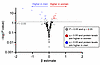 Figure 2
Plasma inflammatory proteome by sex at birth. Plasma levels of inflammatory and immunoregulatory proteins, assessed using the Olink Inflammation Explore panel, are compared between women and men after adjustment for CNICS site, age, race, nadir CD4+, men who have sex with men (MSM) status, smoking, IDU history, hepatitis C virus (HCV) history, obesity, and ASCVD risk score. Adjusted β coefficients (per 2-fold relative increase in protein levels) for women vs. men are plotted on the x axis and nominal significance level on the y axis, with proteins higher in women in red and those higher in men in blue.
 Figure 3
Plasma anti-Müllerian hormone levels by age in ART-suppressed women with HIV. (A) Plasma anti-Müllerian hormone (AMH) levels are plotted by age among 162 women in the subcohort, and correlation was assessed with a Spearman’s rho. The vertical dotted line denotes the median age of the cohort of 47. (B) Plasma AMH levels are plotted in those above and below the median age of 47, with the colored boxes denoting median value and error bars denoting the interquartile range (P for Wilcoxon’s rank-sum text).
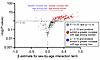 Figure 4
Plasma inflammatory proteome associations with age are modified by sex at birth. The degree to which sex at birth modified the association between age (≤47 vs. >47) and plasma inflammatory proteins was assessed with an interaction term, adjusting for CNICS site, race, nadir CD4+, MSM status, smoking, IDU history, HCV history, obesity, and ASCVD risk score. Adjusted β coefficients (per 2-fold relative increase in protein levels) for the sex-by-age interaction term are plotted on the x axis and nominal significance level on the y axis, with positive numbers (and red color) indicating a greater increase with age among women and negative numbers (and blue color) indicating a greater increase with age among men.
Given this striking evidence for interaction between sex and age on the inflammatory proteome, we performed stratified analyses above and below the median age of 47. Among those younger than 47, more proteins were higher in men than in women at the q < 0.05 threshold (Figure 5A), many of which tended to be immunoregulatory, including ITGB6. In those above age 47, however, women tended to have higher levels of far more proteins than men at the FDR-corrected q < 0.05 level, of which the majority were pro-inflammatory (Figure 5B).
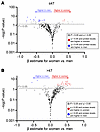 Figure 5
Sex differences in inflammatory proteome stratified by age. Plasma levels of inflammatory and immunoregulatory proteins are compared between women and men after adjustment for CNICS site, age, race, nadir CD4+, MSM status, smoking, IDU history, HCV history, obesity, and ASCVD risk score. Adjusted β coefficients (per 2-fold relative increase in protein levels) for women vs. men are plotted on the x axis and nominal significance level on the y axis, with proteins higher in women in red and those higher in men in blue among those younger (A) vs. older than age 47 (B).
Qualitative interaction between age and sex in the interferon-α pathway. Since HIV expression from cells is known to increase in women as they cross the menopausal transition (16), and women are known to have a more robust type I interferon response to HIV than men (10, 14, 18), all 22 interferon-α–induced proteins in the panel were also specifically assessed. Strikingly, levels of most proteins in the Hallmark interferon-α response pathway increased to a greater degree with age in women than men.
In the stratified analysis, in those ≤47, the levels of most interferon-α–induced protein levels were higher in men (Figure 6A), while in those >47, nearly all proteins were higher in women (Figure 6B). To provide a quantitative assessment of interaction across all 22 proteins, we created an interferon-α response score as the mean of all z-scored proteins in the pathway and compared adjusted mean values across the age and sex strata (Figure 6C). While there was little evidence for a difference by age in the interferon-α response score in men, older age was associated with a dramatic increase in interferon-α score among women. Indeed, the interferon-α response score was higher in men in those ≤47 (P = 0.024) but higher in women in those >47 (P = 0.005, P for interaction < 0.001).
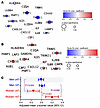 Figure 6
Qualitative interaction in the association between sex and age on interferon-α response protein levels. All 22 Hallmark interferon-α response pathway proteins represented in the Olink Inflammation Explore panel were z-scored and assessed for interaction by sex and age (≤47 vs. >47) after adjustment for CNICS site, race, nadir CD4+, MSM status, smoking, IDU history, HCV history, obesity, and ASCVD risk score. The β coefficients for female vs. male sex (red indicating a greater increase among women vs. blue for men) in the age ≤ 47 (A) and > 47 (B) strata are depicted in STRING protein network map for all 22 proteins in the pathway. A composite mean interferon-α response protein level score was calculated among all 22 z-scored proteins, and adjusted means were calculated for each age-sex stratum and compared, highlighting minimal changes with age among men but statistically significant changes with age among women (C).
Given these findings, we created similar scores for Hallmark IL-6 and coagulation pathways. Both of these pathways had evidence of interaction by sex and age (Figure 7, A and B). Due to many of the proteins overlapping between these pathways, we found high correlation between the interferon-α response composite score with IL-6 and coagulation response scores (rho: 0.87, P < 0.0001 and rho: 0.83, P < 0.0001, respectively) and thus could not separate these pathways analytically.
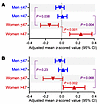 Figure 7
Qualitative interaction in the association between sex and age on IL-6 and coagulation pathway protein levels. Composite mean IL-6 and coagulation response protein level scores were calculated among all z-scored proteins, and adjusted means were calculated for each age-sex stratum and compared. For the IL-6 pathway, similar to the interferon-α pathway, there were minimal changes with age among men but statistically significant changes with age among women (A). There were similar findings in the coagulation pathway (B). Both models were adjusted for race, smoking status, IDU history, HCV serostatus, nadir CD4+, ASCVD risk score, MSM status, obesity, and CNICS site.
Clinical significance of age-sex interactions in inflammatory proteins. In the overall cohort of 922 participants, 103 died of a nonaccidental cause over a median 9 years of follow-up, of which 16 were female. In the mortality analysis, 127 (35%) of all proteins assessed were associated with increased hazard of mortality and 4 (1.1%) with decreased hazard of mortality after adjustment and FDR correction. When restricting the analysis to these 131 mortality-associated proteins, among those younger than 47, only 5 differed by sex, and all were higher in men (Figure 8A). Strikingly, among those older than 47, 79 (60%) differed by sex at the q < 0.05 level, with almost all of them higher in women. Furthermore, nearly all the proteins that were higher among women in the older age group were associated with increased mortality (Figure 8B). Only 3 proteins were higher in men in the older age stratum, and 2 of them (LRNN1 and ENPP5) were associated with decreased mortality. These findings were mirrored in Kaplan-Meier curves stratified by sex above and below the age of 47. In those under the age of 47, women had a lower mortality than men (P < 0.0001), whereas among those older than 47, women had a similar mortality as men (P = 0.84, Figure 9). Collectively, these data suggest that among older PWH, women have plasma proteomic profiles associated with greater mortality risk than men, which coincides with a loss of “female advantage” in mortality that is evident in younger participants.
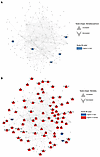 Figure 8
Sex differences in mortality-associated plasma proteins stratified by age. STRING protein network maps are shown for all 131 mortality-associated proteins in the panel, coloring each protein that was significantly different by sex at the FDR-corrected q < 0.05 level (blue higher in men, red higher in women) in those with age ≤ 47 (A) and in those with age > 47 (B). Proteins associated with increased mortality in the cohort are denoted with upward-pointing triangles, and proteins associated with decreased mortality are denoted by downward-pointing arrows.
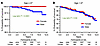 Figure 9
Sex-age interaction in mortality. Kaplan-Meier analysis plots of time to nonaccidental death, incorporating sample weights and testing differences by age with a log-rank test in participants below (A) and above the median age of 47 (B) are shown, with red denoting females and blue denoting males. In the table below each plot, the number of participants at risk using sampling weights is reported.
The relationship between inflammatory proteins and mortality risk is not statistically significantly modified by sex. Since the higher levels of mortality-associated proteins in women than men in the older age stratum might have less clinical importance if the relationship between these proteins and mortality were weaker among women than men, we explored whether sex might modify the relationship between inflammatory proteins and mortality. We found no evidence that sex modified the association between any protein and mortality at the FDR-corrected q < 0.10 level. In fact, the interaction terms tended to favor stronger relationships between biomarkers and mortality in women than in men (Supplemental Figure 3A), including pathways involved in innate and adaptive immune activation (Supplemental Figure 3B).


Copyright © 2026 American Society for Clinical Investigation
ISSN: 0021-9738 (print), 1558-8238 (online)