
Abstract
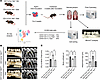
Periodontal disease, a bacterial infection affecting a large percentage of the world’s population, is an important risk factor for several systemic diseases and is significantly worsened by diabetes. To investigate how diabetes exacerbates the inflammatory response to bacteria in this disease, we combined insights from murine and human studies. Through single-cell RNA-Seq, we identified a compelling hyperglycemia-driven molecular pathway: the upregulation of CD137L in dendritic cells (DCs) and increased expression of its receptor, CD137, in IL-17+ T cells. The CD137L-CD137 axis emerged as a pivotal mediator of diabetes-induced inflammatory tissue destruction. Antibody-mediated inhibition of CD137L markedly reduced diabetes-driven bone loss, neutrophil recruitment, expansion of γδ T cells, and excessive infiltration by IL-17A+ cells. In vitro studies further validated these findings and established that dysregulation of DCs mediated by high glucose levels dramatically altered γδ T cell activity in co-culture systems via CD137L. The essential role of DCs as CD137L producers in vivo was definitively established through lineage-specific Akt1 deletion, which abrogated CD137L expression in DCs and reversed the adverse effects of hyperglycemia on increased IL-17+ T cells and loss of Tregs in vivo. Conversely, activation of CD137 with an agonist in normal animals recapitulated diabetes-induced abnormalities in the inflammatory response and accelerated bone loss. These findings elucidate a key mechanism underlying diabetes-induced immune dysregulation and inflammatory damage, and point to the CD137L-CD137 pathway as a promising therapeutic target, offering potential insights into mitigating other diabetes-associated complications linked to inflammatory changes.
Authors
Xin Huang, Min Liu, Michael V. Gonzalez, Rahul Debnath, Hamideh Afzali, Yongwon Choi, Su Ah Kim, Kang I. Ko, Dana T. Graves
Supporting data values - Download (42.72 KB)
No preview available for this file type: xlsx
Use the download link to access the file.


Copyright © 2026 American Society for Clinical Investigation
ISSN: 0021-9738 (print), 1558-8238 (online)