Go to JCI Insight
  • About
  • Editors
  • Consulting Editors
  • For authors
  • Publication ethics
  • Publication alerts by email
  • Advertising
  • Job board
  • Contact
  • Clinical Research and Public Health
  • Current issue
  • Past issues
  • By specialty
    • COVID-19
    • Cardiology
    • Gastroenterology
    • Immunology
    • Metabolism
    • Nephrology
    • Neuroscience
    • Oncology
    • Pulmonology
    • Vascular biology
    • All ...
  • Videos
    • ASCI Milestone Awards
    • Video Abstracts
    • Conversations with Giants in Medicine
  • Reviews
    • View all reviews ...
    • Neurodegeneration (Mar 2026)
    • Clinical innovation and scientific progress in GLP-1 medicine (Nov 2025)
    • Pancreatic Cancer (Jul 2025)
    • Complement Biology and Therapeutics (May 2025)
    • Evolving insights into MASLD and MASH pathogenesis and treatment (Apr 2025)
    • Microbiome in Health and Disease (Feb 2025)
    • Substance Use Disorders (Oct 2024)
    • View all review series ...
  • Viewpoint
  • Collections
    • In-Press Preview
    • Clinical Research and Public Health
    • Research Letters
    • Letters to the Editor
    • Editorials
    • Commentaries
    • Editor's notes
    • Reviews
    • Viewpoints
    • 100th anniversary
    • Top read articles

  • Current issue
  • Past issues
  • Specialties
  • Reviews
  • Review series
  • ASCI Milestone Awards
  • Video Abstracts
  • Conversations with Giants in Medicine
  • In-Press Preview
  • Clinical Research and Public Health
  • Research Letters
  • Letters to the Editor
  • Editorials
  • Commentaries
  • Editor's notes
  • Reviews
  • Viewpoints
  • 100th anniversary
  • Top read articles
  • About
  • Editors
  • Consulting Editors
  • For authors
  • Publication ethics
  • Publication alerts by email
  • Advertising
  • Job board
  • Contact
Entry of parainfluenza virus into cells as a target for interrupting childhood respiratory disease
Anne Moscona
Anne Moscona
View: Text | PDF
Science in Medicine

Entry of parainfluenza virus into cells as a target for interrupting childhood respiratory disease

  • Text
  • PDF
Abstract

Human parainfluenza viruses cause several serious respiratory diseases in children for which there is no effective prevention or therapy. Parainfluenza viruses initiate infection by binding to cell surface receptors and then, via coordinated action of the 2 viral surface glycoproteins, fuse directly with the cell membrane to release the viral replication machinery into the host cell’s cytoplasm. During this process, the receptor-binding molecule must trigger the viral fusion protein to mediate fusion and entry of the virus into a cell. This review explores the binding and entry into cells of parainfluenza virus type 3, focusing on how the receptor-binding molecule triggers the fusion process. There are several steps during the process of binding, triggering, and fusion that are now understood at the molecular level, and each of these steps represents potential targets for interrupting infection.

Authors

Anne Moscona

×

Figure 5

Options: View larger image (or click on image) Download as PowerPoint
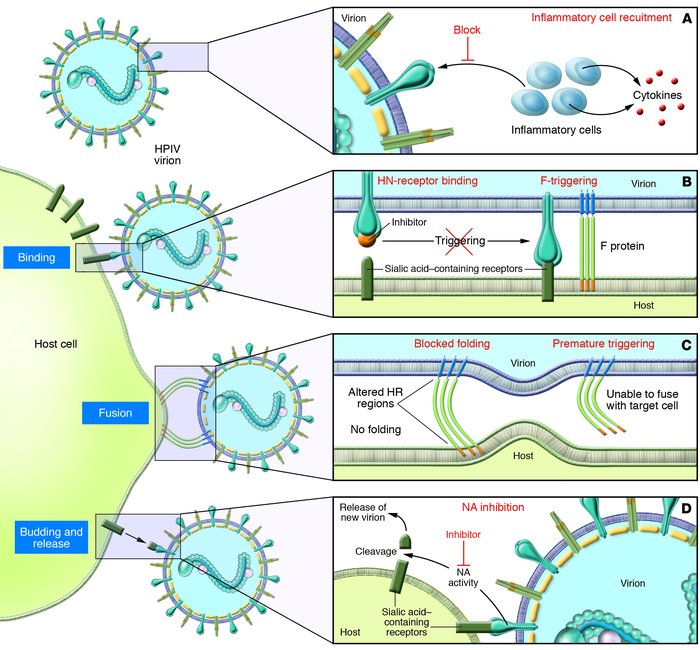
Sites or steps within the viral life cycle that represent potential targ...
Sites or steps within the viral life cycle that represent potential targets for antiviral molecules. (A) Agents directed at blocking the ability of the HN protein to recruit inflammatory cells to the lung and subsequent cytokine expression may reduce the inflammatory response to the HN protein and ameliorate disease. (B) Molecules that fit into the binding pocket on the HN globular head may inhibit HN-receptor binding and the subsequent F protein triggering action of the HN protein stalk. On the left, the HN protein is shown bound with an inhibitor, precluding the scenario shown on the right, in which the HN protein’s binding to the cell has led to its activation of F protein. (C) F protein peptides may be designed to prevent the refolding event that is essential to fusion during virus entry into the host cell. In addition, the F protein could perhaps be prematurely triggered and become incapacitated before it reaches the target host cell membrane. (D) Finally, the HN protein has NA activity and thus the ability to cleave the sialic acid moieties of the cellular receptors, promoting the release of new virions from the host cell surface. Specific inhibition of this activity may prevent virion entry into additional uninfected cells.

Copyright © 2026 American Society for Clinical Investigation
ISSN: 0021-9738 (print), 1558-8238 (online)

Sign up for email alerts