Go to
JCI Insight

Abstract
Research Article
Authors
Emanuela Gussoni, Richard R. Bennett, Kristina R. Muskiewicz, Todd Meyerrose, Jan A. Nolta, Irene Gilgoff, James Stein, Yiu-mo Chan, Hart G. Lidov, Carsten G. Bönnemann, Arpad von Moers, Glenn E. Morris, Johan T. den Dunnen, Jeffrey S. Chamberlain, Louis M. Kunkel, Kenneth Weinberg
Figure 2
Options:
View larger image
(or click on image)
Download as PowerPoint
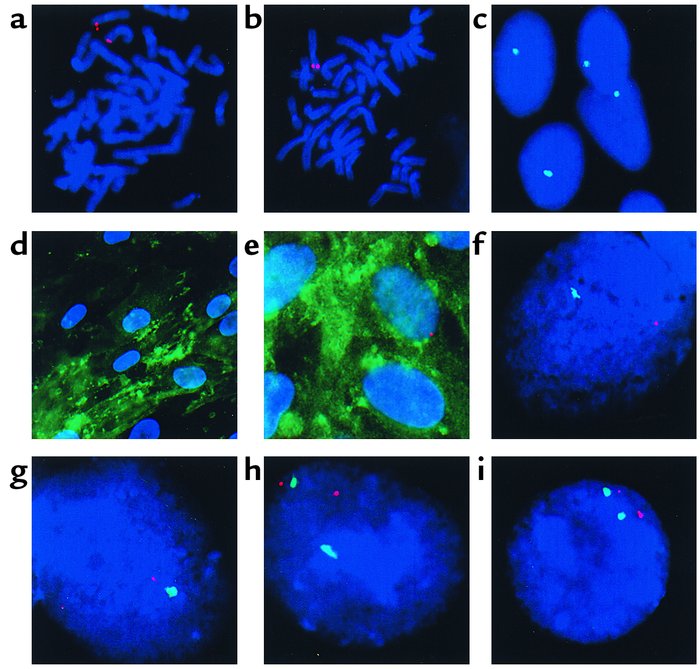
Detection of dystrophin exon 45 deletion in DMD-BMT1 and his mother by FISH analysis. (a ) Unaffected female. Chromosomes are counterstained in blue by 4′,6-diamidine-2-phenylindole dihydrochloride (DAPI) and both X chromosomes have red hybridizations signals using a dystrophin exon 45–specific probe. (b ) DMD-BMT1’s mother’s chromosome spreads. Only one X chromosome hybridized with the dystrophin exon 45-specific probe, thus confirming her DMD carrier status for dystrophin exon 45 deletion. (c ) DMD-BMT1 fibroblast nuclei hybridized with an X-centromeric probe (green) and a dystrophin exon 45 probe (red), which failed to hybridize. (d and e ) Detection of donor-derived nuclei in MSC cultures of DMD-BMT1. (d ) By immunofluorescence, more than 95% of cultured MSCs from DMD-BMT1 are positive for CD105 (green). (e ) FISH analysis using a dystrophin exon 45 cosmid probe (red) shows presence of donor-derived MSCs. (f and g ) Simultaneous hybridization of DMD-BMT1 MSC nuclei with an X-centromeric DNA probe (green) and dystrophin exon 45 probe (red) by FISH. Donor nuclei in DMD-BMT1 MSCs are diploid. (h and i ) Nuclei from an unaffected female hybridized by FISH with the X-centromeric and dystrophin exon 45 FISH probes. Two green and red hybridization signals are expected in each nucleus. Nuclei are counterstained in blue by DAPI.


Copyright © 2024 American Society for Clinical Investigation
ISSN: 0021-9738 (print), 1558-8238 (online)