Go to
JCI Insight

Abstract
Helicobacter pylori are bacteria that have coevolved with humans to be transmitted from person to person and to persistently colonize the stomach. Their population structure is a model for the ecology of the indigenous microbiota. A well-choreographed equilibrium between bacterial effectors and host responses permits microbial persistence and health of the host but confers risk of serious diseases, including peptic ulceration and gastric neoplasia.
Authors
Martin J. Blaser, John C. Atherton
Figure 5
Options:
View larger image
(or click on image)
Download as PowerPoint
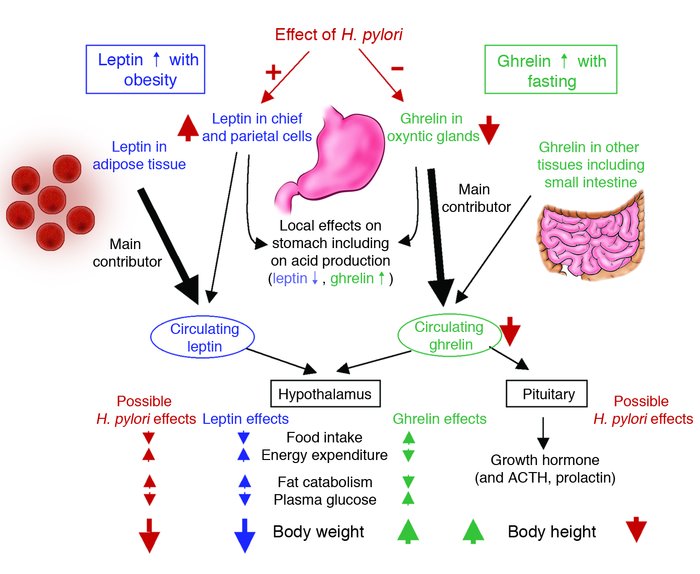
The described effects of H. pylori on leptin and ghrelin, and postulated subsequent effects on satiety, energy expenditure, weight, and height. Although leptin and ghrelin have other important paracrine, autocrine, and endocrine effects, here we concentrate on actions that affect body habitus. The observed effects of H. pylori on leptin and ghrelin are based on observational and interventional (H. pylori eradication) human studies. Other observational human studies support the portrayed effects of H. pylori on weight and height.


Copyright © 2024 American Society for Clinical Investigation
ISSN: 0021-9738 (print), 1558-8238 (online)